Sir Creek: India's unfinished business
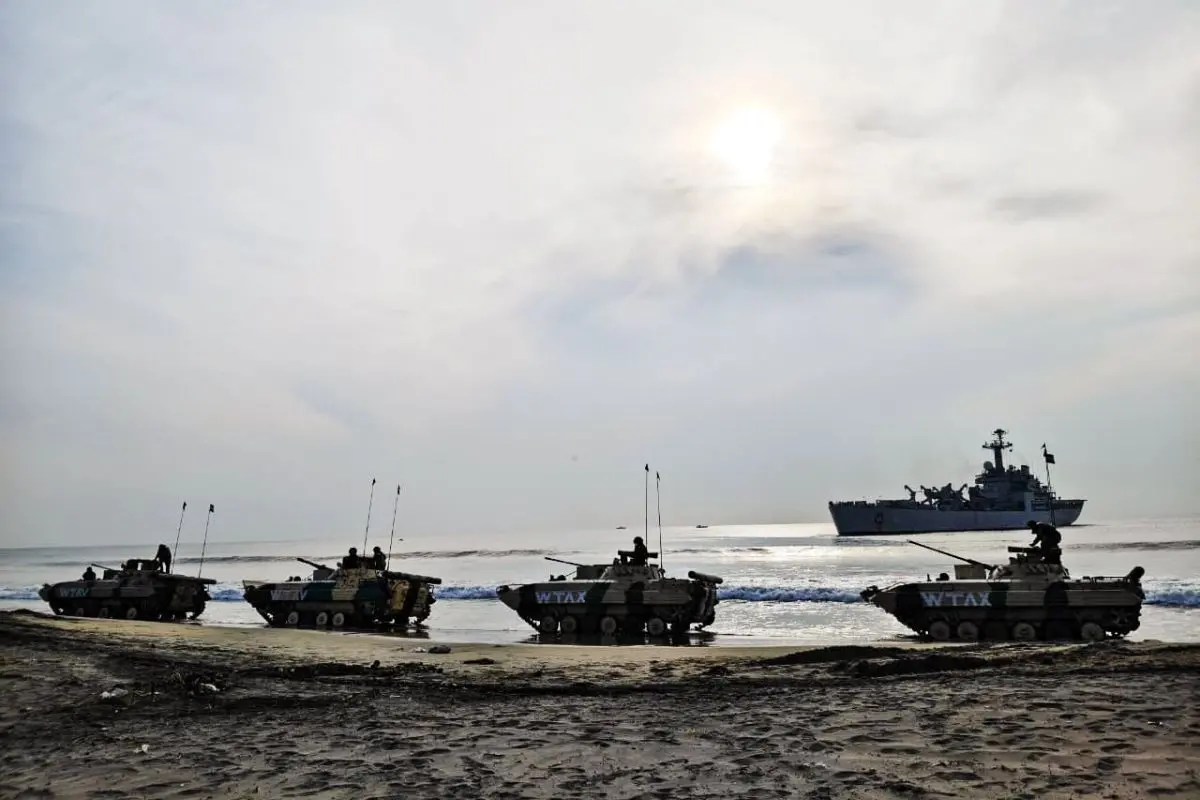
Defence Minister Rajnath Singh's stark warning from Bhuj this week has brought Sir Creek back into national focus. His message to Pakistan was unambiguous: any military adventurism in this disputed waterway will meet a decisive response that could alter both history and geography.
Invoking the 1965 war when Indian forces reached Lahore, Singh reminded Pakistan that "the road to Karachi also passes through the Creek." The minister's concerns are not unfounded. Pakistan's continued expansion of military infrastructure in the area, even 78 years after Independence, reveals intentions that go beyond mere border management.
But what exactly is Sir Creek, and why does this 96-kilometre water strip continue to strain relations between two nuclear-armed neighbours?
Sir Creek, once known as Ban Ganga before being renamed after a British officer, is a narrow waterway in the Rann of Kutch marshlands that flows into the Arabian Sea. It roughly separates Gujarat's Kutch region from Pakistan's Sindh Province. On the surface, it appears to be just another creek -- a small water channel flowing into a larger body. Yet this seemingly modest waterway has become one of Asia's most contentious territorial disputes.
The roots of this conflict stretch back to British India. The entire region once fell under the Bombay Presidency, a vast administrative unit that included present-day Maharashtra, Gujarat, and Sindh. When the Partition arrived in 1947, Sindh went to Pakistan while Kutch remained with India. What should have been a straightforward division became complicated by colonial-era documents that spoke in two voices.
The heart of the dispute lies in how to draw the maritime boundary. Pakistan claims the entire creek, citing the 1914 Bombay Government Resolution, particularly paragraphs 9 and 10. This colonial-era decision marked the boundary along the eastern bank -- the so-called Green Line -- effectively placing the entire creek in Sindh territory. India, however, points to the middle channel principle, supported by a 1925 map and boundary pillars placed in 1924.
Here is where international law enters the picture. When a waterway is navigable -- meaning boats can pass through it -- the globally accepted Thalweg principle applies. This principle, first used in 18th-century Europe to settle river disputes, states that boundaries should run along the deepest part or middle of navigable channels, ensuring equal access for both sides. India argues that during high tide, when sea water fills the creek and makes it deep enough for vessels, Sir Creek becomes navigable. Therefore, the boundary should split the creek down the middle.
Pakistan contests this, claiming the creek is not navigable. Yet the facts on the water tell a different story. Sir Creek is not just a strategic location; it is one of Asia's largest fishing grounds, teeming with marine life that supports thousands of fishing families on both sides. The navigability question is not merely academic -- it has real economic implications.
Beyond fishing, what truly raises the stakes are the suspected oil and gas reserves beneath the seabed. These resources remain unexplored because the boundary dispute has paralyzed any joint or separate exploration efforts. Both nations are sitting on potential energy wealth they cannot access because they cannot agree on whose wealth it is.
The legal framework further strengthens India's position. Under the United Nations Convention on the Law of the Sea (UNCLOS), accepting the middle channel principle would shift the land-sea boundary point by several kilometres. This seemingly small geographic adjustment would cost Pakistan thousands of square kilometres of its Exclusive Economic Zone (EEZ) -- and with it, access to fishing grounds and potential underwater resources. Pakistan stands to lose significantly if the Thalweg principle is applied, which explains its reluctance to accept any solution based on international maritime law.
History has shown that neither war nor diplomacy has resolved this impasse. After the 1965 war, British Prime Minister Harold Wilson mediated a ceasefire and established a tribunal to settle the dispute. The 1968 tribunal verdict granted Pakistan merely 10 percent of its claim over 9,000 square kilometres. Since 1969, there have been twelve rounds of talks, but no breakthrough. The last formal dialogue occurred in 2012, and since then, the status quo has hardened.
Tensions have occasionally flared into violence. In 1999, the Pakistan Navy shot down an Indian MiG-21 fighter plane over the region, a reminder that this is not merely a cartographic disagreement. Lives have been lost over where a line should be drawn on a map.
The Indian Defence Minister's warning must be understood in this context. Pakistan's infrastructure buildup in Sir Creek is not defensive housekeeping; it represents a deliberate militarization of disputed territory. When a nation expands its military footprint in a contested area while simultaneously refusing dialogue, it signals that it seeks a unilateral solution through facts on the ground rather than facts in law.
India's claim rests on solid legal ground. The Thalweg principle is not some obscure doctrine -- it is a cornerstone of international maritime law. The 1925 map, the 1924 boundary pillars, and paragraph 10 of the 1914 resolution that Pakistan cites all support India's position. More importantly, UNCLOS, which both nations have signed, provides clear guidance on maritime boundaries that favours the middle channel approach.
Yet legal clarity has not translated into resolution. Pakistan's strategy appears to be one of perpetual contestation, keeping the dispute alive in hopes that time, international attention, or changing geopolitical alignments might work in its favour. Meanwhile, fishing communities on both sides operate in uncertainty, energy resources remain locked underground, and military assets are deployed where dialogue should prevail.
The Sir Creek dispute is more than a border issue. It is a test of whether international law and rational negotiation can overcome historical grievances and strategic stubbornness. It is also a reminder that the unfinished business of Partition continues to cast long shadows over South Asia, turning marshlands into potential flashpoints and fishing grounds into militarized zones.
Rajnath Singh's message was not sabre-rattling for domestic consumption. It was a declaration that India will not allow Pakistan to change facts on the ground through military expansion while refusing to engage with facts in law. The minister's reference to Lahore in 1965 and Karachi in 2025 was a historical reminder that India has options if diplomacy fails.
But options are not the same as solutions. What Sir Creek needs is not more military posturing but a renewed commitment to the principles both nations claim to uphold. If Pakistan truly believes in its claim, it should present its case at an international tribunal under UNCLOS provisions. If it refuses, the reason is clear: it knows its position does not withstand legal scrutiny.
For India, the challenge is to maintain pressure for a rules-based resolution while ensuring that Pakistan's military buildup does not become a fait accompli. This means continued vigilance, strategic preparedness, and diplomatic persistence. It also means making the case internationally that this is not a bilateral squabble but a test case for whether international maritime law applies equally to all nations or only to those without the military means to contest it.
Sir Creek may be a small waterway on the map, but it represents something much larger: the question of whether South Asia will be governed by the rule of law or the law of force. The answer will determine not just where a boundary line is drawn, but what kind of neighbourhood India and Pakistan will create for future generations. The marshlands of Sir Creek deserve better than to remain a no-man's land between two nations that share history, culture, and a common need for peace and prosperity.
The road forward requires courage -- not the courage to threaten war, but the courage to pursue peace based on principles rather than prejudice. Until that courage emerges, Sir Creek will remain what it has been for decades: a narrow waterway carrying the heavy burden of unresolved history.
The author is a Defence, Aerospace & Geopolitical Analyst