Rhythm, stories and stagecraft: The timeless art of Chavittunadakam | WATCH
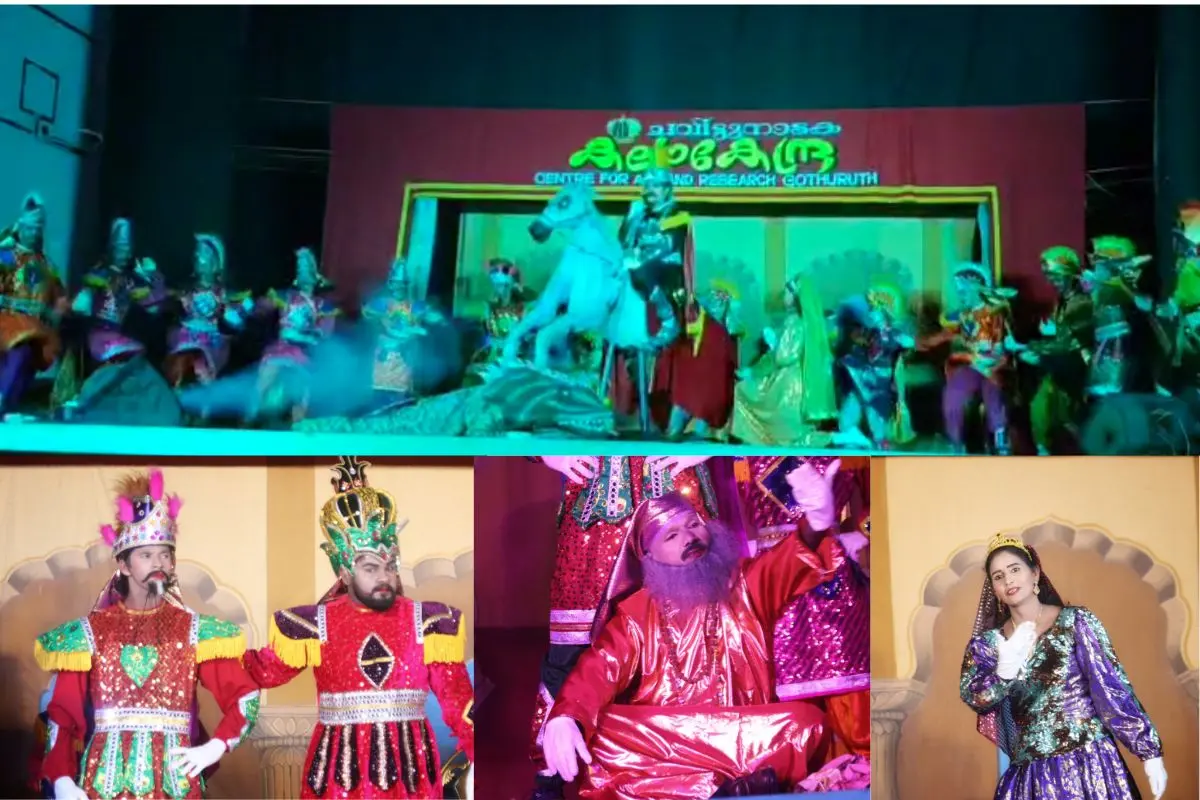
“Art around us has many layers, shaped in different ways by region, culture, religion and so on. But when we start categorising art too rigidly under these labels, it can sometimes restrict the freedom and creativity within that form,” says Abhilash Sebastian Konath, a practitioner, choreographer and founder of the Chavittunadaka Kalakendra, Centre for Art and Research, Gothuruth, Ernakulam.
Speaking to 'Mathrubhumi', Abhilash reflects on the unique world of Chavittunadakam, a vibrant theatre tradition that has been closely associated with Kerala’s Christian community for generations, and shares his thoughts on its nuances and present-day challenges.
Rhythm, roots and inclusivity
Chavittunadakam, as an art form, is believed to have taken root in Kerala during the Portuguese era, when trade and the spread of Christianity brought new cultural influences to the region. The use of intricate, rhythmic footwork and associated rhythms makes it more complicated, attractive, and distinct amidst other art forms in Kerala.
“Our ancestors always reminded us to reflect on why this art form was born and why it should continue to exist. They would speak of the Portuguese idea of art, ‘Art is open for all, irrespective of caste and religion’, and even today, we try to uphold that spirit of inclusivity.”, says the thespian.
From elite halls to common grounds
Church records show that Chavittunadakam was performed as a festival attraction, open to everyone in the community, unlike several other art forms of the time, which were restricted to the elite. By breaking down these barriers, the Portuguese also created a path for ordinary people to engage with stories, literature and religious tales that would otherwise have remained out of reach.
“Since the act was always meant for the common people, the language too was their own. Back then, it was performed in 'Sentamil' or 'Chentamil', the vernacular of the day. That choice of language helped dissolve the barrier between the stage and the audience, and it was one of the main reasons Chavittunadakam was so warmly embraced by the crowd.”, Abhilash explains.
Chavittunadakam traditionally brings to life heroic tales, stories of mighty warriors, epic battles, and the triumphs and tragedies of victory or defeat. Among the most popular are Carelman Charitham (the story of Charlemagne the Great) and Brijeena Charitham (the life of Queen Brijeena).
“These narratives are steeped in valour, so the costumes naturally reflect that grandeur. They are vibrant, rich with deep colours and regal touches, because most of the characters are kings, queens or members of the royal court.”, Abhilash notes.
Today, training in Chavittunadakam is mainly concentrated in Gothuruth, Kochi and Alappuzha. Interestingly, while the same story may be performed across these regions, subtle differences appear in the pace of the performance, the design of the costumes, or even the choice of colour.
“It’s fascinating. The story might be the same, but these variations give audiences a different perspective depending on where they watch it.”, Abhilash adds.
Epic tales on stage
Traditionally, Sentamil was the language of choice for songs in Chavittunadakam. Over time, as the community evolved and its cultural context changed, the language of the performances also underwent refinement. Today, many songs are composed in Malayalam.
“Most of the new compositions come from senior Ashaans, trainers who act more like directors, guiding students through the practice, the texts, and the performance nuances,” Abhilash explains.
An example is 'Ayyappacharitham Sreedharmashashtavu', a play fully staged in Malayalam. “There’s a lot of exciting work happening now,” he adds. “New plays are being prepared, and the tradition continues to grow while staying connected to its roots.”, he adds.
Beyond steps: Texts, songs, and gestures
“A play is rehearsed for four months before it is presented,” he explains. “The student begins by offering a Dakshina and learning the basics from the Ashaan (trainer). From there, the training becomes more intensive.”
He continues, “After mastering the basics, the student moves on to the Chuvadus, the steps. This includes twelve Adishtana Chuvadus (basic steps), Adhika Chuvadus (extra steps), as well as Adantha, Tho-tham-krithi, Thakida-Thinta, and more. At the same time, students learn the texts, songs, gestures, and hand movements orally, building a strong foundation for their artistic mind.”
From newborns to elders on stage
Age, he notes, is never a barrier. “Even a newborn baby can become an actor. Girls and women are also increasingly participating. The art is truly inclusive; everyone, regardless of age, gender, or background, can be part of it. Being involved as a co-artist or trainer is an exciting and enriching experience.”
Breaking boundaries: Chavittunadakam beyond Christian tales
“As I mentioned earlier, many people think of Chavittunadakam as an art form that only portrays Christian stories. To some extent, that’s true, but art should never limit experimentation,” shares Abhilash. “It was this belief that inspired me to train students to perform 'Ayyappacharitham Sreedharmashasthavu' for the Kerala State Kalolsavam.”
Staying true to Chavittunadakam tradition, the songs were composed in Chentamil. The play depicted the birth of Baby Manikandhan and his journey to becoming Lord Ayyappan, though only a portion could be staged due to time constraints at the State Youth Festival.
“The reception was incredible. It opened the door for the story to be performed in several nearby temples around Gothuruth and Ernakulam. For our Samithi, it was a proud moment, seeing the art form break traditional barriers and act as a unifying force through creativity.” Abhilash recalls.
Vanishing characters and financial strains
“Earlier, Chavittunadakam included many characters that are now disappearing,” laments Abhilash. “Take the role of the 'Kattiyakkaran', for instance, a character who could speak directly to the audience during the play. A similar concept exists in Koodiyattam with the Vidooshakan. The disappearance of such roles not only erodes the connection between different art forms but also leaves specialised actors without a steady source of income.”
Abhilash also spoke about the challenges faced by artists today. “Time and space management is a major issue. Plays that once ran for three days are now reduced to just two or three hours. This limits the freedom of the artists to improvise and perform in full detail.”
Another concern is the process of recording and adapting texts. “Ensuring the availability of trained singers, experienced technicians, and proper facilities is always a herculean task. The budget for recordings is enormous, especially when compared to the limited payments and funds managed by the Chavittunadaka Samithis, who also have to cover transportation and costume expenses.”
Chavittunadaka Kalakendra: A hub for art and research
New stories are increasingly being adapted into Chavittunadakam, including tales from Hindu mythology such as the stories of Karna and Bhima. The Chavittunadaka Kalakendra Centre for Art and Research, founded by Abhilash and his wife Doniya Johnson, a research scholar at St. Thomas College, Thrissur, was established with the aim of making this traditional art form more accessible to a wider audience, including researchers.
“We encourage everyone, regardless of age or gender, to learn Chavittunadakam and perform on stage. This stays true to the core Portuguese idea that art should be open to all, without restrictions.” says Abhilash.
Recently, the Kalakendra staged the story of 'Visudha Gevarghese' (St. George) as Chavittunadakam, bringing together many new performers alongside experienced artists. “It was inspiring to see fresh talent emerge on stage. This keeps the tradition alive while embracing experimentation and inclusivity.”, said Doniya.
A scene from Visudha Gevarghese
About the recent status of the artform, Abhilash is hopeful in his words, “The love for the art unifies everyone in the group to march against all the odds. We hope that the art will reach more and get the right, deserved recognition in the mainstream.”