From watching Pulikali to becoming a ‘Penpuli’; Nimisha Bijo on breaking into Thrissur’s tiger dance
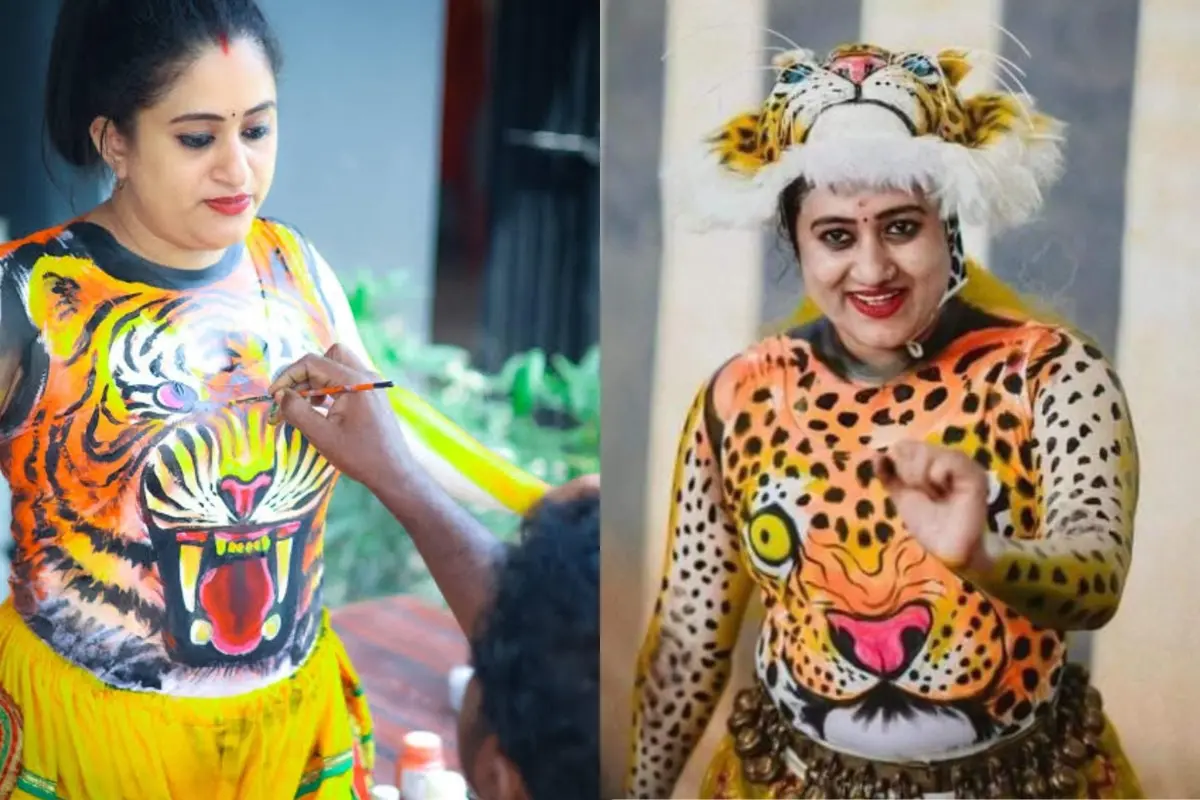
For years, Nimisha Bijo could only watch Thrissur’s Pulikali from a distance.
Standing on top of a building, she would watch the brightly painted tigers move to the beats of chenda and chengila and dance along from afar. She loved the spectacle, but like many women watching the traditionally male-dominated folk art, she never imagined she could actually be part of it.
Then came a thought that refused to go away: Why can't women do Pulikali too?
Three years ago, Nimisha finally stepped into the tiger costume herself. This Onam, the Malayalam television actress, model and influencer is preparing for her fourth consecutive year as a Penpuli, or female tiger, in Thrissur's Pulikali.
And she is doing it as the only woman among the 51 members of her troupe.
Pulikali, meaning the 'dance of the tiger', is traditionally performed during Onam, with artists painting themselves like tigers and leopards and dancing to traditional percussion. In Thrissur, the fourth day of Onam, or Naalaam Onam, sees Pulikali troupes from across the district gather for the much-awaited spectacle.
For Nimisha, however, becoming part of that spectacle was never just about wearing the paint.
‘Why can’t we also step into Pulikali?’
Nimisha was born and brought up in Kottayam. It was only after her family moved to Thrissur that she got to experience Pulikali up close
“Back then, when we heard about Pulikali, we couldn't really watch it,” she recalled. After moving to Thrissur, she would watch the performances from buildings and dance along with the performers.
“That’s how I developed a huge craze for it. I loved it so much. So, a feeling grew inside me: ‘Why can't we also step into Pulikali? What is it that we cannot do?’”
The desire remained with her until an opportunity finally came through a friend.
This year marks her fourth consecutive year performing Pulikali.
But getting that opportunity was not straightforward.
When the answer was ‘women can’t do it’
Nimisha first approached the Ayyanthole Desam Pulikkali Samghataka Samithi seeking a costume and a place in the troupe.
The response, she says, was that women could not perform.
For Nimisha, that only raised another question.
“Men and women are equal, right? This is not the old era to sideline a woman like that; there is no need to sideline anyone now.”
She eventually found a team willing to give her a chance, Sitaram Mill Desam, Poonkunnam. The team gave her a costume, and she has remained with them for all four years of her Pulikali journey.
The decision also challenged one of the most familiar images associated with Pulikali: the large, painted belly of the tiger.
Nimisha points out that many male performers traditionally have prominent bellies, which become an important part of the visual spectacle once the tiger face is painted on them.
“But for me, I don't have a big belly like that,” she said.
Yet that did not stop her from becoming a tiger.
ALSO READ: What if it’s not just a toxic relationship? The narcissistic abuse signs people often miss
From one woman to a 51-member troupe
Nimisha is now the only woman in her troupe.
The group has 51 performers — 50 men and Nimisha as the female tiger.
She credits a mentor figure, Ratheesh, for helping make her wish possible. Seeing how desperately she wanted to perform, he decided to set aside one of his costumes for her.
“Let her wear it; it's her desire, isn't it?” he told the others, according to Nimisha.
The response was mixed. There were supporters, but there were also people who criticised her.
Nimisha says she chose to ignore the latter.
“We discarded the haters and accepted the support,” she said.
Her experience is also part of a wider change in Pulikali. The source material notes that female participation began appearing in the event in 2016, opening the door for greater gender inclusion in a folk art historically dominated by men.
‘We are performing an art’
If the live crowds have largely welcomed her, social media has been a different story.
Nimisha says some online comments have gone beyond criticism and become personal, with people making inappropriate remarks about her body and questioning why she would stand in public to have herself painted.
Her answer is simple: she is performing an art.
“When we stand in public, in front of our family and the family of the artists who paint us, and get painted, we are performing an art there,” she said.
“I really don't understand how people find lust or a sexual thrill in that.”
For Nimisha, the decision to continue is also deeply personal. She says the past few years have brought happiness and peace after a long period of hardship, and she now wants to use her position to give back through charity work as well.
The paint is not the hardest part
There is also a practical side to being a Pulikali performer that audiences may not immediately see.
The masks are large and heavy, with only a small opening through which the performer can see. Wearing them for a long time can become uncomfortable, particularly as the face begins to sweat.
Nimisha says performers sometimes lift the mask slightly when it becomes difficult.
And then there is the paint.
She says women often hesitate because they worry about the paint, their makeup or what people will say if they participate.
But for her, the hesitation never outweighed the desire.
“It is my desire, my craze. So, I do it.”
‘Give ladies a chance’
Nimisha believes the next step is not simply for more women to show interest, but for more organisers to open their doors.
She says there are women's groups and women interested in taking part, but opportunities remain important.
“It was only because the Sitaram Mill Desam team gave me an opportunity that I was able to perform,” she said, adding that organisers should give women the chance to participate.
Her words are echoed by Prasad, one of the artists who paints the Pulikali performers.
According to Prasad, women have continued to come forward and express interest. He recalled that when women first participated, the concern among organisers was primarily about their safety and how comfortable they would be in the middle of a large troupe.
But the women surprised them with their enthusiasm.
“They were very enthusiastic about it,” he said, recalling how the first participants eventually returned regularly.
Prasad says the initial public reaction was also marked by curiosity and positive feedback because people were seeing something new.
No quota for women, just tigers
Interestingly, there is no prescribed male-female ratio in a Pulikali troupe, according to Prasad.
A team can have anywhere between 35 and 51 tigers. Whether those performers are men or women does not determine the team's composition.
“It doesn't matter how the mix is, it's fine if they are ladies, and it's fine if they are gentlemen.”
For Nimisha, that is exactly how it should be.
This Onam, as the drums begin and the painted tigers once again take over the streets of Thrissur, she will return to the troupe that gave her a chance when another door was closed.
She has already spent years watching Pulikali from rooftops.
Now, she has a place in the middle of it.
And for this Penpuli, that place is not a favour. It is something she wanted badly enough to fight for.