Neeraj Ghaywan’s ‘Homebound’ brings Cannes to its feet
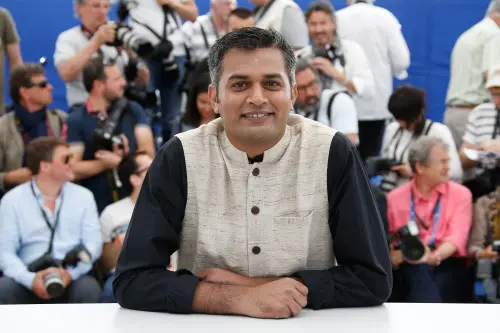
Neeraj Dhaywan is currently in the news since his new film Homebound, backed by no less a name than Martin Scorcese, received a nine-minute, standing ovation at its premier screening at Cannes last week. In all my years, I have never encountered a man with so much patience, dedication and commitment to present his film which has a cause, in fact, several causes like the humiliation of the Dalit, on alternate sexuality and last, a ruthless betrayal of friendship by the lesbian partner. Neeraj Ghaywan began as assistant to Anurag Kashyap for the two parts of Gangs of Wasseypur. He waited for ten long years after his debut with Masaan in 2015.
He made a short film Geeli Pucchi as part of the anthology, Ajeeb Dastaan, on NETFLIX. The long wait was to get a producer to make his second, full-length feature film Homebound. His script finally caught the attention of the biggest Bollywood producer, Karan Johar along with other notable names who joined him. Though it has taken ten long years, Neeraj Dhaywan is today an international figure in cinema.
He could have had an easier life had he pursued engineering which he graduated in followed by a MBA degree. But the worm called “cinema”, bit him all over and took him away from the corporate world. He has made three films altogether of which the second, Geeli Puchhi is part of the Netflix Anthology called Ajeeb Dastaan which also tells the story of the social and occupational ostracisation of the Dalit, this time. a young woman of alternate sexuality, of injustice at the workplace and of betrayal in love.
Homebound goes ahead with his agenda captured against the background of Covid and the struggles of two young men, one, a Muslim and the other, a Dalit. A Dalit himself, Neeraj wants to draw the attention of all Indians everywhere to the marginalized comprised of Dalits, Muslims and women.
Masaan
Masaan is the colloquial equivalent in Varanasi Hindi for smashaan. Smashaan means crematorium or burning ghat. Varanasi is the only city in the world where pyres of the dead keep burning all through the day and night and the flames never go out. Varanasi is the backdrop that captures the evolution of this historic city for Hindus from ancient times into modern lives the youth of the city hanker for and chase and get. The holy river Ganges that flows along the city with the flowers and corpses of the dead is also a center of action as are the streets, the computer classes, the internet cafes, popular music and shairis recorded and played over and over on cell-phones, food stalls and festivals where young boys and girls exchange shy glances, the coin-chasing leaps by little boys into the water of the Ganges that mark the blending of the traditional and the modern, never mind the raised eyebrows of traditionalists and so-called ‘puritans.’
Masaan is about five lives that intersect in different circumstances along the Ganges in Varanasi Deepak (Vicky Kaushal) is a low-caste boy who studies civil engineering at night while he joins his father and family in lighting funeral pyres during the day and late into the night after his classes are over. He falls in love with Shalu Gupta (Shweta Tripathi), a high-caste, smart and pretty girl who lives on the other side of town and loves poetry. Devi Pathak (Richa Chadha), a computer-trained, confident and very quiet young woman is hopelessly trapped by a corrupt policeman after a spontaneous sexual encounter in a hotel room. She does not bear feelings of guilt except for the boy she had the encounter with who suddenly dies when he tries to escape from the hotel room the police hot on his chase.
Why Varanasi? Ghaywan says, “The first reason is that mainstream films in Bollywood have a tendency to place their stories in mega cities like Mumbai, Delhi, Bangalore and so on. I wished to bring out the feeling of a city where tradition and modernity blend and bring about the confusions that result from this contradiction. Less important cities are marginalised by filmmakers. The second reason is that when I was assisting Anurag Kashyap for Gangs of Wasseypur, we spent four months in Varanasi which cast a spell on me despite the crowds, the dirt, the squalor and the narrow bylanes. The city pulled me like a magnet. I cannot quite articulate why and how but it did. Thirdly, I wanted to prove that Varanasi, often called the city of the dead is also a city that pulsates with life on a different level. There is hope and my film spells it out.”
Arjun Appaduraii has written about ethnoscapes (spaces produced through inflow of people such as immigrants, refugees, etc.) technoscapes (inflow of technology, etc.), finanscapes (flow of global capital, commodities, etc.), mediascapes (the repertoires of images and information) and ideoscapes (ideological shifts connected to Western world views.) These are different ways of looking at the global cultural flows strongly influenced by perspective, overlapping, and the rapidly shifting instability and mutability of global cultural flows. Indian filmmakers are fond of making the city the central protagonist of a film. Masaan is no exception, albeit with a difference.
Appadurai’s theory about ethnoscapes is partly fulfilled in Masaan by virtue of youngsters from outside the city arriving for education or employment and youngsters trying to move away. Technoscapes weave themselves via computer classes, social networking sites, cell phones with cameras, videocams and song recording systems, etc. All these are juxtaposed against the Harishchandra Ghat with its steady flow of dead bodies lit up by the raging flames of the funeral pyres with the domes (chandals) stoking the fires with sticks and beating up the bones and the skulls so that the bodies can burn quickly. Mediascapes are present through the corrupt police officer’s video shots of the young Devi trapped in a sexual encounter in a hotel which he uses to blackmail her and her father. And ideoscapes are portrayed through the rapidly changing sexual morals of youngsters in the city that includes an ordinary clerk/peon making a pass at a young, educated girl, or another young man kissing a young girl on impulse and being kissed back in return, and youngsters from two opposite points of the caste ladder accepting this reality yet unprepared to confront it.
Masaan won two prestigious awards - The Un Certain Regard award and the Fipresci Prize at the Cannes in 2015. Neeraj also bagged the Mahindra Sundance Global Filmmaker Award and the script of Masaan, written by Varun Grover was the favourite of the Sundance Screenwriters’ Lab.
On the production front too, Masaan set an example of what is called “crowd-funding” where several producers pitch in to fill the hat with the money needed for production costs. It was a joint production among Manish Mundra (Drishyam Films), Macassar Productions, Sikhya Entertainment and Phantom Films. For the casting, it had powerhouse performers like Richa Chadha and Sanjay Mishra on the one hand and newcomers like Vicky Kaushal and Shweta Tripathi on the other.
Geeli Puchhi
Geeli Puchhi means “sloppy kisses.” On the surface, the title does not seem to have any connect with the story or the characters or their interaction. But looked at closely, the film defines a scathing attack on the humiliation meted out to people who are Dalits, never mind whether it is in the workplace or in personal relationships. Bharati Mandal (Konkona Sen Sharma) is a dark-skinned, young Dalit woman, the only female working in the workshop of a factory though, with her education and skills, she is fit for a much better position in the same factory. Her low caste and her female identity who chooses to wear jeans and top make her a target for constant barbs from her male colleagues though she gives it right back when she can.
Then, the fair-skinned, beautiful, Brahmin bride Priya Sharma (Aditi Rao Haideri) steps in to join the workshop in a higher position, which Bharati was denied outright by her boss. Though Bharati tries to keep her distance from the new entrant who got in with hardly an interview, they gradually grow close and get into a relationship that is much more than just friendship. Bharati is gay and so is Priya. In a minute of intimacy, Bharati confesses that she is Dalit and notices Priya’s hesitancy at the confession. Bharati lives alone with a tiny pup for company and once had a girlfriend who is now married, happy and lives in Delhi.
On Bharati’s advice, Priya agrees to become pregnant with a husband who loves her and is a very good man. When Bharati visits to bless the baby, she notices that her tea is served separately in a steel cup while the other members of the family are served in China cups. Priya’s mother-in-law blurts out the true caste Bharati belongs to, being born into a family of dais (delivery nannies) and Bharati is shocked to learn that not only that she has been brutally betrayed by Priya but also realizes her true place in Priya’s life and in the world out there.
Geeli Pucchi is not only about caste ostracism but also about friendship and how it is betrayed by the one who is in an advanced position against the one she had grown to have faith in. According to one critic, “It is the first film to have a Dalit Queer Woman as a lead. It is a Dalit story being told by a Dalit filmmaker. Even the crew of the film was part of the Dalit and Queer community. The representation we see is more nuanced and more understood compared to other films we have seen before.” Other than Neeraj Dhaywan who tried to strip his backwardness by changing his name, there are just a handful of Dalit filmmakers like Pa Ranjith, Mari Selvaraj, Nagraj Manjule and Vinod Kamble. The last mentioned was born into a family of manual scavengers whose father also dissected dead bodies in the village morgue.
When asked how he makes his actors internalize their characters belong as they do, mainly to mainstream cinema, Neeraj says, “I explicitly tell them that they had to surrender themselves to the character they were playing and to the film they were playing in. They had to “become” the person they were in the film and not “act” out a character and make the city and its surroundings accept them. I learn the local dialect myself so that I can converse with the locals and they can feel one with me. If they are to strip themselves of any baggage of their real environment, they have to have an ‘insider’s’ view of the story and the character. I think that worked because the locals began to like us a lot and contributed to the film too.” This has been substantiated by Ishaan Khatri who was strictly commanded to get completely rid of his abs and his muscled body to fit into his role in Homebound.
The sum and substance of the entire film is comprised in a single dialogue an elderly Dalit colleague advises Bharati about her true position when she tries to break rules, to fight back and to assert her identity. He says:
“We are Dalits. Table kursi par khana milega, table kursi wali naukri nahi. Waha tak pahuchte hue kahi tum jali pari naa milo“.