Mrinal Sen: A life of creative exploration in films
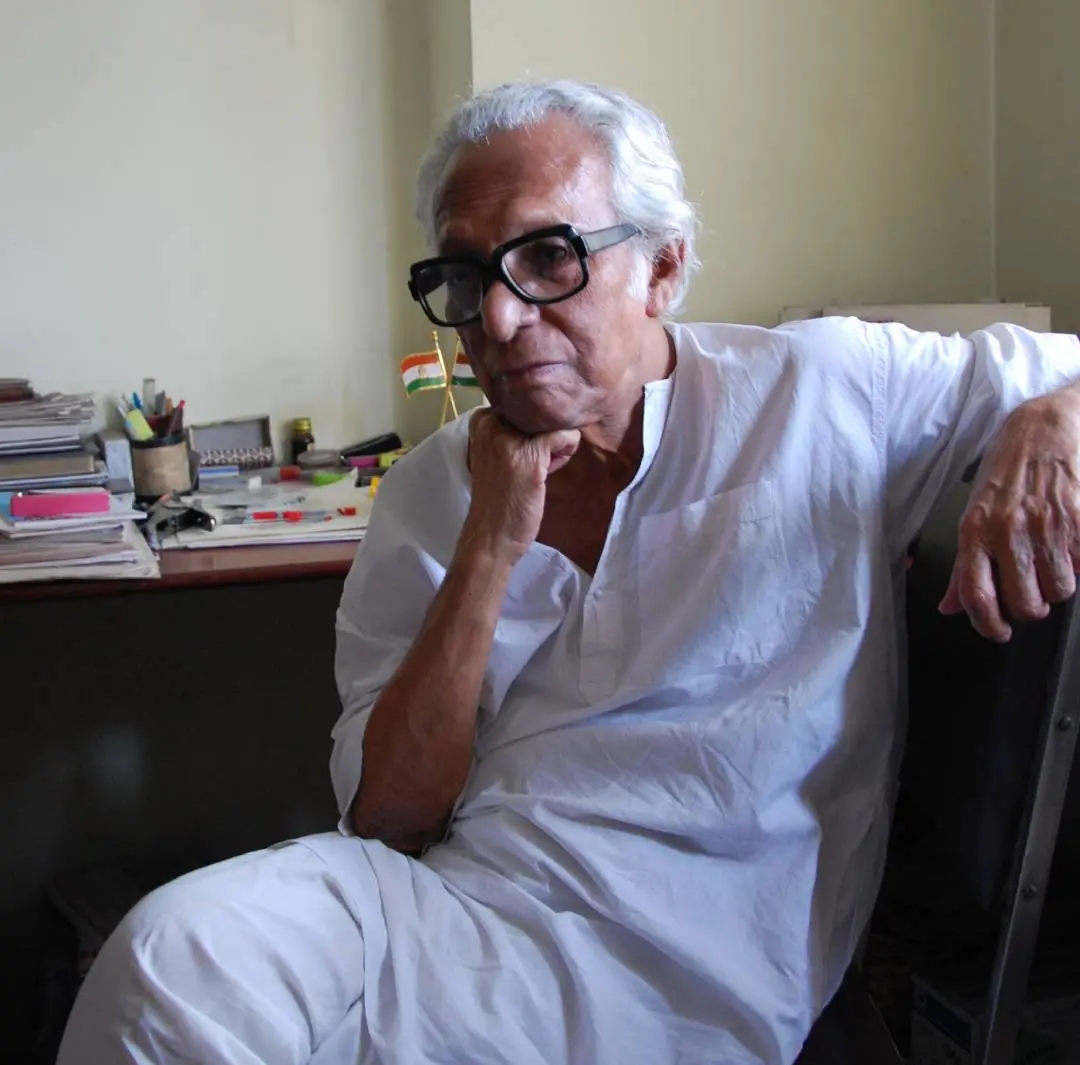
There is an interesting story about the birth of the film Bhuvan Shome, in the centenarian Mrinal Sen’s autobiographical book, 'Always being born'. The filmmaker was literally forced by his friend and one of the Mumbai FILM Forum film society veterans, Arun Kaul, into writing the script in a day for submission to the then Film Finance Corporation (FFC), while he was on his way from Kolkata to Pune Film Institute for a lecture. He did oblige his friend with whom, he made a manifesto for the new wave of films in India, by writing the entire script in a day for submission to FFC paving the way for the historic first “New Wave“ film of India---'Bhuvan Shome' in Hindi, with a budget of Rs 2 lakhs in 1969 and new actors for the Mumbai Hindi films. The story of Bhuvan Shome sums up Mrinal Sen the creative filmmaker as a spontaneous man in search of himself as an artist, since making such films was a near impossibility in India.
The film 'Bhuvan Shome' starring veteran theatre man Utpal Dutt and the then student Suhasini Mulay went on to not just bag awards in the year’s National Film Awards, but found its way to the Hindi theatre circuit, so far a big no for such films. It heralded the arrival of a “new wave“ of low-budget art house films which continued as a new trend in filmmaking by the FTII, Pune, graduates like Mani Kaul, Adoor Gopalakrishnan, and Kumar Shahani. Mrinal Sen used to get theatre releases for his films in Bengal and outside. However, Mani Kaul and Kumar Shahni who made films a few years later and are known as the stars of the “new wave”, with FFC loans did not get the luck of release in popular theatre circuits. Hence those films were restricted to film society and film festival circuits.
Mrinal Sen, along with his contemporaries Satyajit Ray and Ritwik Ghatak are described in the history of Indian films, as the troika which pushed the Bengali and Indian cinema to the world map. But unlike his contemporaries, Sen kept a pan-India approach in his filmmaking, with not just choosing stories of other ethnic groups and making films in languages other than Bengali. This writer as a college student saw 'Mrigayaa' (1976), his Hindi film, also the debut film of Mithun Chakraborty, in a regular theatre at a distant Thiruvananthapuram in the 1970s, before one saw 'Interview' and 'Calcutta 71' at the film society circuit of the city.
'Bhuvan Shome' made in Hindi stands as the first “new wave“ film of India and so is 'Oka Oori Katha' in Telugu and Matira Manisha in Odia. While Ray made Indian films a permanent place in the world map of cinema with his debut film 'Pather Panchali' in 1955 and later Apu trilogy, Sen opened a new chapter in the same map with “New Wave films” of India of the 70s with his 'Bhuvan Shome' of 1969.
In his autobiography 'Always Being Born: A Memoir', Sen describes how he was in a constant search of his creative self to find a real filmmaker in him all through his 40-odd years of filmmaking. It was a search to differentiate himself from his giant contemporaries like Ray, and Ghatak. It was also to excavate his creative self through his 27 feature films and a few other TV films and documentaries. He even named one of his films as 'Akaler Shandhaney' (1980), (In Search of famine) to indicate his ongoing search within himself as a creative filmmaker. He boldly dabbled around political themes in his early years as he was a staunch leftist, and was dubbed as the political filmmaker of India of those days. But later shifted his focus inwards to his own society, the middle class, keeping himself away from overtly political themes.
As a lifelong leftist, his films can be differentiated into many phases, first with the films up to 'Ek Din Pratidin', as the overtly political ones, many with a direct commentary on the contemporary events, especially the extreme Left uprising of the 60s to 70s. With the Calcutta trilogy of 'Interview', 'Calcutta 71', and 'Padatik', he told the world where his heart and creative self were. Unlike the Calcutta trilogy of Ray, Mrinal Sen took a strong political stand in his films and began to be identified as a political filmmaker of his time. It is indeed his commitment to the political Left which found him a place as the nominee in Rajya Sabha by the ruling Left front of West Bengal in the late 90s. However, towards the end of the Left regime in West Bengal, he participated in the protest march against the Left Front government on the issue of Nandigram firing, emphasizing the fact he indeed was a fellow traveler of the Left and not a partisan cultural commissar. No wonder a French journal L'Express described him as a “Private Marxist”, that too after the Cannes Film Festival screening of 'Ek Din Pratidin', in 1980, which marked his new self as a filmmaker.
With his film 'Ek Din Pratidin' about a middle-class family, he took an entirely different route of creative filmmaking pointing his camera to the individuals and their plight and also middle class as a group, leaving his obsession with contemporary political events and social upheavals. He stopped making overtly political films and began to probe the middle-class mind and their values. But with his 'Ek Din Pratidin' he found his best creative slot of analyzing the people around, especially the middle class and their value systems. Each of his films after that revolved around the middle class, be it 'Kharij', 'Ek Adhuri Kahani', 'Ek Din Pratidin'or his last 'Aamar Bhuvan'.
'Bhuvan', world, in short, reflected his world view from 'Bhuvan Shome' to his last film 'Aamar Bhuvan', as he looked at the world around him more closely and intensely with film after film.
Thus Mrinal Sen’s creative curve in films can be seen in three stages, from 'Raat Bhore' his first film in 1955 till his 1969 film 'Bhuvan Shome', where he experimented with various subjects to find his own slot among the meaningful filmmakers, especially with giants like Ray and Ghatak. For ten years from 'Bhuvan Shome' till he made 'Ek Din Pratidin' in 1979, Mrinal Sen creatively responded to the highly explosive political climate of Bengal with the Maoist elements upturning the social and political climate of his State and the country, leading to huge repressions by the State. His Calcutta trilogy is indeed a sharp response of a filmmaker to the ongoing political turbulence of the 70s. All three films are a close creative look at contemporary society from different political angles. 'Interview', the story of the young educated jobless young man of the 60s and 70s, 'Calcutta 71'- an assembly of 4 stories to give an overview of the class differentiation and decay of contemporary society. 'Padatik', was more of the reflection of the revolutionary on the way the rebel movements were conducted leading to self-realization, especially juxtaposed with the rebel middle-class lady whose flat he was hiding. 'Calcutta-71' got Sen into problems with the Indian Ambassador to Switzerland Air Marshal (rtd) Arjan Singh, objecting to the harsh reality shown in the film and prompting him to write a letter to Prime Minister Indira Gandhi defending his film. As an ardent admirer of “New Wave” films of India, Mrs Gandhi who kept her special relationships with the proponents of new wave films never took any bureaucrats' views seriously on such films with regard to the image of India outside the country. But from 'Ek Din Pratidin' onwards, one saw Sen at his creative best-analyzing humans and their situations with his unique worldview rather than responding to contemporary events marking a third and more aesthetically fulfilling period of his career as a filmmaker.
Ray, Ghatak, and Sen were the troika of Indian films from Bengal who influenced a generation after them with their films and creative concepts. While Ray is known for his clinical style of filmmaking dipped in Indian reality and its literature, Ghatak‘s work is laced with deep cultural consciousness and symbols carrying the pain of the partition of Bengal and also the hard realities of an emerging free country. In Mrinal Sen, one can see a constant struggle with his own creativity, political beliefs, and also a deep liberal social worldview as seen in his entire Bhuvan (universe) series films. No wonder he named his autobiography 'Always Being Born'. It is that creative struggle within him and its reflection as seen in his transformation as a filmmaker over the years, which gives Mrinal Sen a unique place among his contemporaries and ensures him a special place in the history of Indian meaningful films.
(VK Cherian is the author of the books, India’s Film Society Movement: its Journey and Impact (2017) and Chalachitravicharam, 2021)