LONG FORMWhen work doesn’t end...
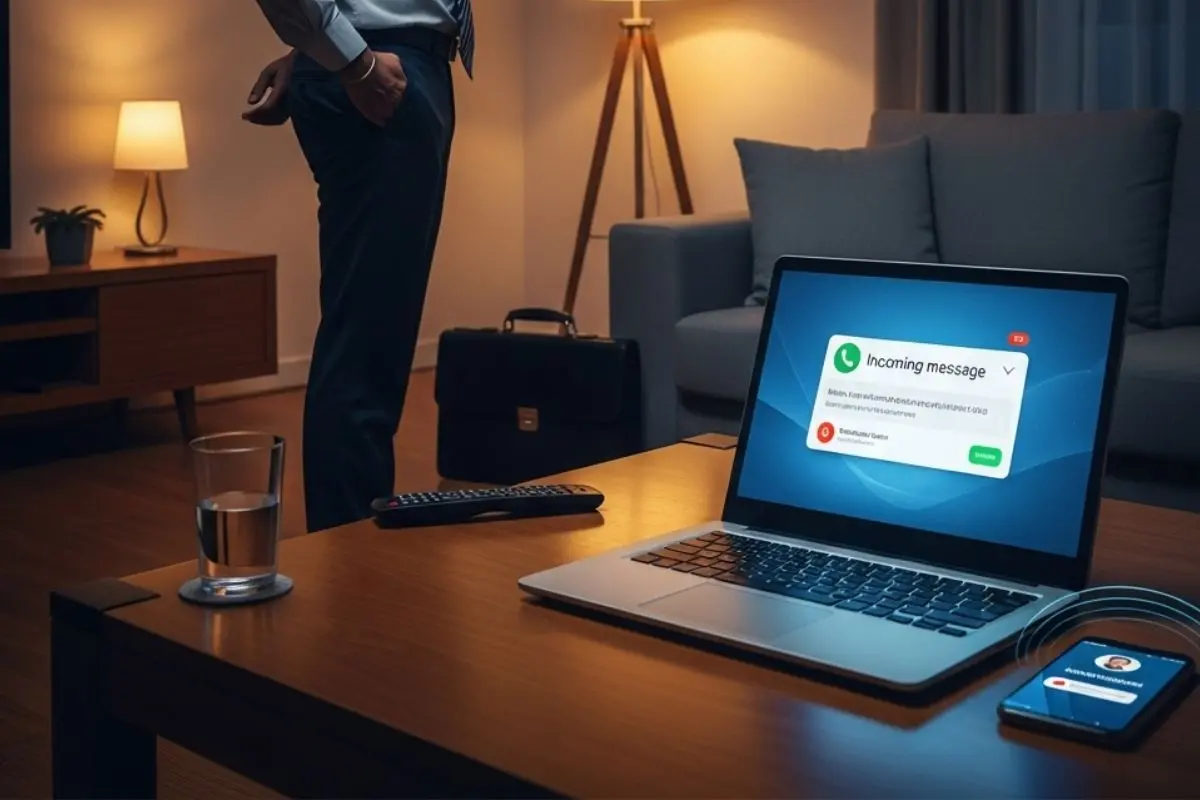
“I can clock out after my regular nine chargeable hours, but when a call comes, you feel obligated to take it. You feel left out otherwise.”
It’s past 10 p.m. in Kochi, and the blue light of Varun’s laptop still cuts across the darkened kitchen. Dinner lies untouched on the counter. He’s already put in nine hours at his IT firm, but the sound of another incoming call makes him flinch.
He tells himself it’ll be quick. It rarely is.
For many like Varun, the idea of “after-hours” has lost all meaning. The workday no longer ends when the computer shuts down; it lingers in the steady ping of emails, the hum of Teams notifications, the quiet expectation of responsiveness.
The modern workplace has normalised what used to be exceptional- the endless extension of work into life. The question is no longer whether work has taken over life, but whether life can still be protected from it.
“You don’t have to, but you’re expected to”
“When you take higher roles, and when there’s a scheduled call at later hours, it’s like, you don’t have to take it, but you are expected to,” says Renuka, another Kochi-based professional.
That quiet, unstated expectation, to be available, to be reachable, to be ‘always on’, has become the new grammar of professionalism. Accessibility is equated with ambition; disconnection, with disinterest. It’s a culture built less on contracts than on compliance and exhaustion.
The price of hustle
In July 2024, 27-year-old Ann Sebastian Perayil, a chartered accountant at Ernst & Young (EY) in Kochi, was found dead in her apartment, barely four months into her new job.
Her parents alleged that “overwhelming work pressure” had contributed to her death. EY denied the charge, saying her workload was no different from that of others. But the incident struck a deep, collective nerve.
Ann’s mother, Anita Augustine, later wrote an open letter to EY that went viral on social media. In it, she spoke of her daughter’s late-night work, weekend calls, and mounting fatigue. The letter was not just a plea for accountability; it became an indictment of a culture.
“Anna’s experience sheds light on a work culture that seems to glorify overwork while neglecting the very human beings behind the roles,” she wrote. “The relentless demands and the pressure to meet unrealistic expectations are not sustainable, and they cost us the life of a young woman with so much potential.”
Soon, social media filled with similar confessions, employees recounting sleepless nights, punishing timelines, and the quiet humiliation of leaving work ‘on time’.
A former EY consultant claimed interns were “mocked” for taking breaks, while “working 20 hours a day” was treated as evidence of grit.
The paradox of Mental Health
Conversations about mental health remain uneasy, half-whispered, and often dismissed. The taboo that silences such discussions in private life quietly extends into the professional sphere, where the stakes are higher and vulnerability feels dangerous.
“It’s hard to admit to your boss that you’re psychologically unwell,” says Malavika, a 28-year-old software engineer in Kollam. “He may understand, but I’m scared he’ll think I can’t handle big projects anymore.”
That fear of being judged as unstable, unreliable, or simply not tough enough keeps many from speaking up. In most workplaces, there’s no language for emotional fatigue. Instead, stress is worn like armour, and burnout is repackaged as commitment.
The result is silence. Employees push through anxiety, depression, and sleeplessness because the alternative- being seen as weak, feels more dangerous. The professional code rewards endurance, not honesty.
India’s growing mental health awareness campaigns, from social media initiatives to government-backed helplines, have opened some space for dialogue. But openness, many workers say, can come with invisible consequences.
“Sometimes senior employees are too understanding,” says Ann. “They listen, they nod, and then you are quietly kept from future responsibilities. That scares me.”
It is the paradox of mental health at work- encouraged in principle, punished in practice.
Still, some organisations are trying to create supportive spaces. “We do have regular sessions for well-being and counselling at the office,” says one employee. “There’s a weekly virtual session on mental wellness, bi-weekly sports activities, and monthly team lunches. The company tries to create a space to unwind.”
Psychologists argue this silence is cultural. Generations have equated mental strength with resilience and vulnerability with failure. In competitive workplaces, this stigma becomes institutional.
“There’s constant pressure, employees are expected to be available at all times, and that brings its own set of issues,” says K.P. Sajina, Counselling Psychologist at Indira Gandhi Co-operative Hospital, Kochi. “If the Bill gets passed, it would be a very good move. People would finally have time for themselves and their families. That kind of deprivation often leads to emotional exhaustion and, over time, can contribute to depression. Having personal time will change a lot, children are also being affected because of this.”
“It was always a crime to steal someone’s time”
For Waamika, a Content Writer in Kottayam, the Bill is both validating and unsettling.
“When I am happy that a bill on work-life balance is in the pipeline, I am also worried,” she says. “It was always a crime to steal someone’s time away from personal life. Why should the normal be legally normalised?”
India’s workforce has been built on the myth of hustle, the belief that success is proportional to self-sacrifice. In Kerala, where IT parks have multiplied and remote work has expanded, this culture has quietly transformed middle-class life.
Psychologists call it ‘availability anxiety’ - the fear of being forgotten if one stops replying. Technology has only deepened that fear.
Inside the Bill: Rest as a right
Against this backdrop, Dr. N. Jayaraj, Chief Whip of the Kerala Legislative Assembly and MLA, introduced the Kerala Right to Disconnect Bill, 2025 in September this year.
If enacted, Kerala would become the first Indian state to legally affirm a worker’s right to rest.
At its core, the Bill codifies something deceptively simple- the right to ignore work-related calls, messages, or emails beyond official hours, without the threat of reprisal.
Employers would be required to define work hours clearly and ensure employees are not penalised for disconnection. The Bill frames rest not as leisure, but as a labour right.
The proposed legislation introduces four key provisions:
•Recognition of the Right to Disconnect: Employees may decline after-hours communication unless prior agreement exists.
•Prohibition of Punitive Measures: Employers are barred from taking adverse action — demotions, dismissals, or denial of benefits — against those exercising this right.
•Grievance Redressal Committees: District-level committees chaired by the Regional Joint Labour Commissioner will handle complaints.
•Enforcement Powers: The Labour Commissioner can conduct inquiries and recommend penalties against non-compliant establishments.
The Bill draws on Article 24 of the Universal Declaration of Human Rights, recognising the right to rest and leisure.
“The proposal is good in principle, but implementing it will be extremely difficult,” says Prof. M. Suresh Babu, Director of the Madras Institute of Development Studies (MIDS), Chennai, and Professor at IIT-Madras. “Many service sector jobs don’t have fixed hours, an eight-hour shift can stretch across different times depending on client needs. This isn’t just about IT; it happens across sectors. In Kerala, a largely service-oriented economy, industries will likely look for loopholes even if the law passes. Given the challenges on both demand and supply sides, it should be optional. Imposing it is where the real problem lies.”
His caution underscores a key tension, the gap between recognising overwork and enforcing rest.
The invisible overwork
India’s labour regime has long focused on tangible concerns- wages, safety, physical exhaustion. But the digital economy has birthed a new kind of fatigue: mental exhaustion disguised as productivity.
A 2024 survey by Indeed found that 88% of Indian employees are contacted by their employers outside office hours, and 85% said such communication continues even during leave or holidays. 79% feared that ignoring messages could harm their career prospects.
A WHO–ILO study in 2021 placed India among the world’s leaders in deaths linked to overwork. The ILO further notes that Indian employees routinely log 10–11-hour days without overtime pay.
Work-life balance: A myth?
In January 2025, L&T Chairman S.N. Subrahmanyan sparked outrage and reflection when he urged Indians to work 90 hours a week, asking, “How long can you stare at your wife?” His remark reignited an old debate: is balance even possible?
Months earlier, Infosys Co-founder Narayana Murthy had called for 70-hour work weeks, insisting that such discipline was essential for India’s progress. The message from industry leaders seemed consistent: work more, rest later; treat fatigue as the price of ambition.
Even global figures have echoed versions of this belief. Former U.S. President Barack Obama once said that if one seeks career success, it’s unrealistic to expect constant equilibrium, it’s acceptable, he added, to “throw yourself into work,” as long as you “make up for it later.”
Indra Nooyi, former PepsiCo CEO, has long rejected the idea of balance altogether. To her, life is a “juggling act,” not a neat division of spheres. She advocates a “no-regret policy,” focusing on what matters most each day, shifting priorities without guilt. For Nooyi, balance is less about symmetry and more about conscious choice.
Not all employees disagree.
“Where do you draw the line? I haven’t thought of work as a separate entity; it’s a part of life,” says Aswin, a private company employee in Calicut. “Finding fulfilment and harmony in both my work and personal life, rather than seeking a strict boundary, would be the essence of my personal philosophy.”
For some, this relentless drive is an article of faith, the belief that long hours are the unspoken currency for future rewards. For others, work itself becomes a refuge from everything else.
Do existing laws protect white-collar workers?
India’s labour laws, from the Factories Act (1948) to the Code on Wages (2019) were built for an industrial economy, not a digitised one.
The Factories Act caps work at 48 hours a week with overtime pay and mandated rest intervals. The newer Occupational Safety, Health and Working Conditions Code (2020) retains the 48-hour limit but allows flexible scheduling, including 12-hour shifts across four days.
But in an age where “the office” lives inside smartphones, especially post-Covid, these frameworks are increasingly outdated.
Global precedents
The idea of a “right to disconnect” isn’t new. France became the first to legislate it in 2017, followed by Spain, Ireland, the Philippines, and Australia.
In these countries, the law didn’t just change schedules, it reshaped culture. Emails began being delayed to the next morning; HR departments built “digital detox” programmes. Kerala’s proposal borrows from these models.
Rest as resistance
In a culture that glorifies overwork, the simple act of logging off can itself be subversive. Rest becomes a quiet form of resistance, a reclaiming of time in a system that monetises it.
Sometimes, defiance doesn’t sound like protest.
It looks like a phone turned face down.
A dinner eaten without distraction.
A message left unread, without apology.
Whether the Kerala Right to Disconnect Bill, 2025 becomes law remains to be seen. But it has begun a conversation.
It recognises that exhaustion is not an individual failure, it is structural.
“Right to disconnect is in the right direction of recognising workers’ right over non-working time,” says Professor Vinoj Abraham of the Centre for Development Studies (CDS), Thiruvananthapuram. “The implications are wider, including the need to compensate for remaining connected, thus overcoming wage theft in modern services. In an era of increasingly individualised employer-employee relations, legislation would help correct imbalances in bargaining power.”
In a culture that glorifies hustle, the most radical act may just be to log off, ON TIME.
*the names of employees have been changed for discretional purposes