Is it the person, or the system? Visually challenged AI engineer from Kerala challenges assumptions
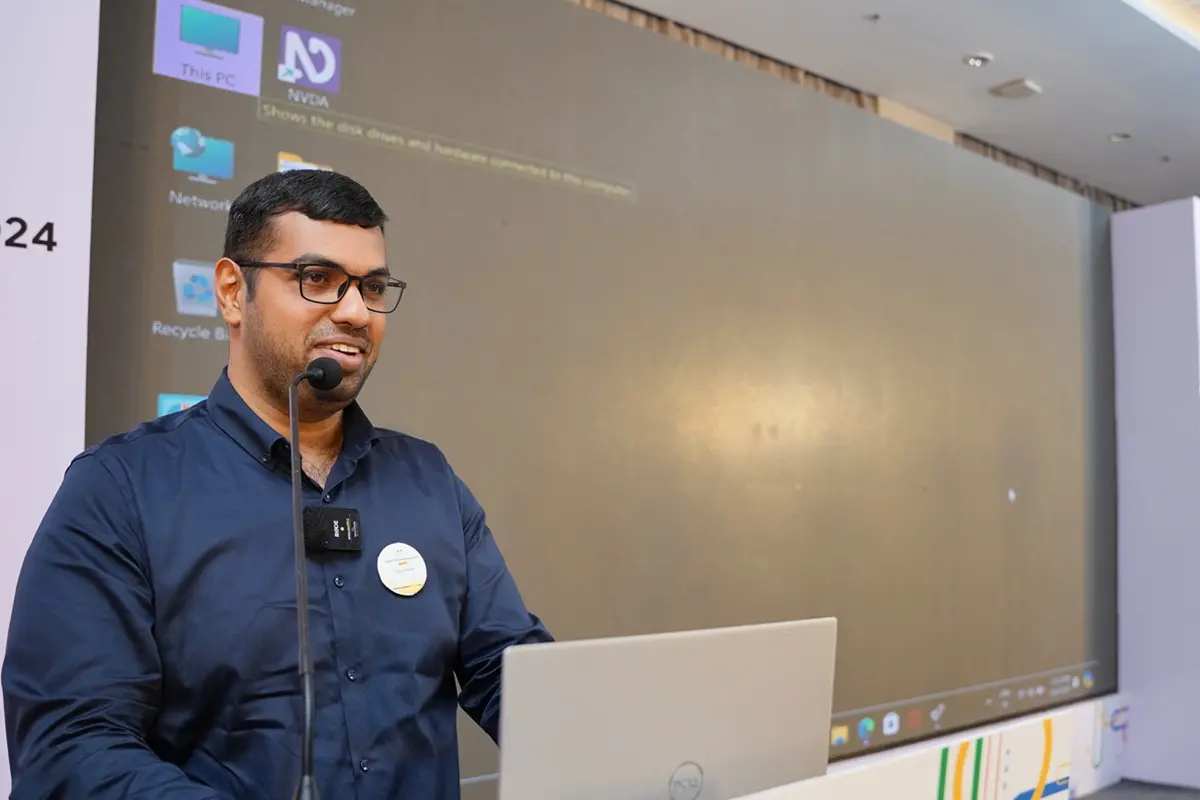
July marks Disability Pride Month, a global period dedicated to celebrating the identity and contributions of the disabled community. Within this international context, Rejin Jose K, a Kochi-based Senior AI Engineer who is legally blind, is sharing his professional reflections.
One day, I needed to reset a password in our payroll software. The system asked me to solve a visual CAPTCHA. I could not do it on my own. For most of my colleagues, this would have taken 10 seconds. For me, it stopped the process entirely.
But here is what I kept thinking about afterwards. This was not my limitation. Audio CAPTCHA alternatives are standard practice. They are part of internationally recognized accessibility guidelines called Web Content Accessibility Guidelines (WCAG). The designers simply never built one in. The gap was in the system, not in me.
I am a blind employee. I have used a screen reader every day for several years across more than one organization. Through that experience, I have noticed patterns that rarely come up in formal diversity training, but that shape the daily reality of many disabled colleagues. The examples I draw on are my own, but the pattern applies more broadly. The most important one starts with that payroll moment, and a distinction that sounds simple but is easy to miss. There is a difference between a personal limitation and a broken system. Once you can see it, it changes how you approach almost everything else.
How Rejin works using screen reader:
Two kinds of barriers
This is the most important distinction I want to share, and it is one that rarely gets made clearly in conversations about disability at work.
There are two types of barriers a blind employee can face.
The first is a genuine task limitation. If you ask me to do color grading in a video editing tool, the software itself may be perfectly usable with a screen reader. But the task requires visual perception that I do not have. That is a real constraint on my side, and I accept it.
The second type of barrier is a system that was never designed to include me. Mandatory employee training is a good example. In one organization, the training platform itself was not accessible to screen readers. Since it was third-party software, the organization could not change it quickly. The solution was to provide me with the course content in an accessible format separately, and I completed the assessment orally with a colleague. The workaround functioned, but it required effort from several people and only existed because someone had escalated the issue.
In another organization, the platform was fully accessible. But the content built inside it was not. Each course was owned by a different global team, and those teams had simply never been asked to think about accessibility when they designed their material. When we raised it, several of them made changes quickly. Others had built content in ways that required a more significant redesign, and those courses took longer. In the meantime, I was excluded from them.
Neither organization was indifferent. But the barrier was not in me. It was distributed across a platform vendor, multiple content teams, and design decisions were made long before I joined. Nobody created it deliberately, and nobody could fix it alone.
The trouble is that both situations tend to look the same from the outside. When a blind colleague cannot complete a task, the instinct is often to attribute it to their disability. But more often than people realize, the real issue is that the system was built without diverse users in mind. Recognizing that distinction matters. It changes where you direct your attention when trying to solve the problem.
What happens when awareness is missing
The second type of barrier, the system problem, tends to persist largely because of a lack of awareness. When the people building and maintaining tools do not know that accessibility standards exist, they cannot apply them. When the people around a blind employee do not know the difference between a personal limitation and a design gap, both get quietly accepted as facts about that person.
This is also one of the reasons some employers hesitate to hire people with disabilities in the first place. Even organizations with strong inclusion commitments can fall short at the team level if line managers have not had exposure to these ideas.
I saw this directly during a leadership training. Our group finished a task early and we started talking. I asked the group how they would manage a blind person joining their team. The responses were genuinely warm and positive. Everyone said they would make sure that person felt included and had room to grow. Then I asked if any of them had ever directly managed a blind employee. None had. I asked how they would handle the person’s limitations.
Their answer was thoughtful. They said they would avoid assigning visual tasks to that person and would reach out to the Diversity and Inclusion team and relevant experts to understand what support was needed.
That is a reasonable and well-intentioned response. But something struck me afterwards. Nobody in the group said they would simply ask the employee directly.
When I brought this up in follow-up conversations, several people told me they were not sure how comfortable the employee would be talking about their own limitations.
I understand that instinct. But it reveals a subtle gap in how we think about disability at work. It stayed with me.
That gap has a practical consequence. When managers are uncertain, they turn to frameworks and experts rather than to the person in front of them. The problem is that no framework knows how a specific individual actually works.
Why the employee is the best starting point
Visual impairment is not a single condition. There are people with low vision, light perception, and complete blindness. Each person uses assistive technology differently and has built their own working methods over time.
I am legally blind with light perception. I lost most of my vision at age 18 and never learned Braille. If a well-meaning expert recommended a Braille display for me, that advice would not apply to my situation at all. My screen reader setup and the way I work are shaped by my own history and experience, not by what a general profile of a blind person might suggest.
The simplest and most reliable way to understand what an employee with a disability can do, and what opportunities suit them best, is to have an open conversation with that person. Inclusion teams can provide frameworks and raise awareness. Accessibility experts can point to tools and standards. But only the individual employee can tell you how they actually work, what they have already figured out, and what kind of support would genuinely help.
This matters more than it might seem. Sometimes a manager assumes a task will be too difficult for a blind colleague and quietly reassigns it, trying to be considerate. But that employee may have already found an accessible way to do exactly that task, perhaps through a community of other blind professionals or through their own experimentation. When we skip the conversation, we may be removing an opportunity from someone who was already prepared to take it.
The intention is kindness, but the effect is that both the organization and the employee lose something.
The small things that add up
Across every organization I have worked in, I have been the only blind employee in my division. People regularly send emails with embedded images. When I receive one of those emails, I get no information from the image at all. For everyone else, this is invisible as a problem because it only affects one person.
But when I have asked individual senders to include alt text for images, they are almost always happy to do it. The issue is that even when someone knows and wants to, it slips through the cracks if it is not part of a standard process. That is completely natural. We all miss things that are not built into our routine.
Many email tools now include built-in accessibility checkers that take only seconds to run. If sending accessible communications became part of how we approach official emails, it would not require extra effort from anyone and it would ensure that information reaches everyone equally. Writing a descriptive alt text is now a single prompt to an AI tool. The friction is genuinely minimal.
What I hope takes root
I have been thinking about these things for a long time, and what I keep coming back to is a single pattern underneath all of them. In each case, the easy move is to draw a conclusion about a person from the outside. The better move is to engage with the system and with the person directly. Everything else follows from that one shift.
The first habit is looking at the system before attributing a limitation to a person. The second is asking the employee directly, rather than consulting only on their behalf. The third is making accessibility a quiet default rather than a special accommodation for edge cases, because it almost always benefits far more people than the ones who immediately come to mind.
These habits are not specific to blindness. The needs vary across different disabilities, but the mindset carries across all of them. Organizations like Allianz Services, alongside many others, are actively working to bridge the gap between policy and practice by listening to people with lived experience.
The biggest risk is not unkindness. It is the well-meant assumption that quietly closes a door.
None of this requires a large initiative or a budget. It starts with curiosity, and with trusting people to speak for themselves.
Author is a Deputy Manager and Senior AI Engineer in the Data & AI, Generative AI team at Allianz Services India. He is legally blind, with light perception, following a gradual loss of vision that began in his late teens. The reflections in this article are based on the author's personal experience across organizations and are intended to highlight broader workplace accessibility patterns. The views and opinions expressed in this article are solely those of the author and do not reflect the views, positions, or official policies of Allianz Services or the Allianz Group.