The Indian Ocean's silent giant: How India's S5 submarine could reshape naval power
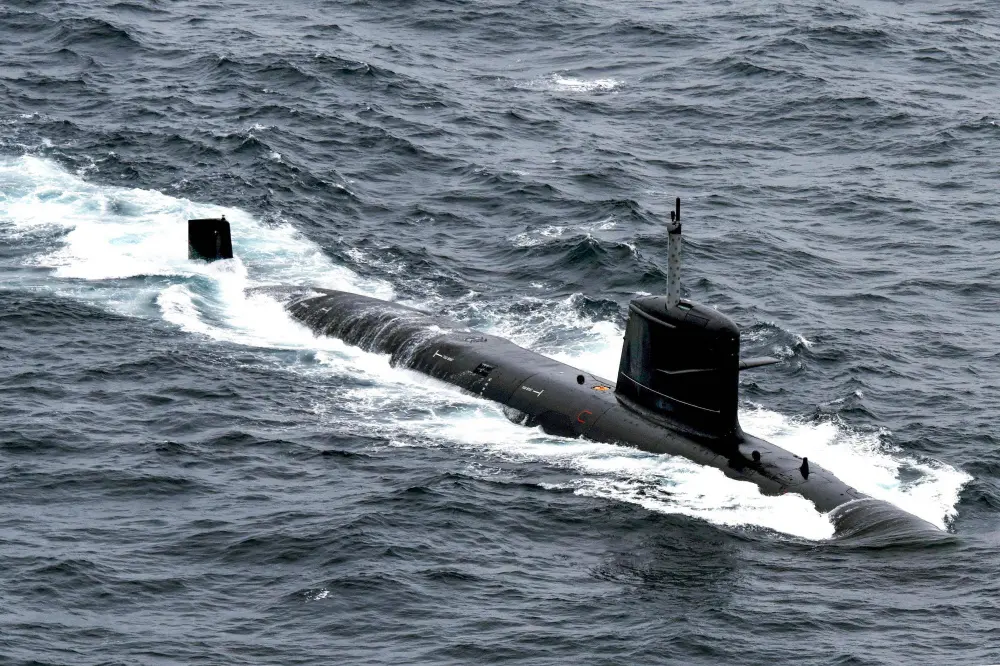
India is building something truly special under the sea. It is called the S5 submarine, and it could become one of the most important warships the country has ever owned.
This submarine is a big step in India's plan to build a powerful navy that can travel far across the oceans, away from its own coastline, and stand strong against China's growing presence in distant waters.
So what exactly is the S5? It is a new type of nuclear missile submarine that India is developing to protect its interests in South Asia and the Indian Ocean. It will be bigger, stronger, and far more advanced than the current Arihant-class submarines. Right now, India faces tough competition from both China and Pakistan, and having a nuclear weapon that can be fired from deep under the sea is becoming very important for the country's safety.
Let us look at what makes this submarine so powerful. Construction of the first S5 began in the last weeks of December 2025, so it is not in service yet. One submarine is being built now, and four more are planned. It will be around 492 feet (150 metres) long and weigh between 13,500 to 17,000 tonnes when submerged, making it nearly three times the size of India's first nuclear submarines. A crew of around 100 to 130 people will operate it.
The S5 will be powered by an advanced 200-megawatt Pressurised Water Reactor developed by the Bhabha Atomic Research Centre. This massive power upgrade, nearly double that of the older Arihant class, allows the submarine to stay underwater for very long periods without coming up. It can move faster than 30 knots, about 55.5 km/h underwater, and because it runs on nuclear power, it can travel extremely long distances without ever stopping to refuel.
Now for its weapons. The S5 is expected to carry K-6 nuclear missiles that use MIRV technology, meaning one single missile can carry many warheads and hit different targets at the same time. It will also carry 533 mm torpedoes, possibly including the Indian-made Varunastra torpedoes.
To understand where the S5 fits in, it helps to look at the steps before it. The first nuclear submarine, INS Arihant, joined the navy in 2016. After that, India built improved "stretched" versions of the same class, the INS Arighaat, which was commissioned in 2024, and the INS Aridhaman, which is currently going through its final sea trials. These next-generation S5 submarines are expected to join the fleet in the 2030s. They mark a massive evolution from the pioneering Arihant class and its recently upgraded sister ships, representing a giant leap forward in technology.
The S5 gives India a strong and hard-to-detect backup. Even if the country were attacked first, this hidden submarine could still strike back, which is a powerful way to keep enemies cautious. More importantly, it is a major step towards building what is called a blue-water navy. To understand this simply, navies come in three types. A brown-water navy guards rivers and inland waters. A green-water navy works close to the coast. A blue-water navy can sail across entire oceans and reach far-off corners of the world. Powerful countries like the United States have such navies. Since India wants to become a major global power, it needs this same strength to operate far beyond its shores.
Here is an interesting point. While the S5 can help keep Pakistan in check, its real focus is on bigger, long-term challenges, especially China. By the 2030s, tensions between the two countries could grow more serious, so building this strength early is a wise move.
The S5 fleet is being built at the Ship Building Centre (SBC) in Visakhapatnam, the same shipyard that built INS Arihant, INS Arighaat, and their larger follow-on versions. The submarine is specially designed to carry the K-6 submarine-launched ballistic missile. This three-stage, solid-fuel weapon is expected to achieve hypersonic speeds of up to Mach 7.5, making it incredibly difficult for enemy air defences to intercept. With a massive range of 8,000 to 10,000 kilometres and MIRV technology, it can strike several distant targets at once.
This means the S5 could quietly reach faraway targets across Asia and even Europe, while staying safely hidden inside the Indian Ocean. That is what makes this silent underwater giant such a true game-changer for India's future.
(Girish Linganna is an award-winning science communicator and a Defence, Aerospace & Geopolitical Analyst. He is the Managing Director of ADD Engineering Components India Pvt. Ltd., a subsidiary of ADD Engineering GmbH, Germany.)