Why India's new ₹80000 crore warships will need foreign muscle for heavy-lifting
The Indian Navy is on the verge of a transformational leap in its amphibious warfare capabilities, with the Ministry of Defence expected to greenlight an ambitious ₹80,000 crore project to build four massive Landing Platform Docks domestically. These warships, each stretching 200 meters and weighing between 30,000 to 40,000 tonnes, will serve as floating military bases capable of projecting power across the Indian Ocean Region.
However -- according to defence news portal IDRW -- as India prepares to issue tenders by year-end, a glaring reality has emerged that threatens to undermine the entire Atmanirbhar Bharat vision for this program -- the country simply doesn't have heavy-lift helicopters powerful enough to operate from these sophisticated vessels.
The LPD project represents more than just four new warships. It signals India's serious intent to develop credible amphibious assault capabilities at a time when tensions with China continue to simmer across multiple fronts.
These vessels will be built by premier Indian shipyards including Larsen & Toubro, Mazagon Dock Shipbuilders, and Cochin Shipyard, with an impressive 90 percent indigenous content. Each ship will feature expansive flight decks designed to accommodate two heavy-lift helicopters, twelve special mission helicopters, and two naval drones, alongside floodable well decks that can launch landing craft carrying troops, armored vehicles, and critical supplies directly to hostile or disaster-affected shores.
The strategic importance of these warships cannot be overstated. Inspired by proven designs like the American Wasp-class and French Mistral amphibious assault ships, India's LPDs will be customized with vertical launch systems for air defense and equipped with the formidable BrahMos missiles for offensive strike capability. They will also house comprehensive medical facilities and command centers, making them genuinely versatile platforms for both military operations and humanitarian assistance.
The fact that this project carries a price tag comparable to two aircraft carriers underscores how seriously the defence establishment views amphibious warfare in India's future maritime strategy. With the first ship's construction planned to begin by 2027 and commissioning expected between 2032 and 2035, these vessels will eventually replace the aging INS Jalashwa and provide India with a genuinely modern amphibious force.
Yet here's where the dream meets a harsh reality. The Navy's current Sea King Mk42B helicopters can barely lift five to six tons, while the new LPDs demand heavy-lift helicopters with a maximum takeoff weight exceeding 30 tons -- a capability gap that's impossible to ignore.
The indigenous solution everyone hoped would fill this void, Hindustan Aeronautics Limited's Deck-Based Multi-Role Helicopter, simply isn't designed for such heavy lifting. The DBMRH, derived from the Indian Multi-Role Helicopter program and powered by the SAFHAL Aravalli engine, operates in the 12.5 to 13-ton category.
While the Cabinet Committee on Security approved ₹13,000 crore in July 2025 for developing DBMRH prototypes, and the helicopter shows genuine promise for anti-submarine warfare, surveillance, and utility missions, it fundamentally cannot handle the 15 to 20-ton payloads that amphibious operations demand.
As a HAL official candidly admitted, "We're building a strong medium-lift helicopter, but heavy-lift capability is still missing."
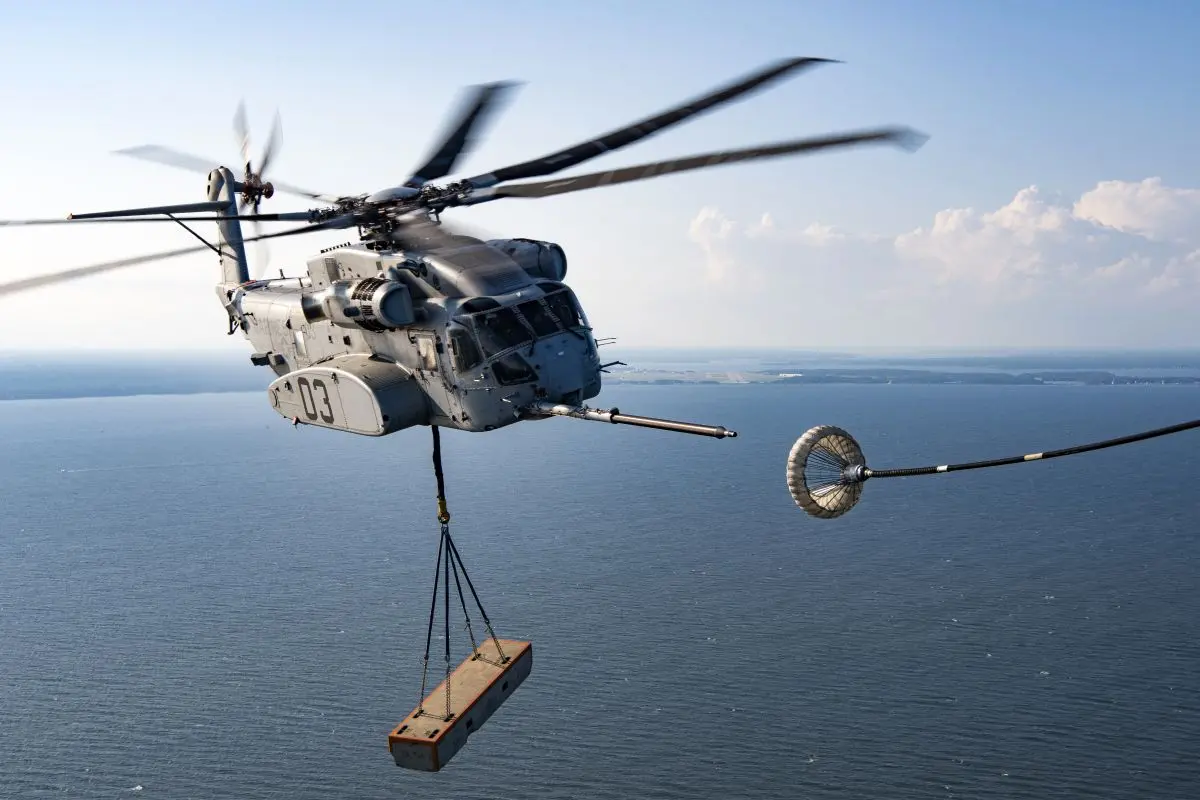
This capability gap means the Indian Navy will almost certainly need to look abroad, and the frontrunner appears to be the American Sikorsky CH-53E Super Stallion. This workhorse of the US Marine Corps demonstrated its impressive credentials during Exercise Tiger Triumph 2024 at INS Dega, where its ability to rapidly move heavy cargo and troops from ship to shore left observers thoroughly impressed.
According to IDRW reports, the Super Stallion's performance during these exercises clearly showcased the kind of heavy-lift capability India's new amphibious fleet desperately needs. With a maximum takeoff weight of 32.7 tons and the ability to externally carry up to 16 tons, the Super Stallion can lift artillery pieces, vehicles, or entire squads of soldiers in single sorties.
Its newer sibling, the CH-53K King Stallion, pushes capabilities even further with a 39.8-ton maximum takeoff weight, incorporating stealth features, fly-by-wire controls, and advanced avionics that make it smarter and safer to operate.
The upcoming tender will likely attract other global heavyweights as well. Boeing's CH-47F Chinook, already operated by the Indian Air Force with a 24.5-ton maximum takeoff weight, offers the advantage of existing supply chains and pilot familiarity.
Airbus may pitch its H225M Caracal, though at eleven tons it would need significant modifications to meet requirements. Russia's gargantuan Mi-26, the world's largest helicopter with a staggering 56-ton capacity, might have been a contender in different geopolitical times, but ongoing sanctions and India's pivot toward Western defense partnerships make this option increasingly unlikely.
The Navy is expected to procure eight to twelve heavy-lift helicopters in the initial phase, with possibilities for local assembly at HAL facilities or private sector partners. The emphasis will be on seamless integration with the LPDs' indigenous systems and avionics, ensuring these expensive foreign helicopters can effectively operate from Indian-built warships.
This situation presents a sobering lesson about the complexities of achieving genuine self-reliance in defense manufacturing. While India has made remarkable strides in shipbuilding -- as evidenced by the 90 percent indigenous content planned for these LPDs -- certain capability gaps remain stubbornly persistent.
HAL deserves credit for pushing forward with the DBMRH program, which will undoubtedly serve important roles aboard these very ships for lighter duties. The company has demonstrated growing competence in rotary-wing aircraft, and the ₹13,000 crore investment shows the government's commitment to building this capability over time.
However, expecting HAL to simultaneously develop medium and heavy-lift naval helicopters while meeting existing commitments for the Light Combat Helicopter, Advanced Light Helicopter variants, and other programs would be unrealistic.
Perhaps, the pragmatic approach lies in strategic partnerships. India could acquire proven heavy-lift platforms like the CH-53K while simultaneously investing in HAL to develop next-generation heavy-lift capabilities over the next decade.
Technology transfer agreements, licensed production, and gradual indigenization could provide the immediate operational capability the Navy needs while building long-term domestic expertise.
The ₹80,000 crore LPD project proves India can build world-class warships, but modern amphibious warfare requires an ecosystem of complementary capabilities, and sometimes the wisest path to self-reliance involves learning from the best before standing entirely on your own feet.