Crafting culture with letters: Hiral Bhagat’s journey through Gujarati calligraphy and more
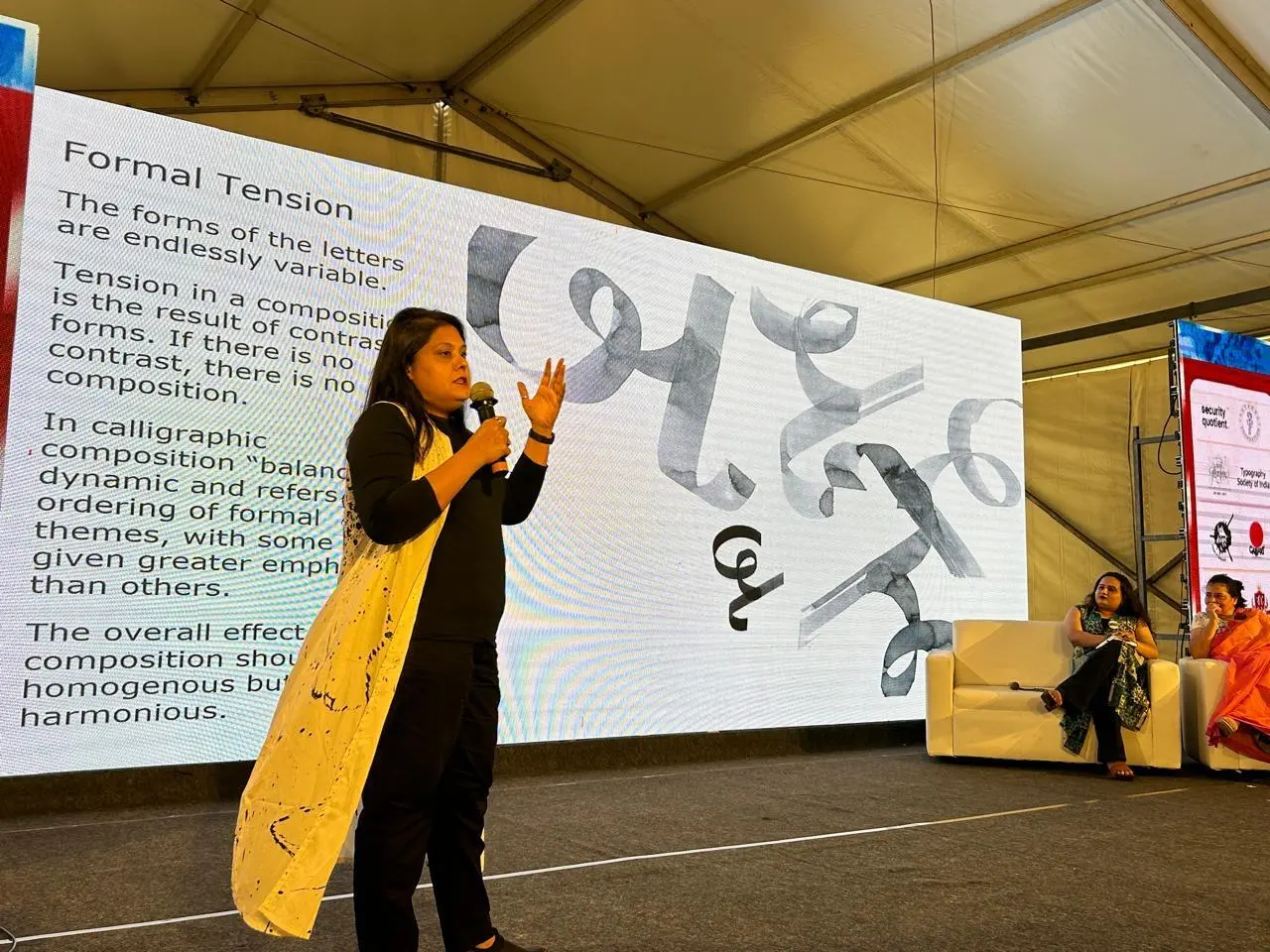
“If you look closer, all our Indian language is inspired by nature. In some letters you can see birds, in some, other creatures, and some letters look like leaves, petals, elements.. You just have to observe.. When you do.. you can create beautiful artwork with just these letters..,” Hiral Bhagat, the first female international award-winning calligraphy artist from Gujarat.
The International Calligraphy Festival, organised by the Ka Cha Ta Tha Pa Foundation from October 2-5, brought together a diverse group of calligraphers, typographers, and art enthusiasts from across the globe to celebrate the beauty of calligraphy in Kerala. Featuring skilled artists from India, South Korea, France, and Vietnam, the event offered immersive workshops, live demonstrations, and thought-provoking lectures, providing a rich learning experience for all involved.
Mathrubhumi English caught up with Hiral Bhagat, one of the gifted artists who took part in this exciting festival.
Hiral Bhagat is a trailblazer in Gujarati calligraphy, known for blending traditional calligraphy with visual art. Her work has been showcased and honoured in prestigious events like Calligraphies in Conversations in San Francisco (2019), Tool Art at the National Library of Singapore (2019), and the Cheongju Jikji World Calligraphy Exhibition in South Korea.
Hiral's artistic achievements include recognition at the 2023 Kochi-Muziris Biennale and features in international publications like ‘Letter Arts Review’. She has won multiple awards for her calligraphy posters at Typoday 2021 and 2023 and has also served as a jury member in major calligraphy events while teaching at top art institutes and design universities.
How does it feel to be a part of the International Calligraphy Festival?
I feel absolutely thrilled to be part of this festival! The International Calligraphy Festival is such a wonderful platform because it gives you the chance to connect with artists and calligraphers from all over the world.
You get to exchange ideas, learn new techniques, and discover different perspectives. Each language and culture adds something unique to your understanding of calligraphy. This experience has truly helped me enrich my craft and broaden my view of the art form.
What inspired you to choose Gujarati calligraphy?
Honestly, it was a very organic decision. I never thought I would take up Gujarati calligraphy. I started with Roman scripts, moved on to Devanagari, and then it hit me.. Why not work in my own mother tongue?
Gujarati is not as common in the calligraphy world. Out of sheer curiosity, I began exploring it, and soon, I found myself connecting deeply with my culture. It was like rediscovering my roots. When I think about it, my knowledge of Gujarati was limited to what I learnt in school. During college, peer pressure made us gravitate toward English, whether it was music, media, or conversations. At a young age, you tend to imitate what your friends do..
But as I started working with Gujarati calligraphy, I felt a stronger connection to my heritage. There was very little about it online, so I thought, ‘Why not give it a try?’ I never expected to reach this level of recognition in Gujarati calligraphy, but now I’m proud to say I’m one of the pioneers in this field.
Could you share your calligraphy journey with us?
I started as a fine arts student, but back then, our exposure was quite limited. I learnt calligraphy with a basic bamboo pen, focusing only on Gujarati alphabets—no vowel signs, no word or sentence formation.
It was just a one-week introductory course. After college, I got into graphic design, working in an advertising agency in Mumbai. But after becoming a mother, I decided to take a break and enjoy motherhood.
During that time, I visited art galleries and libraries, where I stumbled upon a book on calligraphy by Achyut Palav. It reignited my love for the craft. I started learning again, this time formally, at Achyut Palav’s School of Calligraphy in Navi Mumbai. My weekends were spent in classes while my husband babysat. That’s when I realised how little I had actually learnt in college.
After 10 years of learning from different schools, attending workshops, and going to international conferences, I moved back to Gujarat in 2017. Initially, I felt like I was leaving my dreams behind in Mumbai.
But that’s when I decided to try Gujarati calligraphy. I rented a studio in the Kanoria Centre for Arts and began creating my own portfolio using Gujarati scripts. Initially I met a lot of people, pitched through social media.. Slowly, people started noticing my work, and now they come to me for projects. It's been a rewarding journey built on hard work and passion.
How does it feel to have your work exhibited around the world?
It feels incredible! I’m always amazed at how people from different countries appreciate my work, sometimes more than those from my own community. Initially, it was disheartening that our own people didn’t seem to value the language or the art as much. But slowly, more people are taking it up, and that’s really encouraging.
Where do you draw inspiration for your artworks?
I’ve had to learn a lot on my own, as my college education was quite basic compared to other design schools. My inspiration comes from books, research, and interviews with other artists.
I always tell young artists to go to books for their knowledge rather than relying solely on quick social media content. Books are a deeper, more authentic source of information.
In the International Calligraphy Festival, she has exhibited works named “Akshar haiku,” which are haikus created out of alphabets, and poetry called 'Mumbai local train' that depict lives of people who travel on local trains, through alphabets.
How different is calligraphy when it comes to different languages?
Each language has its own personality. For instance, Devanagari has a ‘Shiro Rekha’, the horizontal line at the top of letters, while Gujarati doesn’t. The shapes and curves of Gujarati letters are more flowing, and they have a lot of loops and beautiful joineries.
Which calligraphy artwork holds personal significance for you?
There’s one piece I hold very close to my heart, an artwork titled ‘Adunik Aranya’ (Modern Jungle), based on a poem by Niranjan Bhagat. It was featured in the prestigious ‘Letter Arts Review’ magazine and displayed at my solo show, ‘Calli Kavya’. I’ve decided never to sell it. Even if someone offers me crores, I won't! It’s hanging on my wall at home.
Who's your favourite calligrapher? What aspect of their work impressed you?
In India, Achyut Palav has been a huge influence. His work is always inspiring.
But as I explored more, I discovered many other incredible calligraphers, both men and women. Female artists like Qamar Dagar, Salva Rasool, Denise Lach, Yukimi Anand, and Marina Soria create powerful works, and I am impressed by their creations. They bring so much grace to their craft and make their voices heard through their art.
What's your favourite Gujarati letter or word to write?
I love the Gujarati letter ‘Ksh’. It has such beautiful loops and curves, almost like a dancing figure. It’s elegant, fluid, and feels alive when you write it. It's almost like a female figure dancing gracefully.
With technology making calligraphy more accessible, do you think this affects the art form?
Technology may make it easier, but it often leads to shallow learning. Without proper training and deep understanding, the work lacks substance. Its temporary. Imitation has its limitations! . True calligraphy requires dedication and patience; there are no shortcuts.
How do you express your emotions through letters?
It all starts with your thoughts and feelings. When I create a piece, I first tap into the emotion I want to convey, whether it's sadness, joy, or nostalgia. The choice of material, techniques, and letters follows.
For example, I created an artwork based on a poem about the quiet sadness inside a café. I have used letters, techniques, colours, and strokes in a way that immediately resonates with the sadness the poet wanted to convey. The piece was selected for display at the All India Fine Arts and Crafts Society in Delhi.
What advice would you give to aspiring calligraphers looking to explore Gujarati script?
Learn properly. It’s okay to imitate at first, but keep it private until you’ve truly mastered the craft. Read a lot, meet different people, exchange ideas, and be patient.Calligraphy is a slow and disciplined art form. It requires time, dedication, and ‘Riyaz’ (practice). You cannot learn calligraphy like you make 2-minute noodles.
When I started learning, my child was 3 years old. That's a time when they require lots of attention. I managed to practice whenever he went to play groups or sleep.. Nothing comes easy, but with passion and perseverance, you can achieve great things.
From a layman's perspective, is it necessary to have good handwriting if we want to learn it?
That’s a myth! Good handwriting and calligraphy are two completely different skills.
Calligraphy is about using specialised tools like a chisel or brush, while handwriting is done with monolinear tools like a pen or pencil. With enough practice and patience, anyone can learn calligraphy. By learning calligraphy, you can actually improve your handwriting. When you learn calligraphy, you learn patience. It reflects in your handwriting, as you have got your energy and breathing in line.
How do such events help? What more can be done to encourage others to take up calligraphy?
Events like these are eye-opening, especially for beginners as well as creators like me. I am still a learner. I haven't received padma shri.. yet! They show how much can be done with letters beyond just writing. We create art from alphabets!
Meeting international artists and seeing their work helps push the boundaries of our own creativity. These events encourage new forms and ideas. I truly appreciate the effort Narayan Sir has put into organising this festival, and I hope he continues to bring artists together from around the world.