From Hollywood hits to Gebonions: Meet the Malayali animator making Kerala his stage
"Kousalya Supraja Rama Purva Sandhya Pravartate…"
The familiar morning chant echoes through a sleepy Kerala village. A man heads out for his daily walk. Another lovingly waters the plants in his courtyard. It is the kind of morning that unfolds in thousands of homes across the state.
Then, without warning, disaster strikes.
Not in the form of an alien invasion or a serial killer. Not even an angry neighbour.
A newspaper.
Hurled with frightening precision by the local newspaper delivery boy, it sends a man crashing to the ground. Suddenly, the paperboy isn't delivering the day's headlines—he is the headline.
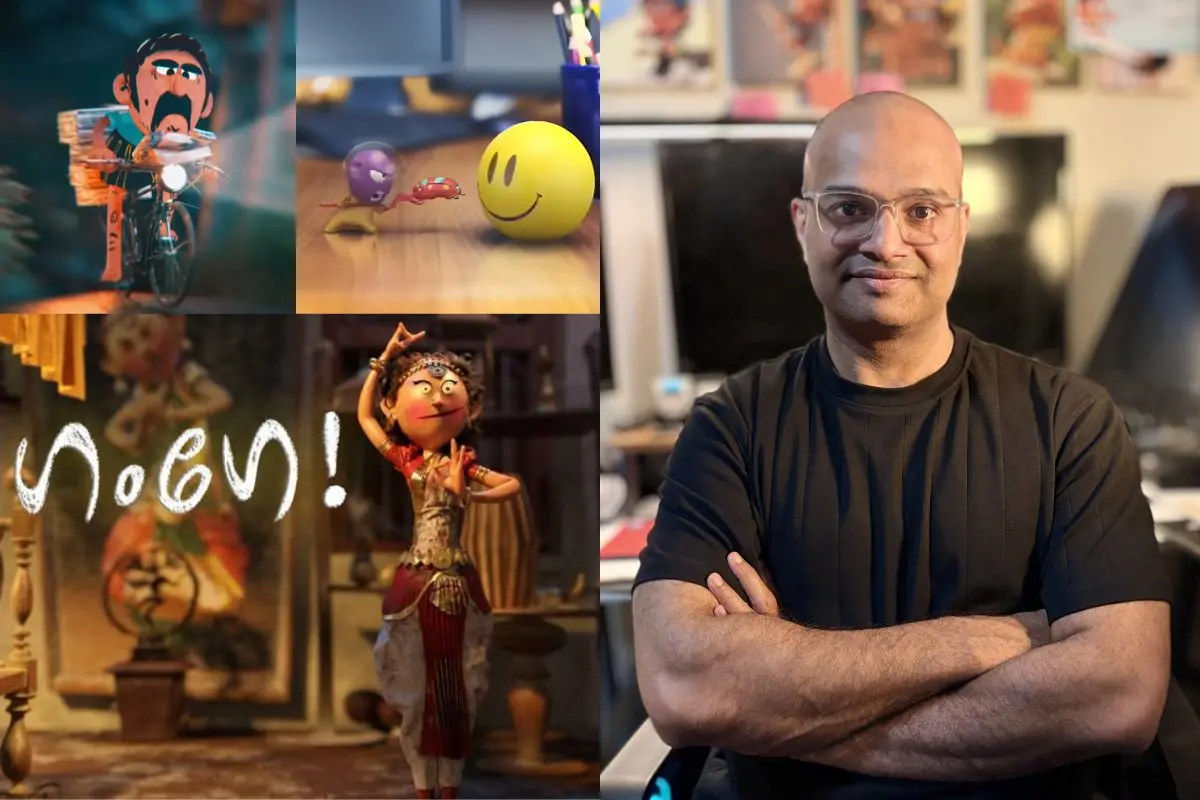
As bizarre as the premise sounds, 'Attack of the Paperman' wasn't born entirely out of imagination. Its creator, Thiruvananthapuram-born character animator Aju Mohan, admits it was inspired by an oddly specific childhood fear.
"One day, our newspaper delivery guy threw the newspaper so hard that it shattered one of our flower pots. From that day on, I had this weird fear that he was eventually going to destroy our entire house. Silly, I know, but as a kid, that fear felt completely real. And that's how 'Attack of the Paperman' was born."
Welcome to the wonderfully peculiar universe of Gebonions, where the familiar is twisted into animated comedy and ordinary-looking people become unforgettable characters.
By day, Aju works as a character animator at Cinesite in Vancouver, Canada. Over the years, he has worked with studios including Disney, DreamWorks and Framestore, contributing to films such as 'Kung Fu Panda', 'Trolls', 'Deadpool 2' and 'Mulan'. Most recently, he wrapped up work on 'Ray Gun', directed by Brad Bird, the filmmaker behind 'Ratatouille', 'The Incredibles' and 'The Iron Giant'. His next Hollywood project, however, remains under wraps because of a non-disclosure agreement.
By night, he creates the animated shorts that have earned Gebonions a loyal fan following, including 'Chaya', 'Gangee' - inspired by 'Manichitrathazhu', 'Tony Kutta', 'Objection' and several others.
A tiny alien that became a brand
Ironically, Gebonions didn't begin with Kerala humour at all. It began with a three-centimetre alien.
"The name Gebonions actually has a pretty random origin," Aju laughs.
"A long time ago, I made a short animation about a tiny alien that landed on Earth with one goal–to destroy everything. The only problem? The alien was just 3 cm tall."
After struggling to name the character, the word "GEBO" simply came to him. Years later, when he launched his YouTube channel, he revived the concept with two aliens instead of one and eventually retained Gebonions as the channel's identity, even as the stories evolved.
Away from animation, however, Aju insists he is far less interesting than his characters.
"A very normal introvert guy who likes to read and sketch, play games and spend time with his family when he is not animating!"
Where do these ideas even come from?
If there is a secret formula behind Gebonions' humour, Aju hasn't found it yet.
Ideas, he says, rarely arrive while sitting at his desk. Instead, they appear during showers, walks or while watching television, and disappear just as quickly if he doesn't write them down.
"Every once in a while, something worthwhile peeks above the surface, and you have to grab it before it's gone. That's why I always carry a notebook and write down ideas as soon as they pop into my head."
But even a funny idea is only the beginning.
"Having an idea is just like holding onto a dream. If you want to bring it to life, you have to shape it into a story."
Keeping those stories simple is also a practical necessity. As a solo creator working after office hours, he has to build every character, prop and environment himself.
The perfectionist who is never satisfied
Ask Aju whether any animation has turned out exactly the way he imagined, and the answer is immediate.
"I am never completely satisfied with any of my work. I always feel I could have pushed it a little further, maybe made the character more comical, pushed the poses more, or exaggerated the expressions."
He points to 'The Abduction' as one project he would happily revisit because he believes it could have been even funnier.
Creative blocks, meanwhile, are solved not by forcing ideas but by walking away from them.
"The best way for me to get over a creative block is to step away from the project for a day or two and come back with a fresh mind. Or I'll jump onto another project... It's really strange how the mind works!"
Making people laugh at what once scared them
Whether it is a terrifying newspaper boy or a playful tribute to 'Manichitrathazhu', Aju has developed a knack for turning fear into comedy.
He credits a quote often attributed to American humourist Will Rogers for explaining why.
"Everything is funny as long as it is happening to somebody else."
"Most of life's mishaps can be turned into comedy if you look at them from a different angle. The trick is to walk that fine line."
Hollywood by profession, Gebonions by passion
For Aju, one of the greatest rewards has been the audience that has grown around Gebonions.
"Most of them are very appreciative of the effort and the amount of time it takes to create these animation clips. I honestly believe my audience is one of the most polite and awesome communities compared to many other channels... I am genuinely proud of my audience."
His animated tribute to 'Manichitrathazhu' also drew appreciation from several Malayalam film personalities.
"A lot of actors and other people from the film industry have messaged me appreciating my animation clips... like Kunchacko Boban, Binu Pappu, Alphonse Puthren and Darshana Rajendran, to name a few."
What Indian animation can learn
Having worked in both India and Hollywood, Aju believes the biggest lesson has little to do with technology.
"Respecting the artist and not treating them like mere factory workers!"
He recalls experiencing studios where artists were expected to work relentlessly with little regard for burnout or overtime compensation.
"I have seen and experienced this in some Indian studios where I have worked. I am not generalizing all Indian studios, but from my experience, many of them focus on one thing: more work in less time, which ultimately means more profit."
Hollywood, he says, generally values healthier working conditions.
"Artists are treated with respect, and I believe that is the most fundamental thing any artist truly aspires to have."
He also hopes Indian animation breaks free from being seen purely as children's entertainment.
"We have so many amazing folk tales and stories from every region of India, and animation is the perfect medium to bring those stories to life."
He also wishes more people understood what animation actually involves.
"That it's all fun and glory, it is actually fun if you are really passionate about it. But there is still a lot of hard work that goes into making these.
"Another thing people usually don't realise is that animation is a team effort. You are just a small cog in a big machine. There are so many different departments involved (modelling, rigging, lighting, texturing, simulation, effects, compositing, etc.) even though we put everything under the single name 'Animation.'"
AI, politics and staying in his lane
While many artists are embracing artificial intelligence, Aju remains sceptical of AI-generated art because of how image-generation models are trained.
"I am not really a fan of AI art... I personally feel that is unacceptable. That being said, I am not against AI as a technology. For things that are not directly related to art, I don't mind using AI assistants. I have used AI for research purposes, and I have also experimented with AI to create realistic photographic 3D assets, which are quite similar to photogrammetry scans."
Administrative work, however, is another matter.
"All those repetitive and time-consuming tasks are things artists would happily hand over to AI so they can focus more on the creative side of the work."
As for politics, don't expect Gebonions to become a platform for social commentary anytime soon.
"I consider myself more of a simple entertainer and nothing more... If I can make even one person forget their personal struggles for a moment and bring a smile to their face, I feel like I have succeeded as an artist."
The woman behind Gebonions
Behind every late-night animation session is someone Aju credits for making the channel possible.
"It has to be my wife, even though she probably won't admit it!"
Creating Gebonions means sacrificing evenings and weekends after a full day's work in Hollywood animation.
"Her patience, understanding and support have meant everything. This channel wouldn't exist without her."
Perhaps that is the biggest plot twist of all.
Not the alien that accidentally became a brand.
Not the newspaper boy who became Kerala's most unexpected supervillain.
But, the fact that one animator can spend his weekdays helping create Hollywood spectacles and his nights reminding us that sometimes the funniest villains are the ones delivering tomorrow's news.