Gulzar's 'Aandhi' turns 50: Indian cinema's struggles with women in power
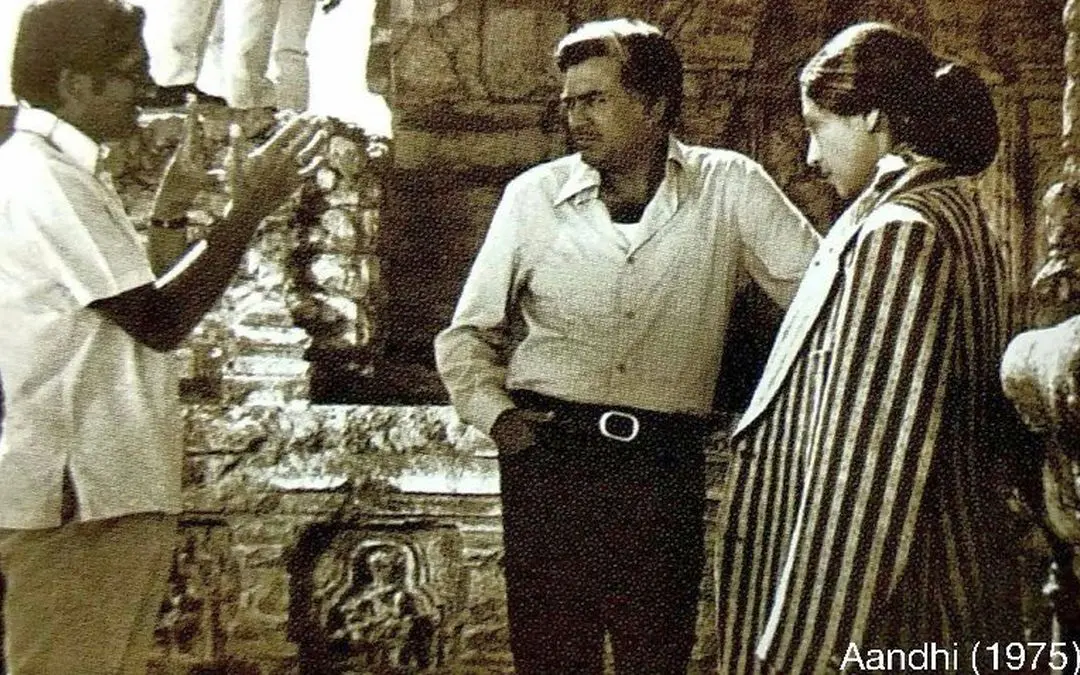
Gulzar’s Aandhi celebrates its fiftieth birthday this year. Aandhi remains the first Indian feature film on a woman political leader and featured none other than Suchitra Sen as the dignified and regal protagonist of the film. She portrayed Arati, a woman almost thrust into politics by her ambitious father and then, rising to the top. Sad, however, that after Aandhi, Indian mainstream cinema has hardly explored women as political leaders in films. The few that do exist have neither been popular among the audience nor memorable as cinema per se.
The Political Backdrop
Indian women have been contesting elections from the pre-Independence era. In the 1930s, the powerful motivation of Jawaharlal Nehru made the United Provinces a showcase for women’s active participation in politics. The legislative council and the legislative assembly had sixteen women members. The most prominent among them were Begum Aizaz Rasul, the deputy speaker of the legislative council, and Vijaya Lakshmi Pandit, who held a Cabinet post. But one must note that both these women came from highly politicized, elite families who had no first-hand knowledge of the political situation and were not in touch with the masses.
After the first general elections in 1937, almost every province had a sprinkling of women legislators. Every election from 1967 to 1984 in the post-Independence era was dominated by the towering personality of Indira Gandhi. Till 1984, among the twenty-eight women members of the Lok Sabha, two-thirds came from well-known political families and had no independent base of their own. One finds that the family legacy has now percolated down to regional politics also in quite a big way. Not all political candidates, women or men, are elite or Western educated, like Rabri Devi, but the filial connection is too obvious to be brushed aside.
Women Political Leaders in Cinema
It would be in context to look back on Madhur Bhandarkar’s Satta (2003), Indu Sarkar (2017), Thalaivi (2021) and Emergency (2025). Among these, other than Aandhi, a love story spread over a decade framed within a narrative that explores the rise of a woman political leader and the failure of her married life in the most memorable film of this genre. The film is enriched with the lyrical touch of the poet-lyricist Gulzar and the music of RD Burman but more importantly, because of the brilliant performances of Suchitra Sen, Sanjeev Kumar, AK Hangal and so on.
Aandhi tellingly depicts the changing shades of a husbandwife relationship. With the narrative telescoping between the past and the present, the story zeroes in on a politically ambitious wife who drifts away from her hotelier husband, driven by her political father. It is not the woman who aspires for a political career; it is her father who wishes to pass on his mantle to his only child. Nine years later, when the couple meets in a small town where the wife has come on a political campaign, the fire of love is rekindled, leading to a scandal. She wins the election when she publicly announces her relationship with the man.
Gulzar leaves the film open-ended, with the husband spurring her on to go to Delhi, for higher aspirations, opening up possibilities of a reunion in the future, or perhaps, to the lady in course of time, becoming the PM of India. Aandhi was banned a few weeks following its release in 1975. It is reported that Indira Gandhi felt that the protagonist’s character, played by Suchitra Sen, bore similarities to her and there was a scene showing the protagonist stubbing out a cigarette in an ashtray to suggest that she was a smoker. It had to wait for nearly two years before it got cleared. The ban drew more attention to it. But after Indira Gandhi’s party was defeated in 1977 by the Janata Party, the ban on the film was lifted and it was premiered on a state-run television channel.
The strange contradiction that exists in the scheme of filial politics that brings the woman from her inner domain to be a part of the public sphere is that, though family stability is an essential prerequisite of a woman’s political success, once she attains a certain position, the very stability of the family that formed her support structure begins to collapse. Families, by and large, appear extremely supportive of their women joining the ‘political battlefield’. But they feel threatened when the same women assume larger-than-life proportions by virtue of their fame and power earned through electoral triumph and personal grit. The very entry of a married woman into politics involves a renegotiation of duties and responsibilities among family members even in countries as culturally disparate as Australia and Malaysia.
Satta, directed by Madhur Bhandarkar however, was different. It was about a beautiful, modern girl who falls in love and marries the scion of a powerful political family who, however, turns out to be a drunkard, a wife-basher and a womanizer. Anuradha Saigal (Raveena Tandon), is chosen by her father-in-law and his political followers to contest in the elections when her husband is arrested for a murder. Anuradha is taken aback because she lacks both experience and confidence. She also has no faith in the political corruption going on around her.
Surprisingly, she wins and slowly, with the help of the family’s political advisor Yeshwant Vardhe (Atul Kulkarni) learns the ropes and decides to change the corrupt politics ruling the nation. She has an affair with Yeshwant which adds a realistic touch. But Yeshwant has plans of using her political popularity to further his own political ambitions. However, he is killed by his political opponents.
Anuradha decides to change the entire political scenario by impressing upon her party bigwigs to choose the senior-most member of her party, and the most honest leader as the CM of the state.
Despite its mainstream inclinations, Satta, meaning power, manages to underscore that it is not just the hungry and greedy for power who seek to rule the country but there are a few leaders like
Anuradha who not driven by ambition and greed but by a more generous approach to rebuilt honesty in administrative politics. The film did not do too well commercially but brought across a sterling performance by Raveena Tandon with solid support of Vallabh Vyas, Atul Kulkarni, Govind Namdeo, Samir Dharmadhikari and Atul Kulkarni.
It is almost impossible to connect the same Madhur Bhandarkar who made Indu Sirkar (2017) which, quite purposely, names the film to sort of cheat the audience into thinking that the film had to do something with Indira Gandhi. It is an entirely fictional take on the Emergency to narrate an absurd tale of a speech-impaired, orphan young woman joining the extreme Left Movement against the Emergency from 1975 to 1977.
Indu Sarkar (Kirti Kulhari) is married to a top-ranking bureaucrat Nabin Sarkar (Tota Roychoudhury) who is ready to stoop to any level to win the confidence of political leaders he works under. He treats her more with empathy than with love and respect and pokes her often for her speech impairment. She suddenly finds herself entangled in a group actively creating anti-Emergency slogans, marches and so on. This happens during the Turkman Gate demolitions when Indu rescues rescuing two Muslim kids and brings them with home, much to the anger of her husband. She becomes part of a rebellious activist group involved in going against the Emergency when her husband gives her an ultimatum either to leave the children to where she found them or to leave home. Indu decides to leave home. To play completely safe, Bhandarkar keeps Indira Gandhi almost invisible and absent from the entire scenario of the forced male sterilizations, from the Turkman Gate forced demolitions for political gains. Sanjay Gandhi, called “Chief” right through the film, is underscored as the sole villain who diabolically engineered the Emergency and Mrs Gandhi is completely whitewashed with a minute-long presence at the end of the film. The film was a miserable failure. The sole redeeming factor was the wonderfully convincing performance of Neil Nitin Mukesh as “Chief.”
A Tamil film dubbed in Hindi and watched on an OTT platform carries its own baggage of troubles. Thalaivi is no exception. It is not just the language switch that throws up a problem. Since this is a fictionalized account of a noted and controversial political leader where the politics of the region is intricately woven into the cultural and cinema matrix of Tamil Nadu, this creates yet another distancing impact on the audience of dubbed versions. The third problem is Kangana Ranaut where the time-lapse and the much-publicized weight gain hardly makes its presence felt. Except for a puffed-up face which good prosthetics can easily create, and the body robe does not make her look much overweight. As a result, Kangana Ranaut remains the much-awarded star who publicly claims she has ordered the dress she is going to wear for her fifth National Award for her work in the film. She fails to internalize the character she is demanded to perform. Her performance is impeccable to say the least, but it is not very different from her portrayal in Manikarnika as the Rani of Jhansi. Thalaivi is based on the book 'Thalaivi' by Ajayan Bala.
The questions that arise in the case of fictional biographies of high-ranking political leaders are many. One, how authentic are these to the real lives of these leaders? Two, are they showcases of sycophancy disguised as ‘entertainment, information and education’? Three, is it a kind of ‘rescue act’ to erase the many controversies the protagonist was embroiled in which made it to the mass media? Four, do they intend to rake up controversies while the films are in the making to ensure that the initial box office draw will suffice to cover costs and some more? This should really be interesting.
This is almost like a promotional film made to underscore the versatility of the star actor Kangana Ranaut rather than an attempt to represent the life and career of an Indian woman who crossed many barriers -- familial, social, professional and personal to become the Chief Minister of a very politically sensitive state like Tamil Nadu not once or twice but six times. She was trained in several schools of Indian classical dancing under noted gurus but this is not even touched upon briefly. One unique aspect of high-profile women in Indian politics is their political family background.
Women not necessarily from elitist backgrounds, such as Ahilya Rangnekar, were from politically conscious family backgrounds. Few women like Mrinal Gore and now Mamata Banerjee and Mayawati came directly from the grassroots. Many contemporary women politicians such as Sonia Gandhi and Rabri Devi are the direct outcome of their close relationships with politically important men. In journalese, we often call this ‘wife-cracy’, ‘widow- cracy’ or ‘daughter-cracy’. All these women have successfully extracted emotional and political mileage out of these relationships.
But Kangana Ranaut’s Emergency (2025) actually bakes the cake and eats it too. Firstly, the title of the film is a misnomer. Though it is titled Emergency, in reality, the film, produced and directed by Kangana Ranaut, is a celluloid biography of Indira Gandhi and the “Emergency” part in the film comes much later. Secondly, it is a film made solely by Kangana Ranaut to prove to the world how great an actress she is and how she can pull a film minus a hero for the mass audience. Thirdly, it logically follows that it is a film targeted more at self-promotion than at the rational analysis through the language of cinema of Indira Gandhi as the PM Fourthly, it is a politically motivated political film initially taken up by Ranaut to appease the current administration at the Centre where there is no love lost between past administrators and the present “rulers”. But somewhere along the way, Ranaut seems to have rubbed the Establishment the wrong way and fell foul of their favour.
A thoroughly confused Kangana could neither keep her promotional aims intact nor could she call the film off. This confusion comes through the film despite a carefully designed casting which does not help. Her decision to include songs lip-synced by great political leaders such as Jayprakash Narayan (Anupam Kher), Atal Bihari Bajpai (Shreyas Talpade), Sam Manekshaw (Milind Soman) Jiddu Krishnamurti (Abhishek Dutt) and many others, all of who begin actually to sing in chorus, a specialized written and composed ‘patriotic song’ which destroys the serious mood of the film. The song, repeated, goes, sinhasan khali karo and spoils the serious ambience of the film.
The characters of Rajeev Gandhi, Sonia Gandhi, Morarji Desai and Maneka Gandhi have been reduced to less than glamourised ‘extras’ and no one knows why. The most outstanding performance comes from Darshan Pandya as RK Dhawan, the close associate of Indira Gandhi followed by Ranaut herself. But the constant twitches in her dialogue delivery are wrongly placed as she had eye
twitches changed here to mouth twitches. Her very shrill voice sounds irritating at times. Vishak Nair as Sanjay Gandhi is very good too.
Cinema in India, inspite of the wide penetration of television entertainment across the country, remains the media of mass entertainment. In a situation like this, it is indeed difficult to draw the line between cinema as entertainment and cinema as an agency for political awareness, statement, comment or critique. It is difficult to tell where entertainment ends and the political element begin and
vice versa. Does a director use entertainment to cushion his political statement? Or does a filmmaker make a pretentious attempt to spout something covertly political to add one more dimension to the entertainment factor?
The author is an award-winning independent journalist, film scholar and author based in Kolkata. Views expressed are personal.