Goutam Ghose's ‘Parikrama’: A cinematic exploration of displacement and Narmada river
While watching Goutam Ghose’s latest film Parikrama, which, to describe in a single word, is ‘amazing’, the fact that struck me is that this is one director who is strongly influenced by water bodies -- rivers, lakes, the seas, the works. They tend to bring out the best in him as a creative artist with multiple talents -- cinematography, music, direction, the works. Yet, he has never been into any institutional training for cinema.
The film has a smattering of Italian, some Hindi and some English. But the multi-tongues do not intrude into the narrative. Viewed in retrospect, they are necessary.
But just take a look at some of his films and the backdrop, or, the protagonist and it happens to be a water body. The names of the films should remind you -- Paar (1984) is rooted in a water body though the story is about the terrible struggle of a young couple against hunger, poverty and Nature; Padma Nadir Majhi (1993), based on a noted novel by Manik Bandopadhyay featured the river Padma, now in Bangladesh where people making their livelihoods alongside and from the river, are not tainted by communal differences. This was an Indo-Bangladesh
production. Mahayatra, a novel authored by Kamal Kumar Majumdar, formed the basic narrative of Ghosh’s seminal film Antarjali Jatra (1987) where the sea is captured as the primary location and setting of the story caught in its simmering, fiery, all-consuming anger that destroys everything it comes across. Even the puppet in Gudia (1997) is lost in the waves of the sea in the sad climax in this Mahasweta Devi’s short story-based film.
Parikrama means ‘the path surrounding something’ in Sanskrit, and is also known as Pradakshina (‘to the right’), representing circumambulation. Both words are mostly used in the context of religious practice of circumambulation of sacred entities according to Hindu practice.
The film begins as a film-within-a-film focused on two motherless boys who feel lost but try to find themselves separated though they are, on two very distanced parts of the world. One is an Italian boy, Francesco (Emanuele Esposito) with a wandering filmmaker for a father and the other is an Indian boy who sells trinkets to tourists because he is determined to earn enough money for his father to buy back the land submerged under the Narmada river where his entire village is drowned.
While the Italian boy is without his mother, the Indian child has lost his
motherland and is determined to reclaim it. Whether he will be able to reclaim it is beyond the film just as the Italian boy who grieves his mother’s loss left lonely when his father leaves for India is without a summing up. There cannot be a closure for either of them. The only closure is hope limited to children of ten or twelve.
The film also focusses on the changing priorities of the Italian filmmaker Alessandro (Marco Leonardi), who, like many filmmakers, suddenly decides to switch over to the story of Lala, the street side hawker, forced out of his village when it is about to get submerged from his original plan to do a documentary on the pilgrims crowding round the year to offer their prayers to Narmada river which ruthlessly targets its seething anger at the indiscriminate damming of the river, went a head and completely submerged the villages it flooded. But these saffron-robed pilgrims are also captured in long shots walking along to offer their
prayers so the omniscient presence of the river Narmada, captured both as a messenger of peace as well as a conveyor of destruction is not ignored at all.
Due to the huge Sardar Sarovar Dam built by the government, upstream villages that stood for hundreds of years are slowly and surely, becoming submerged. The dam has been subject to controversy ever since its construction began in 1987 and continues to spell disaster for many local villages. But Ghosh plays it safe by not making any comments, oblique or direct, against the project and lets the film tell it all through the small boy, Lala.
"The narrative in Parikrama travels through multiple spaces and times, through parallel experiences of its twin protagonists that crisscross each other, though the boyscome from worlds apart. Two civilizations, both with history and greatness, mingle with each other in a greater human context .That is my enquiry into cinematic time and space,” according to Ghosh.
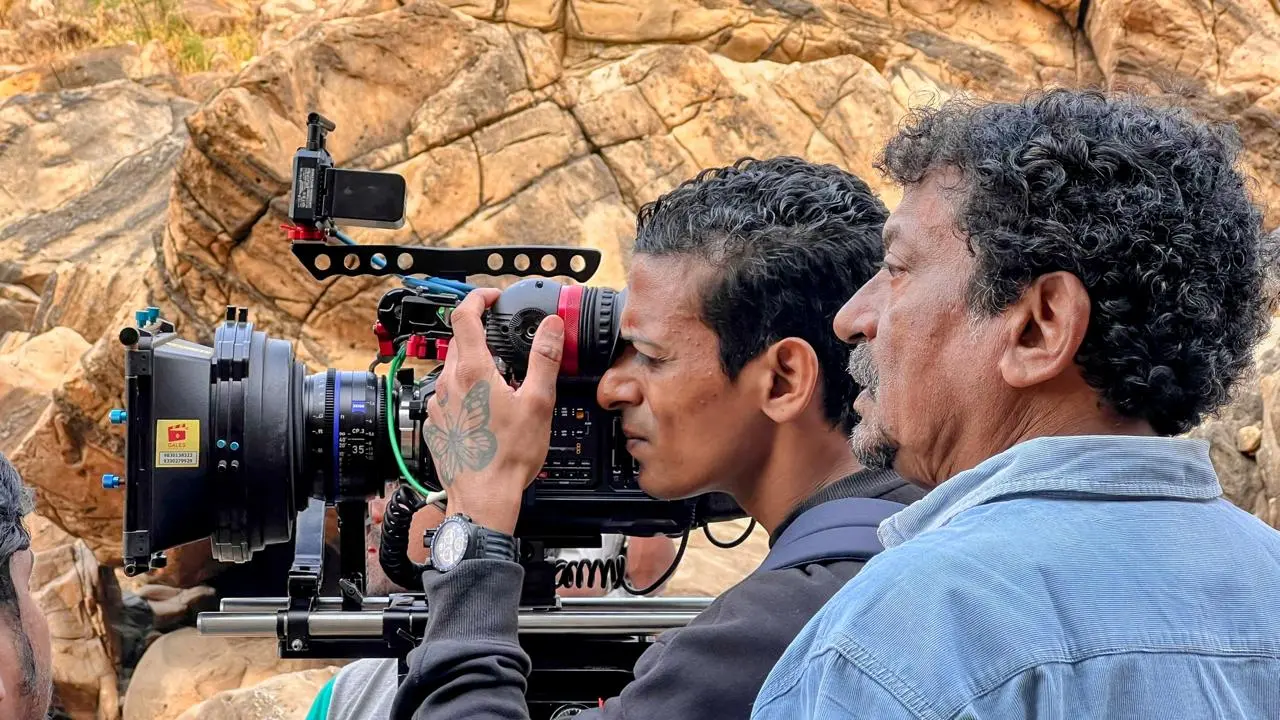
Parikrama is a dream of a film for any cinematographer anywhere across the world because the father-son duo of Goutam Ghosh and Ishaan Ghosh who together won an international award for the cinematography have produced technically brilliant and aesthetically rich work. Yet, though the river is not the protagonist, it fleshes out the story of the small boy Lala (Aryan Badkul), whose spontaneous performance enriches the film beautifully which, however, cannot be said about Chitrangada Singh who joins the film crew as writer and gives an unsure-of-herself performance.
The music, the editing, are without parallel as they blend into the narrative and neither disturb nor distort. They flow along with the characters and the narrative. The sole lapse appears to be the lack of the natural bonding that ought to have evolved between Lala, the boy and Alessandro, the director. Lala is very talkative so the director-within-the-film could have quite easily got closer to him to get a closer glimpse into the tragedy of his forced migration in search of work and livelihood. This is absent.
Says Ghosh, “The idea for this film was sparked nearly twenty years ago during the premiere of my film on Dalai Lama at the Venice Film Festival. Sergio Scapagnini, the producer of that film, gifted me a manuscript of his short novel about a young boy from a small Indian village. After reading the story about the courageous boy, I saw potential for a cinematic adaptation, but I needed a broader context and backdrop for the movie.”
“Years later, I stumbled upon Amrit Lal Vegad’s book on Narmada Parikrama, which ignited my imagination. I traveled to the Narmada valley to experience the beauty of the holy river and witness the struggles of the people affected by the dams. Despite the challenges, the faith and spirit of Narmada Parikrama remained strong in the valley. This experience merged with the original story, shaping the film. Parikrama follows Alessandro, an Italian filmmaker on a journey along the sacred Narmada river, where he meets Lala, a village boy fighting for his family’s lost land. As their paths cross, their stories echo themes of loss, belonging, and identity – one without his mother, the other without his motherland.”
“In the story, the young village boy, now a hawker, meets a European writer at Juhu Beach in Bombay to share his tale, as mentioned in the epilogue. I envisioned a Western filmmaker creating a documentary on environmental displacement, whose journey takes a new turn when he encounters the hawker boy in Amarkantak, the source of the Narmada river. Intrigued by the boy’s story, the filmmaker embarks on a new Parikrama, delving into the boy’s real-life experiences,” says Ghosh.
Cinematically, the narrative is structured like the waves of the turbulent Narmada river and in one miraculous scene, the camera dives under water to give us a glimpse of an entire village, probably Lala’s, submerged underwater.
Parikrama thus, is a metaphor for life, for humanity, for the inseparable, almost unified relationship between the artist and his art against ‘development’ which might lead to the loss of huge groups of humanity forever. Lala’s life rises and falls like the waves of the river he suspects his family is lost under. A family he is so fond of.
Says Ghosh, "I think cinema is primarily a visual medium. That’s why right from my first fiction film I started designing a visual style meticulously for the subject. Cinematography in Parikrama was very challenging because after I shot the Italian scenes myself the project collapsed due to Covid. We revived the project with great difficulties and I asked my son Ishaan to join me as co DOP for the Indian shoot. The shooting was very hectic but we did it with passion and sincerity. We
could create a dynamic visual range all through. Our hard work was recognised at Asian art film festival in Macau. Father and son duo have received the best cinematography award in International competition. I think this has no precedence in world cinema.” He is right. There is none, till now.
“The multiple responsibilities of direction, cinematography, music and lyrics are no problem for me because I do them automatically, almost by reflex because I have been used to this from the beginning. As a director myself, I personally feel that the film is a metaphor on a filmmaker and his film. The struggle for survival, the spirit of endurance, the struggle to constantly innovate and improvise, the passion to reach your audience, this is as much a part of the filmmaker as it is a part of Lala, or Allesandro,” sums up Ghosh.