EXPLAINED: The Evolution of Akash Air Force Launcher
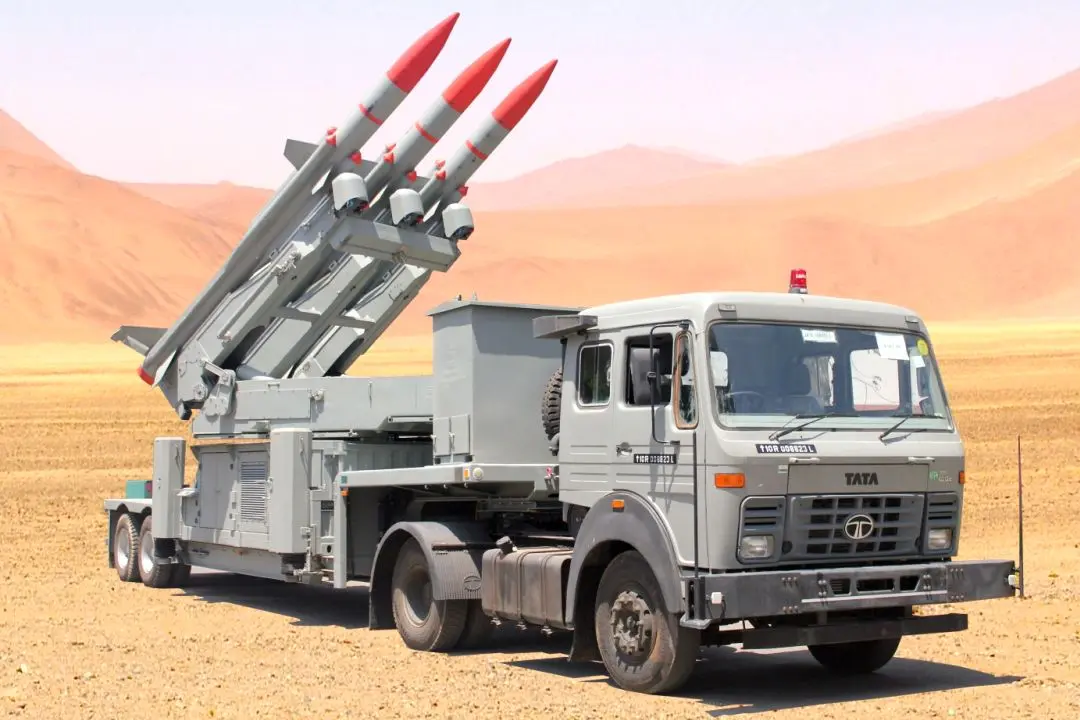
The Akash Air Force Launcher (AAFL) is a versatile weapon launch platform designed for air defence missiles. It has been developed in collaboration between Tata Advanced Systems and the Defence Research and Development Organisation (DRDO). This mobile launcher can transport and fire up to three Akash medium-range surface-to-air missiles, either individually or in a group.
The AAL is a reliable system designed to operate in any weather and at any time, day or night. It includes a self-powered, fully automated electro-mechanical launch system mounted on an 8x8 heavy military vehicle.
This vehicle is built to withstand tough environments and challenging terrains, making the AAL a popular choice for missile launch platforms due to its quick startup and shutdown times.
Akash Air Force Launcher: Key Features
* Self-powered: It generates its own energy, so it does not require an external power source. As far as the AAL is concerned, this could involve having an onboard generator or battery system that provides electricity for its mechanical and electronic components, allowing it to function independently in various environments.
* Fully automated: The system can perform its tasks without human intervention. For the AAL, this would involve:
- Automatic Launching: The system can detect targets and launch missiles on its own, using pre-programmed instructions and sensors
- Self-Diagnostics: It can monitor its own systems and identify issues, notifying operators only if maintenance is needed
- Autonomous Movement: The vehicle can navigate to its launch position without manual driving, using GPS and other technologies. Overall, it allows the AAL to function efficiently and quickly in various situations, enhancing its effectiveness in operations.
* Electro-mechanical launch system: This system uses electrical and mechanical components to launch missiles. Here is how it works:
- Electrical Components: These include motors, sensors and control systems that provide the necessary power and automation for launching. They handle such tasks as aiming and triggering the launch
- Mechanical Components: These are the physical parts, such as launch rails and mechanisms, that physically hold and propel the missile when it is time to launch
Together, these components allow the system to launch missiles accurately and efficiently, using electrical controls to operate the mechanical parts.
* 8x8 Vehicle: This term describes a vehicle with eight wheels, all of which can drive and steer. This design enhances traction, stability and manoeuvrability, especially in rough or uneven terrain, allowing it to handle challenging conditions more effectively than vehicles with fewer wheels.
The Firing Unit and Its Components
A firing unit consists of four Advanced Artillery Launchers (AALs), along with a Troop Control Centre (TCC), a Troop Level Radar (TLR) and support vehicles, such as the Transporter-cum-Loader Vehicle (TLV) and the Troop Equipment Maintenance Vehicle (TEMV).
The AALs are responsible for launching artillery shells. They are equipped with a reliable communication system that includes two types of connections to the TCC: a wireless radio frequency (RF) link, which allows for communication without wires and a physical wired link, which provides an extra layer of reliability.
The TCC acts as the command hub, coordinating operations and making tactical decisions. The TLR is a radar system that helps detect and track targets, improving the accuracy of the artillery fire. The TLV is used for transporting and loading artillery, while the TEMV handles maintenance and repairs of the equipment. Together, these elements enhance the overall efficiency and effectiveness of artillery operations.
Akash SAM System: Advanced Capabilities
Akash is a surface-to-air missile (SAM) system made in India to protect against air attacks. Developed by the DRDO and produced by the BDL, it is a short-range missile system that can defend important areas from enemy aircraft.
Akash is often compared to Israel’s Iron Dome defence system. The DRDO has announced that India is the first country to develop a system that can simultaneously target, and engage, four aerial threats up to 25 kilometres away using a single firing unit guided by commands.
Key Features of the Akash SAM System
* The Akash missile system can engage many targets at the same time in both group and autonomous modes
* It is equipped with electronic counter-counter measures (ECCM) to overcome enemy jamming and evasion tactics
* The entire Akash system is mounted on mobile platforms, allowing for quick transportation and enhanced agility
* Its mobility increases survivability by relocating after firing missiles to avoid enemy counter-attacks
* The Akash system can intercept UAVs, smaller projectiles, helicopters and aircraft, similar to Israel’s Iron Dome
* Primarily designed for defence against larger aerial threats, such as aircraft, rather than smaller rockets
* Capable of hitting targets between 4.5 km and 25 km with an altitude range of 100 metres to 20 km
* The missile is 5,870 mm long, of 350 mm diameter and weighs 710 kg, with quick response time and adaptability to various air defence scenarios
The author of this article is a Defence, Aerospace & Political Analyst based in Bengaluru.