A voice unwithered: Asha Bhosle's hidden film gem and the tragedies behind her smile
“Age could not wither her, nor custom stale her infinite variety.” This is a famous quote from William Shakespeare's play Antony and Cleopatra (Act II, Scene II), spoken by the character Enobarbus to describe Cleopatra. It praises her timeless allure, suggesting she remains exciting and desirable regardless of age or familiarity. Asha Bhosle was no Cleopatra, true. But eighty years of a career in singing – 20,000 songs in around 800 languages, surely fits this description reserved for Cleopatra.
Asha Bhosle who breathed her last at a Mumbai nursing home on April 12 at the mellow age of 92, gave her last recorded performance hardly two months ago. She last lent her voice to Gorillaz’ Album The Mountain where she sang the track, The Shadowy Light which released on February 27 2026.
Born in 1933, Asha was the third or fourth child of Pandit Dinanath Mangeshkar and was born in Sangli, which was then within Goa, on 8th September 1993.
Dinanath Mangeshkar was famous for his command over Hindustani classical and Marathi Natya Sangeet so the small house was filled with the air of music since the very childhood of the children, - Lata, Meena, Usha, Asha and the only son Hridaynath. But the father died when the children were very young, reportedly of alcoholism and the family was steeped in poverty.
The family moved to Bombay where both Lata, the eldest and her sister Asha, began singing in films and sometimes, even acting. “My first stage performance happened in 1943 when I was just ten years old and found myself on a stage with a microphone standing in front of me. I had no idea what a microphone was and was quite nervous because I was not at all sure of my musical talents. I used to believe that it was only Tai (Lata) who could sing. But that first performance, filled me with the confidence of my ability that in fact, I could sing,” she once said in an interview.
She still holds the world record in terms of carrying on with her legacy of music for eighty long years right across the globe and also, for winning the largest number of awards one could imagine.
In a career spanning over eight decades, she won two National Film Awards, four BFJA Awards, eighteen Maharashtra State Film Awards, nine Filmfare Awards including a Lifetime Achievement Award and a record seven Filmfare Awards for Best Female Playback Singer, in addition to two Grammy nominations.
In 2000, she was honoured with the Dadasaheb Phalke Award, India's highest award in the field of cinema. In 2008, she was honoured by the Government of India with the Padma Vibhushan, the second-highest civilian honour of the country. The Guinness Book of World Records acknowledged her in 2011 as the most recorded artist in music history.
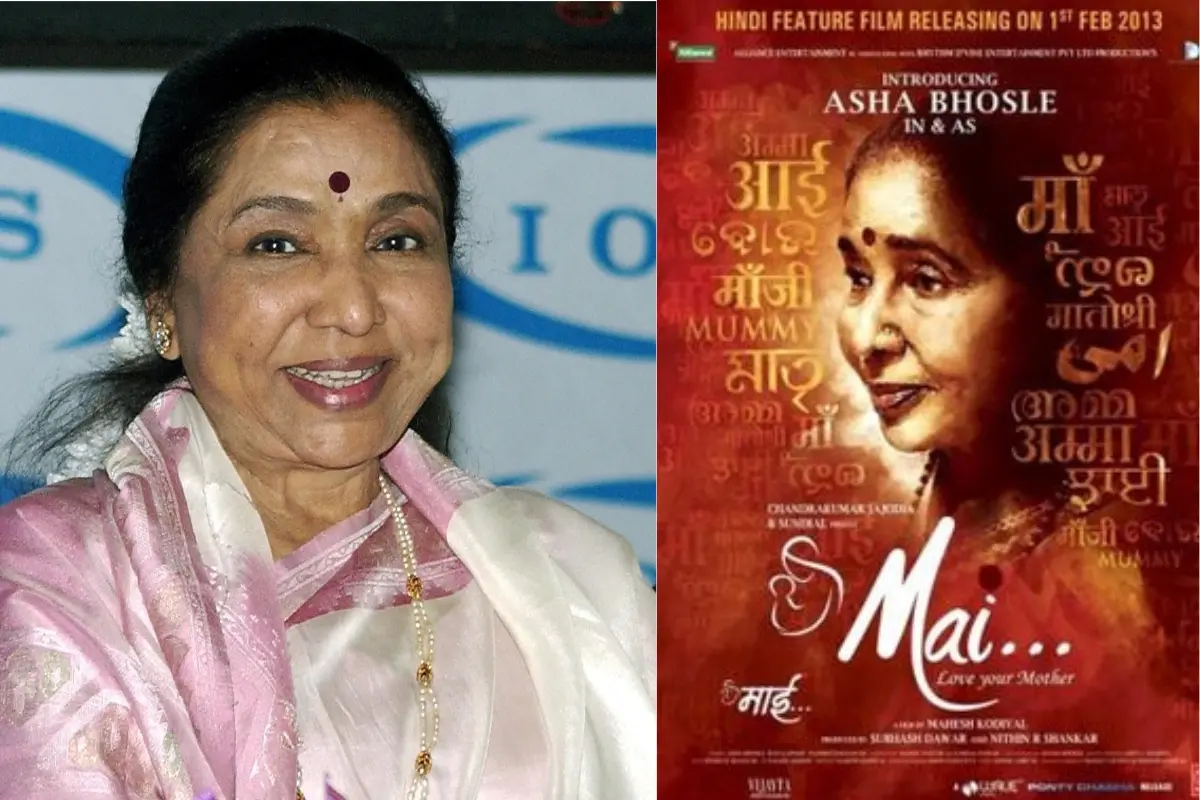
But very few of us are aware that Asha Bhosle also acted in a Hindi film called Mai (Mother) in the title role. She was a ‘young’ 79 then and enacted the main role of an aged mother who is slowly losing her memory as a victim of Alzheimers’ Disease. The film was released in 2013 with some lovely music composed by Nitin Shankar.
The story is very relevant in today’s Indian cities where grown-up children are loathe to take on the responsibilities of aged parents.
Mai is one such parent who, her only son, sends off to his eldest sister’s house on the false excuse that he is migrating to the US which is revealed to be a lie. So Mai arrives at her eldest daughter’s house (Pallavi Joshi) married to a successful journalist (Ram Kapoor), holds a job herself and has a teenaged daughter who is loathe to share her bed and room with Mai. The son-in-law too, is not too pleased with this unwelcome guest but begins to accept her with the warmth she deserves when he finds that his wife is willing to give up her promising job just to take care of her mother.
Problems begin to accelerate when Mai is discovered suffering from rapidly enhanced Alzheimers Disease and keep forgetting everything and everyone. The end is a foregone conclusion but the prize of the film is the natural and spontaneous performance of Asha Bhosle in the title role. She brings out the confusion of an aged old woman who does not quite know where she belongs yet keeps remembering the son who betrayed her faith in cold blood.
No fan of Asha Bhosle could have ever imagined that a voice like she owned and trained in could turn a magical performance in films as well. But she knew where to draw the line and never acted ever again.
Bhosle dedicated the film to her mother, who was also lovingly called "Mai". About her acting experience she says that she did not find acting difficult but also states that this will be her "only experiment with acting."
She was so full of fun and vigour, that no lay person could guess the personal tragedies that riddled her personal life which she preferred always to keep within her best-kept secrets.
She eloped with an aide, Ganpatrao Bhosle in 1949, at the age of 16 and married him, but her mother, Lataji and the entire family cut off from her though she continued with her tapasya in music. The marriage did not work and Asha came back to her mother and sisters and brother with two little kids in tow and pregnant with a third one.
Some say that Ganpatrao committed suicide soon after she left him but others say that she could not live on in an abusive marriage. Hemant, the eldest, died of cancer in 2015.
Hemant was a music director of considerable talent, having composed songs like "Jage jage nainon mein" for 'Damaad', Marathi bhavgeet "Shaarad sundar" and "Yeu kashi priya", all of which his mother sang. 'Shraddhanjali' and 'Nazrana Pyar Ka' became popular too.
Her only daughter, Varsha Bhosle, was a journalist of some renown but she suffered from deep depression and reportedly shot herself to death in 2012.
Anand, her youngest son, who is settled in the US with his wife, stood like a solid iron wall behind his mother, managing her musical career, her travels and tours, her media coverages and last but never the least, the ten restaurants Ashaji began right across the globe under the name Asha’s specializing in North Indian cuisine.
She is said to have been a very good cook of mainly Maharashtrian recipes and is reported to have once said that had she not become a singer, she would have become a Chef.
Her persistence, with a creative boost from the masters Ghulam Mohammed, OP Nayyar and later R. D. Burman, paid off and hoisted her firmly on an equal but independent pedestal among the top female singers of that era. She may have passed on but her voice and her songs will remain for generations together, forever and ever.