Article 370 vs Main Vaapas Aaunga: Two political films, two directions in filmmaking
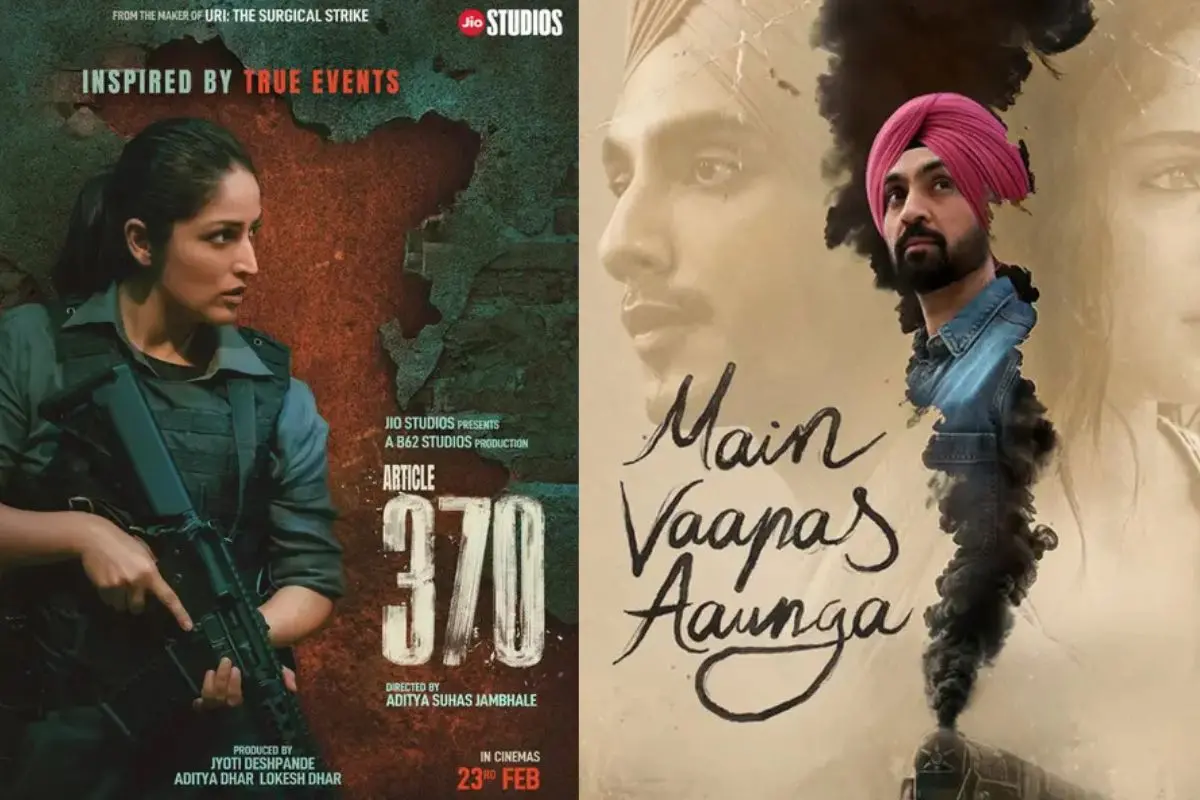
National Film Awards are increasingly becoming political. No wonder a crass propaganda film, Article 370, has been bestowed the Best Film award at the 72nd National Film Awards. At the 71st Film Awards, the director of The Kerala Story was adjudged the Best Director too. Not to talk about The Kashmir Files, which was awarded earlier.
However, in 2026, there is a breath of fresh air with the Hindi film Main Vaapas Aaunga (I Will Return), an emotional-political drama about the India-Pakistan Partition, which remains a wound in North India even today. As there is no scope for films declaring inter-religious and national integration themes, director Imtiaz Ali has turned an emotional love drama into a political film, carefully weaving a Sikh-Muslim love story and its unfulfilled pangs suffered by a dying 95-year-old man. It seems there is no scope for Hindu-Muslim love stories anymore; hence, the director has placed families of Sikhs and Muslims in erstwhile Western Punjab, which is part of Pakistan now.
The dying old man Ishar Singh Grewal, portrayed by veteran actor Naseeruddin Shah, and his grandson, to whom he responds about his pain and pangs of the past, carry the film. But there is the whole unearthing of life in a pre-Partition Pakistan town near Lahore, namely Sargodha, where the old man grew up and escaped to India as a college boy while being desperately in love with a Muslim girl. The young Grewal (Keenu) had promised Afsana/Jiya, whose family was part of the progressive writers’ movement of the town, that he would never leave the town without her, but could not keep his word. They all believed that there was a space for liberals despite Partition and that they could continue to live in their ancestral places, but were rudely shocked as the Sikh family was forced to leave. The Muslim family decided to secure the women of the Sikh family as the men fled the violence, seeing their farms being burnt. The women who were secure in the Muslim family were attacked by rioters, and the grandmother killed the young girls to avoid their inhuman rape and murder.
That being the main story, the film unfolded through the grandson Nirvair, a stand-up comedian, who descends from London to be at the deathbed of his grandfather. As the traumatised grandfather struggles with death, he decides to leave, only to be prevented by his father, who asks him to help the dying soul give closure to his story. The dying lover wanted to apologise to his college lover Afsana for not keeping his word of not leaving without her after Partition. The grandson explores the Sargodha family and finds that indeed the old man had visited the town searching for Afsana in the 1950s, only to find her married. Grandfather Grewal had returned with a heavy heart without meeting her and without apologising for leaving the town. The death wish made the grandson do another search, this time showing the old man through mobile video the places, and he ends up at Afsana’s house, only to find her dead and her own daughter speaking to them in front of a huge portrait of her mother. The old man realises he cannot apologise to anyone and closes his eyes eternally.
This straight love story has been woven into a complex narrative of over two hours by the filmmaker, maybe to avoid or water down the heavy liberal social-political message, which would not be palatable to the existing regime in India now. The film narrates this pre-1947 love story through a complex web of the successful Grewal family of three generations, the grandson who is based in London and is also in love, and a brother who knows the story but is equally at pains. Two or three stand-up comedy sessions by the grandson make it even more diluted. To the extent that one feels the director has become an apologist for promoting his liberal values of love and affection beyond religion and even beyond borders. There is indeed a sequence where the drawing of the India-Pakistan border by the British expert is mocked at, clearly revealing the historic idiocy of such an act, especially of the division of an ethnic community like the Punjabis.
The best scenes of the film hence become the pre-Partition sequences, where the brotherhood is shown beyond religion and the love affair between young Grewal and Afsana. The slow poisoning of society is also well narrated, especially when Grewal wears a Muslim hat over his Sikh turban twice in the film. First to visit his lover and then later tries to smuggle himself back to Pakistan to search for women of the house and get back to his lover. On both occasions, he is badly caught and rebuffed in his efforts. The death of an injured father on the desperate train journey to Amritsar is another touching scene. So is the murderous attack by miscreants on the house of a Muslim family friend of Grewal who was hosting the women of the Sikh family. The chilling scene of the grandmother killing young girls to avoid a brutal attack from the miscreants echoes in the words of the dying old man, when he says the family has a curse on its women as they were left to die tragically.
While the film Main Vaapas Aaunga creates such an emotional impact on viewers, the film Article 370 raises the political graph in favour of the ruling party at the Centre. The film has even the present Prime Minister and Home Minister as characters, acted out by lookalike persons. The central character is an intelligence officer, a woman, Zooni Haksar, who hates back-channel activities with terrorist groups and wants to eliminate them all. She did so with one popular one and was transferred to Delhi. Here she is picked by the system to head a special group to prepare the place for the abrogation of Article 370, which gives special constitutional status to Jammu and Kashmir. She became part of the deep state and politicians who wanted to delete Article 370. She is shown as an effective officer who can get the missing clauses of the constitutional papers and also control the local situation for the smooth proclamation of Article 370. She has a personal grudge against the former Chief Minister, whose system ensured her father’s exposé of the local bank frauds went to waste, leading to his “suicide”. She, in the end, takes care of the former Chief Minister by handing over a file with his own scams. The film is full of vengeance and hurt feelings of a group of people and also politicians whose only remedy for all the ills of the State is an article in the Constitution. Nowhere do the people come in as the affected party, and the characters remain as terrorists, the villain and the State as the punisher. The film almost glorifies the killings and shows the State as all-powerful and all-knowing. True to its genre, a propaganda film made to justify the acts of a ruling party at the Centre. It is not surprising that the lead character played by Yami Gautam Dhar, who is the spouse of Aditya Dhar, producer of Dhurandhar films, is given the Best Actress award too.
While the Imtiaz Ali film struggles to justify its interreligious harmonious society of the past, there is no such contradiction with the director of Article 370, Aditya Suhas Jambhale, as he is crystal clear that it is a film to justify the abrogation of Article 370. As a one-sided political statement, he justified the suppression and house arrest of all opposition leaders and showed the government as the absolute arbitrator of justice and truth. Indeed, the film is like the Nazi propaganda films which hail the Führer as the messiah. Here there is no Führer; the ruling party and State take the leader’s (Führer’s) place.
The film also gives a sharp exposure of what a political film does. The Imtiaz Ali film made a wave in North India, which still carries the wound of the India-Pakistan Partition, and Article 370 enthused the support of the present regime. Both were hits at the box office, and Article 370, made with a modest budget, made four times its investment for the producers. A film with full support of the State can never fail, while a film which reaches people through its own narrative has to try hard to reach its audience. But people never failed the film Main Vaapas Aaunga, as it made a mark in North India, though critics and film buffs will rate it down due to its structural issues to please the system.
National Awards were instituted 73 years back to flag the best trends in filmmaking in India. It seems the best for the present regime is the propaganda films which justify its political decisions, going by the honours it bestows on films like Article 370.
(VK Cherian is author of the book on history of Indian film society movement, "Celluloid to Digital: India’s Film Society Movement”)