‘Festivals are expensive, legally and politically’: Inside the perils of arts management
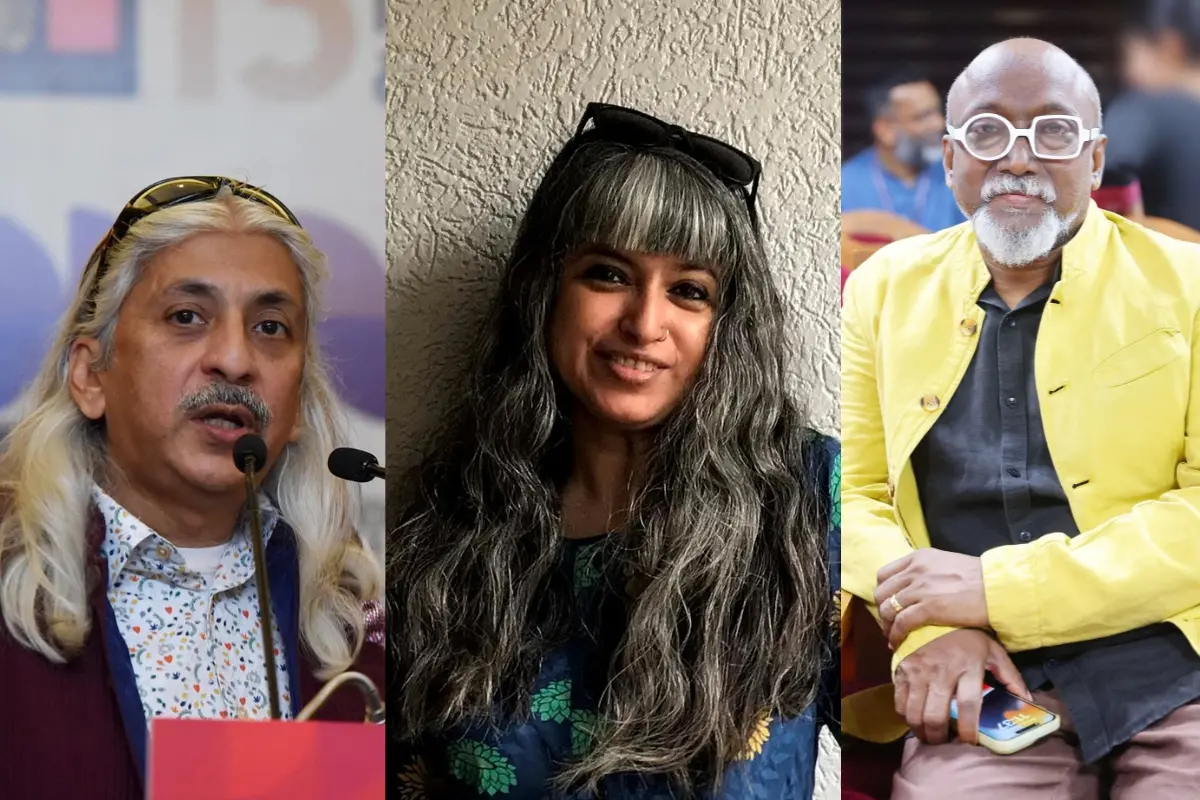
Running a cultural festival or art institution in India involves far more than curating ideas or celebrating creativity. It requires navigating legal threats, political pressure, financial uncertainty and bureaucratic systems that rarely understand artistic labour. These realities were laid bare during the session “Perils of Arts Management” at the seventh edition of the Mathrubhumi International Festival of Letters (MBIFL).
The session brought together Sanjoy K. Roy, Managing Director of Teamwork Arts and founder of the Jaipur Literature Festival; Bose Krishnamachari, artist and co-founder of the Kochi Muziris Biennale; and Arundhati Ghosh, former Executive Director of the India Foundation for the Arts (IFA). Moderated by Sanjay Kumar, Director of Sakshi Gallery, Mumbai, the discussion moved beyond celebration to examine the structural pressures that shape arts management in India.
The conversation focused on the structural, political and economic challenges of sustaining cultural institutions and large-scale festivals in India.
Accessibility and inclusion challenges
Arundhati Ghosh highlighted the difficulty of ensuring access in a country marked by linguistic and socio-economic diversity. “How do you remain accessible in a country so diverse in language, privilege and geography?” she asked, referring to the complexities of running a funding organisation like IFA.
She noted that IFA accepts grant proposals in 36 Indian languages to widen participation, but this inclusivity comes with logistical challenges. She also stressed the importance of skilled personnel in the sector. “In an organisation like ours, you are only as good as your people,” she said, pointing to difficulties in retaining talent in the arts ecosystem.
Bureaucracy and technical burdens in exhibitions
Bose Krishnamachari spoke about the often invisible logistical and bureaucratic challenges behind international exhibitions. “The perils are not just intellectual. Transporting artworks, customs duties, insurance — these are nightmares,” he said.
He also criticised the lack of understanding within official systems about artistic labour. “Government audits don’t understand cultural work. They treat an artwork like cement value and sculpture value — they don’t understand time, process, or artistic labour,” he said.
Political pressures and legal risks
Sanjoy K. Roy addressed the political realities of managing festivals, noting that cultural platforms often become sites of controversy. “What people forget is that festivals are expensive, not just financially, but legally,” he said.
Referring to the Salman Rushdie controversy at the Jaipur Literature Festival, Roy warned against self-censorship. “If we start programming out of fear, that’s the end,” he said, while acknowledging the need for pragmatic survival strategies. “We are conscious that the platform must survive. You have to push boundaries without shutting the door on yourself.”
Ghosh recalled an incident involving a theatre production funded by IFA that faced threats from a political group objecting to its title, raising concerns about artist safety and real-world risks associated with cultural programming.
Role of the state and funding
The panel discussed the role of government in supporting the arts, agreeing that state support is necessary but should focus on infrastructure rather than control. “Arts need funding. Philanthropy alone is not enough,” Roy said, arguing that cultural initiatives contribute to local economies and community life.
Krishnamachari emphasised dignity in cultural funding. “Self-respect is important in culture building. Funding should not come with conditions about portraits or political proximity,” he said.
Despite the challenges, the speakers reaffirmed that questioning power remains central to artistic practice. “If art isn’t questioning, it becomes vanity,” Roy said, summarising the ethos of the session.