From Panipat to Bengaluru: Re-reading the Maratha Empire legacy at MBIFL 2026
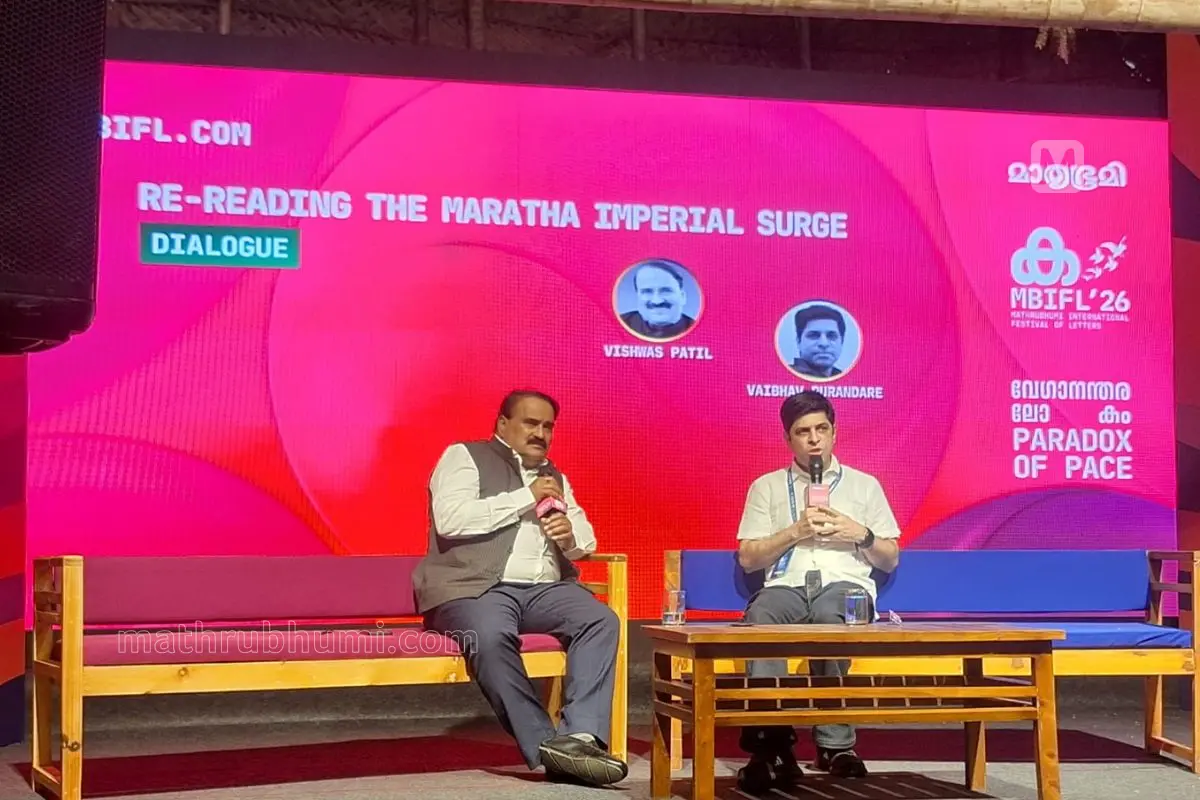
Thiruvananthapuram: At the Mathrubhumi International Festival of Letters 2026 (MBIFL), historians and authors Vaibhav Purandare and Vishwas Patil revisited the Maratha empire in a session titled “Re-reading the Maratha Imperial Surge”, exploring its military strategies, administrative ingenuity, and enduring legacy.
Purandare, author of Tilak: The Empire’s Biggest Enemy and Shivaji: India’s Great Warrior King, and Patil, Sahitya Akademi Award-winning Marathi author of Mahanayak and Ambi, offered a nuanced view of Maratha history, challenging commonly held perceptions.
“The Maratha cavalry reached all the way to the Atak,” referencing the border region of Afghanistan and Pakistan. “Today, with mobile phones, emails, and instant communication, we take connectivity for granted. But in those days, journeys were on horseback or camelback. For the Marathas to reach the Afghan border was a remarkable feat of organisation, endurance, and creativity.”
The discussion touched on the Third Battle of Panipat, often considered an unmitigated disaster. “Panipat was far more complex than that. They faced Ahmad Shah Abdali’s forces, suffered setbacks, yet within ten years, the Marathas rose again stronger than before. It was one of the greatest battles of the medieval era—over 140,000 people and 80,000 animals died in a single day. To put it in perspective, Hiroshima and Nagasaki caused fewer immediate casualties.”
While exchanging the dialogues, they emphasised the strategic and ethical dimensions of the Maratha campaigns. “Whenever a victor achieves their target, the first goal is to seize power. But Abdali left Delhi trembling, fearful even after victory. The Marathas, on the other hand, fought for a cause larger than themselves—they died not for their own kingdom, but in service of the nation.”
Patil added context on the broader Maratha expansion. “People think the Marathas only expanded north and south after Shivaji Maharaj’s coronation. But it began with his father, Shahaji Raje, who established a jagir in the south, including modern-day Bengaluru. Shahaji’s administration laid the groundwork for Shivaji’s campaigns decades later. Even his stepbrother Venkoji went on to establish the Maratha state of Tanjore.”
The conversation highlighted the logistical brilliance of the Maratha armies. Purandare described the complex support systems needed to sustain large cavalry forces: “Horses, bullocks, and elephants required constant care. Each horse had a dedicated caretaker. Thousands of buffalo were reared to provide water and resources. The armies operated with limited communication yet managed large territories effectively.”
Both speakers reflected on the Maratha military strategy. “Aurangzeb sent over a million troops to crush the Marathas, yet despite their overwhelming numbers, he failed. The Marathas, often numbering just over 100,000, used hill forts, guerrilla tactics, and strategic brilliance to defend and expand their empire. Leaders like Shivaji, Sambhaji, and later Bajirao displayed extraordinary mastery over terrain, mobility, and logistics,” Purandare explained.
Patil also highlighted the cultural and historical significance of these campaigns. “The Maratha expansion was not merely a regional phenomenon—it was national history. From the Deccan to the north, they laid the foundations of an empire. Their story is about resilience, strategy, and a commitment to principles beyond personal gain.”
The session concluded with reflections on the legacy of the Maratha empire. “History is often simplified,” Purandare noted. “But when we examine it closely, we see leadership, organisation, and courage on a scale that continues to inspire. The Marathas’ ability to fight, administer, and govern with limited resources is a lesson in ingenuity, discipline, and vision.”
Patil echoed the sentiment: “The Maratha story is not just about battles—it is about statecraft, strategy, and the spirit of a people who shaped India’s history.”