Borders, history and uncertainty: India and her neighbours at MBIFL
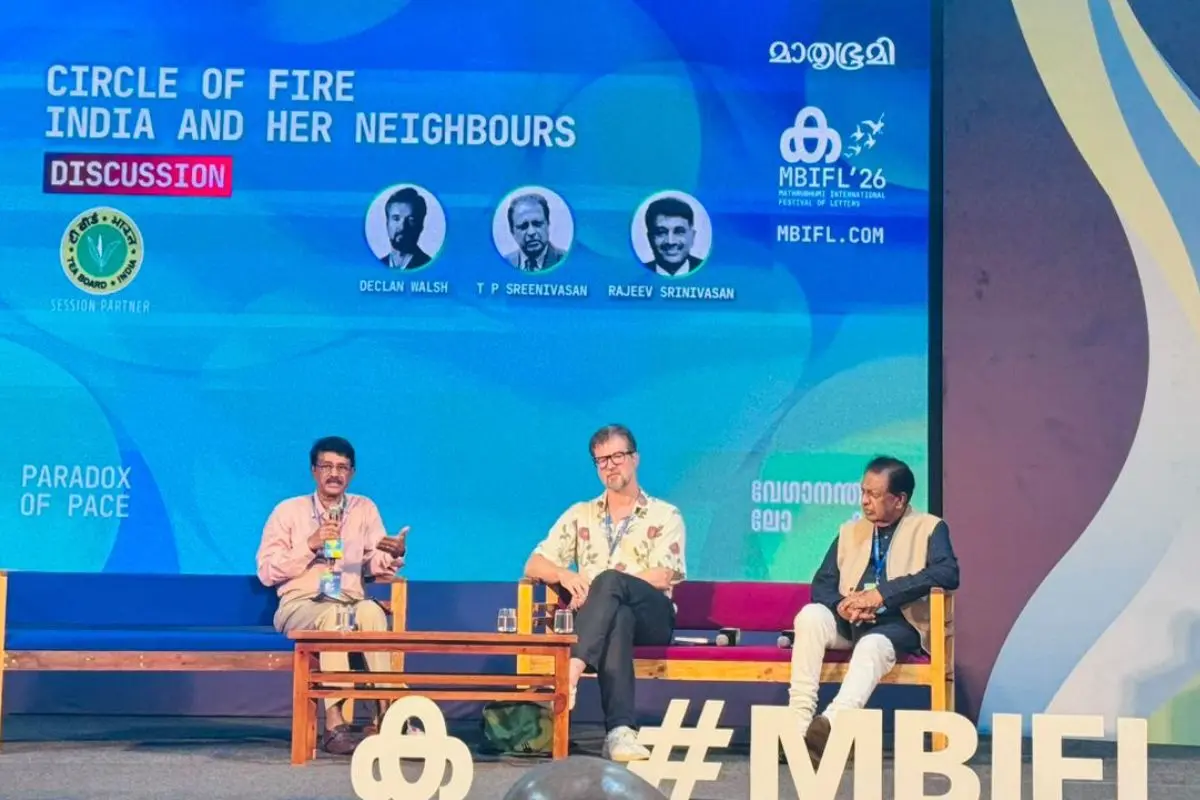
At Circle of Fire: India and Her Neighbours, a session at the Mathrubhumi International Festival of Letters (MBIFL), the conversation moved fluidly between history, personal anecdote and hard strategic reality, anchored by former Indian diplomat T.P. Sreenivasan and author-journalist Declan Walsh, both veterans of decades spent watching borders shift, alliances fray and certainties collapse.
T.P. Sreenivasan opened with an unexpected literary reference. Long before geopolitics became a television spectacle, he said, Vaikom Muhammad Basheer had already grasped the fragility of regional friendships. “He once said India would end up with two enemies instead of one,” Sreenivasan noted, suggesting that Basheer instinctively understood that India’s relationship with Bangladesh was never destined to remain uncomplicated.
Bangladesh, Sreenivasan argued, remains one of India’s most sensitive eastern flashpoints. With elections approaching, rising violence, and a visible reversal of sentiment, the mood is volatile. India’s role in Bangladesh’s liberation in 1971, he pointed out, has never been fully acknowledged. Today, the prospect of Pakistan and China working in tandem, alongside a politically unstable Bangladesh, signals turbulence ahead.
Declan Walsh, Pulitzer Prize–winning journalist and international correspondent, widened the frame. Having spent years reporting from Pakistan and Afghanistan, he said India-Pakistan tensions were always “front and centre, yet lurking in the background”—a constant hum beneath daily life. Walsh contextualised South Asia within a shifting global order, marked by the rise of middle powers and the erosion of old certainties.
“The Trump era accelerated a reordering that was already underway,” Walsh said, pointing to countries like Turkey asserting industrial and strategic influence alongside—or in competition with—the United States. His current work in Africa, he added, reveals similar patterns: regional powers testing limits as global authority fragments.
ALSO READ | Africa is the ultimate battleground of time; Declan Walsh explains why
When the discussion turned squarely to Pakistan, the mood sharpened. Walsh noted that the Indus Waters Treaty had long remained sacrosanct despite recurring crises. That stability, however, fractured after the Pahalgam attack and Operation Sindoor. The greatest danger, he warned, lies in miscalculation. “The India–Pakistan relationship is not just hostile—it’s unpredictable,” he said.
Sreenivasan was more dismissive of Pakistan’s strategic heft. Calling it a “much smaller and weaker country,” he argued that India inflates Pakistan’s importance by responding to every provocation. “What are we afraid of?” he asked, recounting a visit where airport officials told him there was only one gate in the airport. “We’ve given them a larger-than-life image.”
He was particularly critical of India’s decision to internationalise Kashmir by taking it to the United Nations decades ago. “Had we settled it on the battlefield, it might have been easier,” he said bluntly. Today, he argued, India receives little credit for secularism or scientific progress, while the conversation is continually reduced to demands for territorial concession. Pakistan’s most persistent justification—that “freedom fighters are also terrorists”—has only muddied global perception.
ALSO READ | A democracy built under pressure: Revisiting Ambedkar and the Poona Pact
Yet the neighbourhood is not uniformly hostile. On Nepal, Sreenivasan struck a surprisingly optimistic note. A recent visit to Kathmandu, he said, revealed deep goodwill among ordinary citizens. Political instability remains Nepal’s weakness, but India, he argued, stands to gain from patience. “Nepal has far more to gain from stability than we do,” he said, suggesting relations will eventually normalise.
Walsh turned attention westward, to Afghanistan and Iran. Having witnessed the Taliban’s resurgence firsthand, he described a region still grappling with the consequences of American withdrawal. Iran, meanwhile, faces renewed instability amid threats from the Trump camp, deepening uncertainty across West Asia.
Sreenivasan broadened the map further—Myanmar, Sri Lanka, the Maldives—calling these countries pragmatic rather than ideological. “They are exploiting the space created by India–China rivalry,” he said. Myanmar, once India’s most reliable neighbour, now negotiates even basic trade cautiously. Sri Lanka and the Maldives, he added, are keenly aware of their leverage between competing powers.
ALSO READ | ‘Bearing witness still matters’: Pulitzer winner Declan Walsh on journalism in the age of repression
China loomed large over the discussion. Sreenivasan recalled Beijing’s phrasing after the 1962 war—“We wanted to teach India a lesson”—a line repeated during Ladakh tensions decades later. “China sees itself as the centre of the world,” he said. Nehru’s belief that India and China could dominate together was, in hindsight, a misreading. “They want us to learn a lesson,” he said. “We just refuse to.”
Turkey’s alignment with Pakistan, alongside Iran, was cited as another complicating axis in the regional puzzle—less about ideology, more about strategic commitment.
What emerged by the end of the session was not a neat roadmap, but a clear diagnosis: India exists in a ring of constant negotiation, where goodwill is fragile, power is relative, and missteps carry long shadows. The fire, as the title suggested, is not always explosive, but it is always burning.