Beyond the Birthday celebrations; What Amma awakens in those who meet her
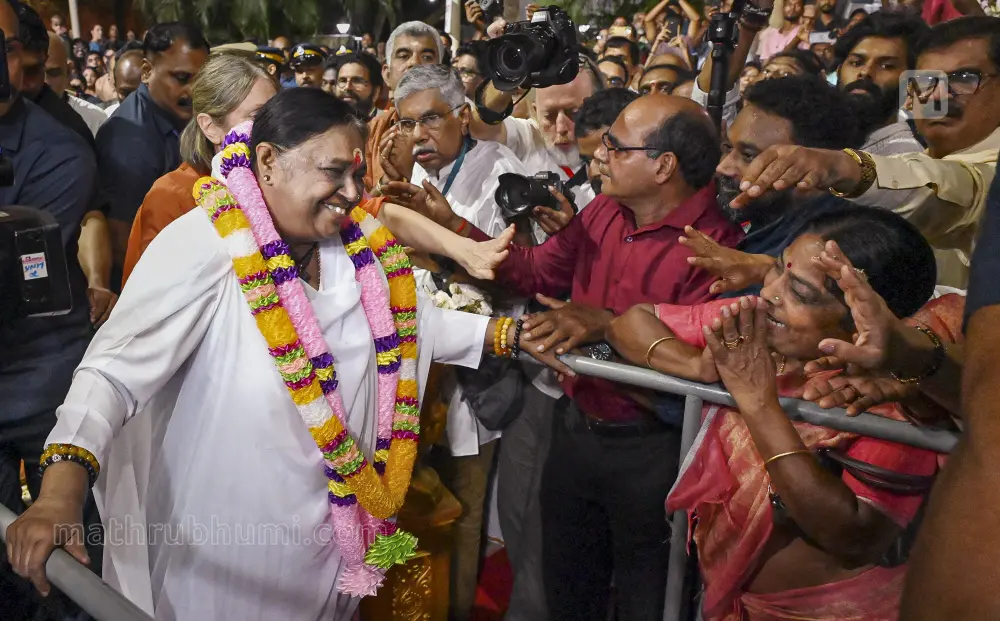
Mata Amritanandamayi celebrated her 73rd birthday in Amritapuri (Vallikavu) on 26 and 27 September, felicitated by lakhs of devotees and well-wishers, including a galaxy of notables, from the Vice-President and the Home Minister of India to the Chief Minister of Kerala and the Ambassador of Nepal (to whom she handed over a cheque of Rs 2 crore for disaster relief). But beyond all the panoply and fanfare, I found myself wondering what happens to a person when he comes into her ashram.
Someone may arrive without much kindness left in him. He may leave with a little more compassion. Someone may have lived without enough love. Here, he may discover that he still has love to give. Someone may have become hard through the disappointments of life. A few moments around her can make him gentle again. And someone who has not been particularly good may, for reasons he cannot quite explain, feel like becoming better.
What is it about Amma? I do not know whether it can be explained. I only know that it can be felt.
That is where I would like to begin today—not with Amma as an institution, not with the years of her life, and not even with all that has been built around her, but with this very simple experience: what happens to a human being when he comes into the presence of Amma. Because that, to me, is where the meaning of her life begins.
There are many ways of describing a life. We can speak of the years, the achievements, institutions, charitable work and the millions of people who have been touched by it. All of that matters. But there is another measure of a human life which does not appear in any report.
How many people became a little less lonely because you were there? How many found courage when they had very little left? How many learned to forgive? How many discovered that giving something away can bring greater happiness than possessing it?
Those are things that cannot easily be counted. Yet they may tell us more about a life than numbers ever can. This is what I find so moving about Amma. When a person learns to forgive without keeping an account, to love without asking who deserves that love, and to help without calculating what may come back in return, something changes in that person. The self becomes a little smaller. The world becomes a little larger.
Our traditions have given many names to such a state of being. They have spoken of compassion, of service, of seeing the divine in another human being. The divine, in that sense, is not about power. It is about the highest possibilities within us. And perhaps that is why Amma is not merely a name, connoting the maternal protectiveness that she evokes in all those she embraces.
It is a word people use when they feel that they have found a place where they can be received without being judged, where their suffering need not be explained before it is understood, and where giving and caring are treated as natural parts of being human.
We live in a world that badly needs such a reminder. We have travelled further into science and technology than any previous generation. We can communicate across continents in seconds. We can see distant planets, alter the building blocks of life and place extraordinary powers in human hands. And yet, we have not learned how to live peacefully with one another.
Wars continue. People are still driven from their homes. Children are born into conflicts they did nothing to create. At the same time, enormous wealth exists in the world, while millions of people still struggle for food, healthcare, education and decent work.
This is not simply an economic problem. It is a question about what we consider important. “Development” is necessary. No society can ask people to remain poor in the name of protecting the environment. People need homes, education, healthcare, employment and the opportunity to live with dignity. But development cannot mean taking from the earth without asking what remains. The forests are not endless. Water and clean air are not infinite. Fertile soil is not inexhaustible. The richness of the natural world is not something that can be replaced once it is destroyed.
And climate change has made one fact particularly difficult to ignore: the consequences of what we do are not confined to our own time or our own country. There is another question here—a question of fairness. The world has not used its resources equally. Nor have all countries contributed equally to environmental damage. Yet the people with the least resources to protect themselves can face some of the harshest consequences.
So the challenge before us is to find a way of living in which human progress does not become another name for destroying the conditions that make life possible. That requires a change not only in technology or policy, but in the way we think.
And that is where Amma re-enters the story. Because her life does not begin with a theory. It begins with a human being: One person in need. One person who is hungry, frightened, lonely, sick or simply looking for someone who will listen. If we can care for that one person, something has already changed.
And if that feeling of responsibility grows, from one person to a family, from a family to a community, from a community to the world, then compassion becomes something larger than an emotion. It becomes a way of living.
Kerala has known this language before. Sree Narayana Guru gave us a profound vision of human dignity and equality. He challenged divisions that had become so deeply rooted in society that people had begun to mistake them for the natural order of life.
His time and Amma’s are as different as the horse-cart and the jet plane. But there is a meeting point between them: the belief that no human being should be made smaller by another human being. Today that idea has to travel even further. We cannot think only in terms of the people who live beside us. The world is too closely connected for that. Something done in one country can affect people thousands of miles away. The air we pollute does not carry a passport. A river does not stop at a border. And the decisions we make today will be inherited by people who have not yet entered this world.
We are living in the middle of a long human story. We did not begin it; we will not finish it. We have only been given our portion of it to write. That should make us more careful about what we leave behind.
This is where Amma’s message of love, inclusion and peace acquires a larger meaning. It is found in very small things: Can we forgive someone? Can we help someone who cannot repay us? Can we make room for someone who feels excluded? Can we treat another person with dignity even when there is nothing to gain from doing so?
Can we leave something good behind for someone whom we will never meet? These are not extraordinary acts. But a life made up of such ordinary acts can become extraordinary.
“Amma” is a small word. A child says it before knowing anything about philosophy, religion or the world. It means: there is someone here for me. Perhaps that is why the word has such power.
People may come to Amma from different countries, different religions, different cultures and very different circumstances. They may have little else in common. But the word that unites them remains the same: Amma. A word for care, for refuge, for love. And, at its deepest, a word for that part of human nature which still knows how to give without asking what it will receive.
On this birthday, we can count the years of Amma’s life. We can speak of what has been built, what has been achieved and how many people have been helped. But I would rather remember something more difficult to measure. The person who came to her angry and left a little calmer. The person who came to her lonely and found companionship. The person who had stopped believing in kindness and encountered it again. The person who came looking for help and, somewhere along the way, discovered the desire to help someone else.
Those changes may never appear in a balance sheet. But they are real. And they may be among the finest things one human being can give to another. That, to me, is the enduring meaning of Amma’s life: Not simply that she has done many things, but that she has reminded people of something within themselves: The capacity to love, to forgive, to care. The capacity to become better than we were.
On Amma’s birthday, that is what I would like to celebrate. Not only the years that have passed, but the goodness that those years have awakened in others. As we celebrate her life, let us also celebrate everything we can give to another human being.