When the village goes digital: Who benefits?
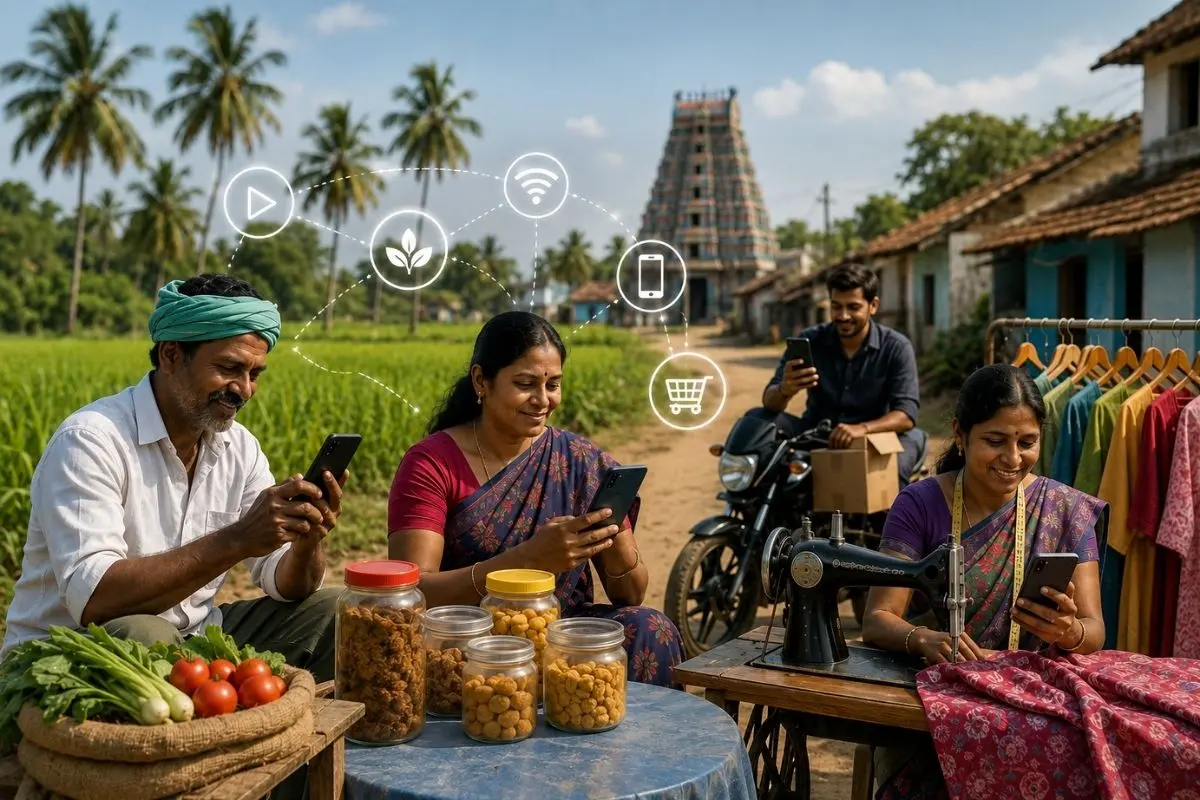
By August 2026, nearly 98% of India’s villages have 3G/4G mobile connectivity. But connectivity alone does not guarantee inclusion. Experiences from rural Tamil Nadu show how digital technologies are creating new livelihood opportunities while also exposing a new divide between those who can turn access into opportunity and those who cannot.
The Changing Rural Villages
For many farmers in rural Tamil Nadu, YouTube is no longer just a source of entertainment. A 45-year-old farmer in Salem told us that he routinely watches videos to learn about crop management, organic farming and sustainable cultivation. For a homemaker, WhatsApp has become a marketplace to sell homemade pickles and snacks. She also accepts her payments through UPI. A local tailor uses digital payments to make her business easier to manage, while others use WhatsApp to receive orders and find customers beyond their immediate neighbourhood.
These may seem like small and obvious changes. However, they point to a larger transformation in rural livelihoods in South India. Internet-connected smartphones are increasingly becoming part of rural livelihoods and a source of upskilling. Rural livelihoods are no longer shaped only by traditional agricultural and allied activities. They are increasingly connected to digital platforms that can bring information, skills, customers, payments and opportunities directly into the village.
The Era of Hybrid Livelihoods
What is emerging is not necessarily a replacement of traditional rural work, but its adaptation. Digital technologies are creating what might be called ‘hybrid livelihoods.’ Here, the existing skills and occupations are combined with new digital tools, markets and opportunities.
A farmer can continue cultivating while using online videos to learn new techniques and digital platforms to check prices and reach customers. A tailor can supplement traditional orders with a WhatsApp-based business model. A small shopkeeper can take orders online and offer home delivery. Young people can combine agricultural or wage work with freelancing or digital services. For women and self-help groups, social media and online training can open opportunities to market products, acquire new skills and reach customers beyond their village.
The significance lies in this diversification. Hybrid livelihoods can reduce dependence on a single, often seasonal, source of income. Villagers described using digital platforms to find work, maintain orders during lean periods, learn new activities and access wider markets. In this sense, the digital economy is changing how existing livelihoods are organised and sustained.
The Unequal Access Puzzle
However, the benefits of the hybrid livelihood era are highly unequal. Having a smartphone and internet connection does not automatically translate into digital economy access. For many villagers in our discussion, the barriers began after access: job portals and applications were often difficult to navigate because they were available mainly in English. They were also subjected to unstable networks, and the recurring cost of mobile data limited regular use. Some also relied on family members or neighbours to operate unfamiliar applications.
Trust presents another barrier. Villagers spoke of discomfort with digital payments and concerns about online fraud. One youngster reported losing Rs.500 to a fake online job listing. Many were comfortable using WhatsApp but struggled with more complex applications and payment platforms. Older devices also limited access to newer applications. Many also disclosed their worry about privacy when they had to depend on others for tasks such as entering a UPI PIN.
These experiences point to a digital divide that is more complicated than connectivity in the hybrid livelihood era. The emerging divide may not simply be between those who have digital access and those who do not. It is rather between those who can turn access into livelihood opportunities and those who cannot.
What Rural Digital Inclusion Demands
As digital technology is becoming an inevitable part of rural livelihoods, digital inclusion cannot stop with mere connectivity. The challenge is to ensure that people have the skills, confidence and support needed to engage with that connectivity effectively.
Villagers repeatedly called for free or low-cost continuing training at the village level, delivered in simple, regional-language formats. They also emphasised that training should be practical and hands-on, rather than limited to the kind of one-time awareness programmes that many perceived as less useful. User-friendly guides for agriculture, banking, marketing and e-commerce, along with local digital service centres or trained volunteers, could help first-time users navigate these unfamiliar platforms.
Safety in the digital space matters as much as affordability. Primarily, reliable mobile networks, affordable data and access to suitable devices remain important, particularly for low-income households. At the same time, addressing online fraud, cyber safety and the risks faced by people entering digital work for the first time remain crucial.
The lesson is, therefore, straightforward. Digital inclusion is not simply an infrastructure challenge; it is a livelihood and capability challenge. Connecting villages to the digital economy is only the first step. The more important task is ensuring that rural workers can participate in it with confidence, safety and meaningful economic benefit.
Whose Digital Village is it?
The digital transformation of rural livelihoods is a reality and fast-paced. Villagers are using online information to make decisions, women are building home-based enterprises, young people are finding new forms of work, and self-help groups are using digital platforms to acquire skills and reach markets. These changes suggest that technology can make rural livelihoods more diverse, connected and resilient.
However, technology alone cannot guarantee inclusion. For instance, a smartphone is effective only when people can afford the data, navigate and understand the application, trust the payment system and have support when something goes wrong. Without these capabilities, the same digital transformation that creates opportunities for some can leave others further behind.
India's rural digital transition therefore needs to move beyond the question of whether villages are ‘digital’. The more important question is what people can do with that digital tag. The real test is whether the digital village economy is becoming accessible and economically meaningful for everyone in the village.
Authors:
Dr Maneesh P
Assistant Professor (Economics), School of Social Sciences & Humanities (VISH), VIT-AP University, Amaravati, Andhra Pradesh, India.
&
Dr Ashraf Pulikkamath
Post-Doctoral Visiting Fellow, International Inequalities Institute, London School of Economics and Political Science (LSE), London, UK.
Disclaimer: The views expressed in this article are personal to the authors.