OPINIONCockroach Janta Party and the anxiety of power in India
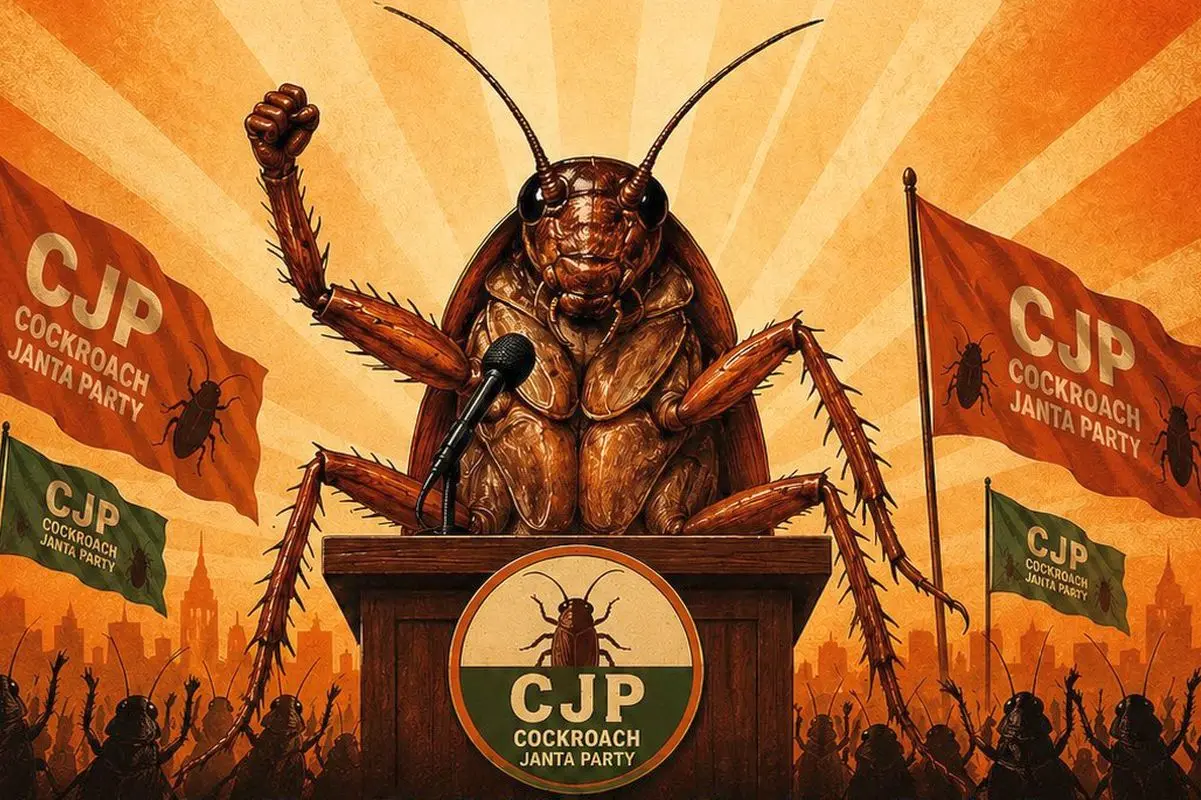
The sudden rise of the 'Cockroach Janta Party' (CJP) may look like a meme, a joke, or merely another fleeting internet phenomenon. But dismissing it as harmless online noise would miss the woods for the trees. What it actually reveals is the growing frustration among young Indians, an increasingly defensive state, and a democracy becoming visibly uncomfortable with scrutiny, satire, and dissent. The timing of the phenomenon is what makes it politically significant.
Just days before the CJP exploded across social media, Prime Minister Narendra Modi's visit to Norway had already triggered uncomfortable discussions about press freedom and political accountability in India. Norway, consistently ranked among the world's top countries for press freedom, represented unfamiliar terrain for a political leadership accustomed to highly curated public interactions.
Also Read: CJP founder's father fears viral Cockroach Janta Party fame
The Prime Minister's media appearances during foreign visits are typically carefully choreographed, with limited opportunities for unscripted questioning. When journalists in Norway attempted to raise direct questions, the visible discomfort became part of the story itself.
The Ministry of External Affairs later suggested that questions could be addressed during an official briefing. But the subsequent response from the Indian spokesperson, a lengthy and elaborate explanation to a simple question about why India should be trusted on press freedom, only intensified criticism because it appeared to avoid the core issue altogether.
This matters because India's press freedom concerns are no longer confined to activist circles or opposition rhetoric. India currently ranks 157th out of 180 countries in the World Press Freedom Index published by Reporters Without Borders, a ranking the government disputes, but one that nevertheless reflects growing international concern about media intimidation, concentrated media ownership, legal pressure on journalists, and shrinking space for independent criticism.
Into this already tense atmosphere came the now infamous 'cockroach' remarks. The controversy erupted after Chief Justice Surya Kant, in remarks captured on video and widely circulated online, referred to sections of unemployed youth on social media as 'cockroaches'. The comments triggered immediate outrage because they were widely understood not as a narrow criticism of misinformation or fake credentials, but as a sweeping and deeply contemptuous generalisation about frustrated young Indians themselves, unemployed, digitally active, and politically angry.
Also Read: Can ‘Cockroach Janta Party’ survive and topple the government?
The later clarification only intensified the ridicule surrounding the episode. The explanation that the remarks were supposedly aimed at "youth with fake degrees" struck many observers as both unconvincing and unintentionally comical.
In fact, it opened the door to another layer of political irony, given the long-running public controversies and legal opacity surrounding Prime Minister Narendra Modi's own academic degrees, an issue that has repeatedly generated public debate, RTI disputes, and demands for transparency.
What may have been intended as damage control instead reinforced the perception of an establishment increasingly disconnected from the anxieties and sensitivities of India's youth.
The anger did not emerge in isolation. India's youth are already carrying immense frustration over unemployment, competitive exam scandals, paper leaks, delayed recruitments, and collapsing trust in institutional fairness. The NEET controversies became emblematic of this crisis. Thousands of students felt betrayed by repeated allegations of irregularities and leaks.
Reports of severe mental distress among aspirants, including suicides linked to exam pressures and uncertainty, further deepened public anger. In such an environment, language matters. When authority figures appear dismissive toward struggling youth, the reaction is not merely emotional; it becomes political. That is the context in which the Cockroach Janta Party was born. The satirical movement was reportedly started by Abhijeet Dipke, an Indian postgraduate student based in the United States, after the controversy surrounding the 'cockroach' remarks.
What began as internet satire rapidly evolved into one of the largest digital political phenomena India has seen in years. The movement adopted the cockroach itself as a symbol, turning an intended insult into an identity of resistance. Its messaging combined humour, sarcasm, unemployment anxiety, anti-establishment frustration, and criticism of political and media elites.
Also Read: Want to join ‘Cockroach Janta Party’? Here’s how the viral trend works
Within days, the numbers became astonishing. According to multiple media reports, the CJP's Instagram following surged from a few thousand to over 6 million within days, later surpassing 10 million, then 15 million, and reportedly approaching or exceeding 20 million within a week. At various points, it overtook the official Instagram accounts of the BJP, Congress, and other mainstream political parties in terms of follower count. Its X account reportedly surpassed 200,000 followers before becoming unavailable in India due to legal demands.
And that is where the story became even more revealing. Instead of ignoring the parody or politically engaging with the underlying frustrations, the apparent instinct was suppression. The withholding of the X handle immediately transformed the movement from internet satire into a larger conversation about censorship, insecurity, and democratic tolerance.
Almost instantly, backup accounts and Instagram pages multiplied, attracting even more followers and visibility. The irony is difficult to miss; the attempt to contain the satire ended up amplifying it. None of this necessarily means the Cockroach Janta Party represents an actual electoral force.
Social media virality does not automatically translate into votes, organisation, or political power. India's elections are still shaped by caste coalitions, welfare networks, party machinery, regional identities, and ground-level mobilisation. But that is not the real significance of this moment.
The real significance is that millions of young Indians appear increasingly willing to use humour and ridicule as forms of political speech. Satire has become a language of democratic frustration in a society where many feel conventional opposition politics has failed to represent them effectively.
Governments confident in themselves generally tolerate mockery. Governments anxious about public sentiment often react to satire as if it were sedition. The rise of the Cockroach Janta Party is therefore not really about cockroaches at all. It is about a generation that feels unheard, economically insecure, institutionally betrayed, and increasingly unafraid of laughing at power.
The author is a National Award winner for Best Narration and an independent political analyst. Views expressed are personal.