Between Washington’s tariffs and Beijing’s ambitions: India’s diplomatic dilemma
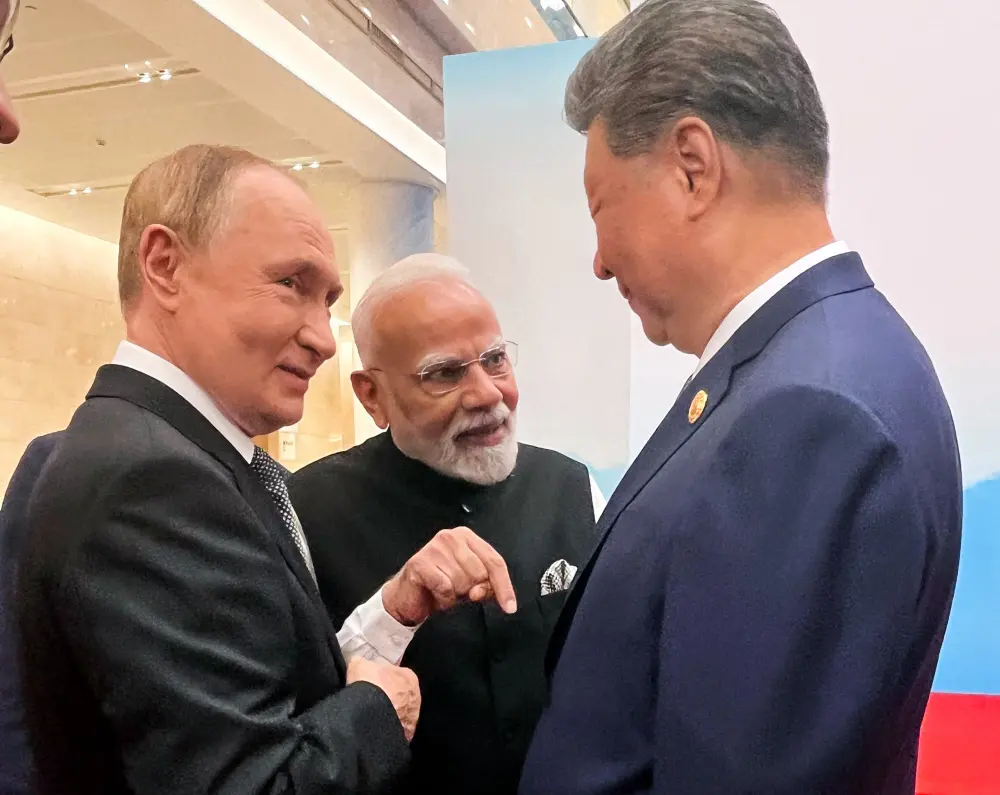
It is one thing for a nation to be squeezed by great powers; it is quite another to look like you are enjoying the squeeze. Unfortunately, that was exactly the optic India presented at the Shanghai Cooperation Organisation summit in Tianjin, an affectedly beaming Prime Minister sandwiched between Putin and Xi, laughing for the cameras as though global realignments were some picnic. The backdrop was no less telling - Trump’s tariff war on India had just gutted entire sectors of export trade, Beijing’s military parade had rolled out the hardware of a confident challenger, and Moscow was happily playing junior partner to China in a staged “axis of convenience.”
Strip away the forced smiles and what emerges is a harsher truth: India is currently caught in a no-man’s land of its own making, punished by Washington, courted by Beijing, indulged by Moscow, and sadly unsure of where it truly belongs. The world order is not being upended into neat blocs of East and West; it is thickening into layers of competing interests, each demanding clarity, and India’s tragedy is that it has no clarity, at home or abroad.
Donald Trump has always wielded trade as a weapon. The 50% tariff on Indian imports (explicitly tied to our continued purchase of discounted Russian oil) is more than just economic calisthenics. It is as blunt a message as it can get; hedge all you like, but there is a price for defiance. The consequences are immediate and brutal. Textiles, gems, machinery, and chemicals - industries that feed millions of households - are staring at a loss of market share in the United States, and hundreds of thousands of jobs hang in the balance. Unlike China, which can leverage its manufacturing dominance, or Russia, which thrives in the shadows of sanctions, India has no such cushion. We are neither indispensable nor ignorable; we are simply vulnerable.
The contrast is striking: while American CEOs are being serenaded at the White House, pressed into pledging billions in fresh domestic investments, Indian exporters are left to grapple with cancelled orders and rising inventories.
Washington is drawing its corporate barons into a national economic strategy. New Delhi, meanwhile, tinkers with GST cuts and bland assurances.
Tianjin’s Photo-Op Politics
At Tianjin, the theatre was indeed rich, but the script was poor. Modi’s conviviality with Putin and Xi was intended as a performance of strategic autonomy. Instead, it reinforced the image of India as a prop in someone else’s play. Beijing used the summit as a stage to present itself as the alternative convenor of global discontent. The Victory Day parade days later, with Putin and even Kim Jong-un on the dais, was a deliberate signal that this coalition is unbothered by Western disapproval and is comfortable flaunting its military heft, and confident that tariff-battered states will fall in line. Russia, for its part, gains every time India hedges. As long as our oil purchases remain robust, Moscow’s wartime economy breathes easier. And with the visuals of Putin’s bonhomie with Xi, Russia reclaims its place as co-architect of multipolarity rather than a mere supplicant.
And India’s role? A reluctant extra in a spectacle it neither scripted nor fully believes in! The optics of warmth with China do not erase the memory of Galwan. The nods to Russia do not erase Moscow’s drift into Beijing’s arms.
The BRICS Mirage
If the SCO was theatre, BRICS is marketing. Expanded, enlarged, and loudly advertised, the bloc now represents nearly half the world’s population and about two-fifths of global trade. Its rhetoric is grand: alternatives to dollar finance, South-South solidarity, resistance to unilateral sanctions. Its reality, though, is less so: internal rivalries, divergent interests, and no serious free-trade architecture. India’s relationship with BRICS is a study in ambivalence. On paper, New Delhi should be a leader of the Global South. And in practice? Well, Modi has chosen to skip the forthcoming virtual summit, deputing his foreign minister instead. The calculation is there for all to see, too much proximity to BRICS risks aggravating Washington at a time when tariffs are already biting. But isn’t the cost of absence equally stark? A reputation for inconsistency, unreliability, and a diminishing claim to leadership. BRICS will not displace the Western alliance system.
It may, however, chip away at the monopoly of the dollar and offer workarounds on payments, insurance, and energy. For India, the bloc is neither salvation nor threat; it is an instrument, useful in cushioning shocks but dangerous if mistaken for an anchor.
The fashionable term is “multi-alignment.” In practice, though, it is more like walking a tightrope in a storm. India condemns the US-Israel strike on Iran alongside SCO partners, then quietly reassures Washington by downplaying its BRICS role. It buys Russian oil to keep energy prices stable, then signs Quad statements about a free Indo-Pacific. Hedging has its uses, but it is not a strategy. Over time, the lack of clarity becomes a liability. Nations may tolerate ambiguity in a swing state, but they punish inconsistency in a supposed partner. The tariffs are proof enough, reminding India that hedging does carry a price. What, then, is the alternative? Not blind alignment with Washington, which would compromise energy security and regional autonomy. Not a headlong plunge into BRICS, which would tether India to a China-Russia axis inherently hostile to our interests. The alternative is disciplined hedging, firewalling the U.S. track on security and technology, and monetising (not demonetising!) convening power in forums like SCO and BRICS, as well as aggressively diversifying trade corridors towards Europe, the Gulf, Africa, and Latin America. But this requires more than rhetoric. It needs an industrial policy with precision, closing competitiveness gaps in key sectors within a couple of years, offering exporters currency risk tools and insurance, and investing in real capacity rather than mere optics. That said, it also calls for discipline in optics, with fewer staged laughathons and more sober signalling of India’s long-term aims.
Between Posture and Policy
The global order is not moving towards cleanly defined blocs; it is thickening into overlapping and often contradictory layers. Tariffs, sanctions, and industrial policy are now instruments of daily statecraft. China is weaponising tariff fatigue to boost its convening power. The US is corralling its corporations into a national project of re-industrialisation. Russia is milking its oil leverage to stay relevant. Where does India fit? Nowhere, if it continues to substitute posture for policy. Somewhere, if it learns to leverage its size without overplaying its hand. Everywhere, if it remembers that autonomy is earned through resilience, not optics.
History will not remember how warmly Modi smiled or how wide his grin was at Tianjin. It will remember whether India squandered a moment of flux by mistaking hedging for strategy. Trump’s tariffs are not an aberration; they are a warning. Xi’s parade is not bluster; it is ambition. And Putin’s bonhomie is not nostalgia; it is recalibration. India cannot afford to be the lonely man at the feast - applauded by no one, courted by all, and trusted by none. Multipolarity is messy, but it is also an opportunity. To seize it, India must step away from the theatre of affected smiles and laughs, and embrace the discipline of strategy.
(The author is an independent political analyst and can be contacted at hari@healthcombine.com)