Track stress with an e-tattoo? Scientists develop ultra-thin forehead sensor to monitor mental workload
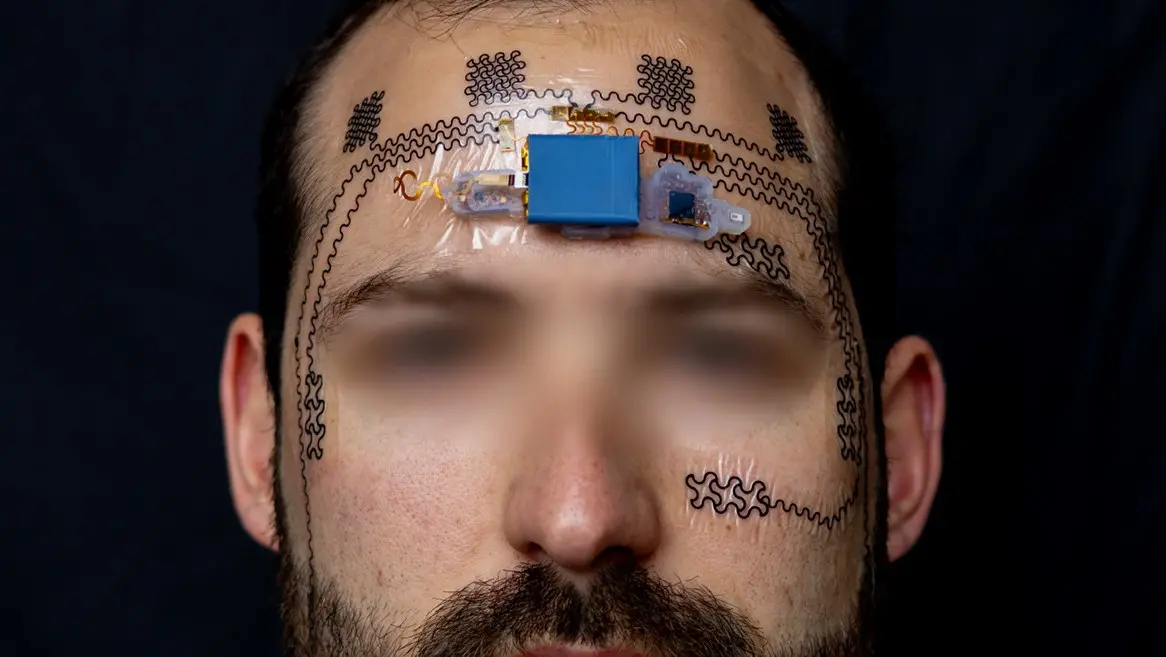
In a major breakthrough for wearable neurotechnology, researchers at the University of Texas at Austin have developed a wireless, ultra-thin “forehead e-tattoo” that can monitor mental workload in real-time, offering potential applications for high-stress professions such as aviation, healthcare, and robotics.
Published in the journal 'Device', the study details how the new e-tattoo uses cutting-edge materials and machine learning to track brainwaves (EEG) and eye movements (EOG), delivering high-fidelity readings while being minimally intrusive. The system is designed to be as lightweight and flexible as a temporary tattoo, allowing users to wear it comfortably under headgear during physically demanding tasks.
“This technology is meant to help people in high-stakes, high-demand jobs monitor their stress in real-time,” co-author Nanshu Lu told IEEE Spectrum.
Conventional EEG and EOG devices are often bulky and prone to motion artefacts, making them impractical for real-world use. The e-tattoo overcomes these limitations by using PEDOT\:PSS-coated electrodes that stick securely to the skin, ensuring stable signal acquisition even during movement. A flexible printed circuit integrated with the patch allows wireless data processing and transmission.
In trials, participants completed a dual N-back working memory task while wearing the e-tattoo. Researchers correlated their EEG and EOG data with NASA Task Load Index (NASA-TLX) assessments, and a machine-learning model successfully estimated mental workload across different task difficulties.
“While many previous studies have explored individual aspects, such as electrode materials or manufacturing techniques, our key innovation lies in the successful decoding of mental workload using a wireless, low-power, low-noise, and ultra-thin EEG/EOG e-tattoo device. It addresses the unique challenges of monitoring forehead EEG and EOG, where wearability, non-obstructiveness, and signal stability are critical to assessing mental workload in the real world,” the researchers noted.
Future applications could include cognitive state monitoring for pilots, healthcare workers, and operators of complex machinery, marking a significant step forward in human-machine interaction and stress prevention.