Could asteroid Bennu’s mysterious ‘space gum’ reveal how life began?
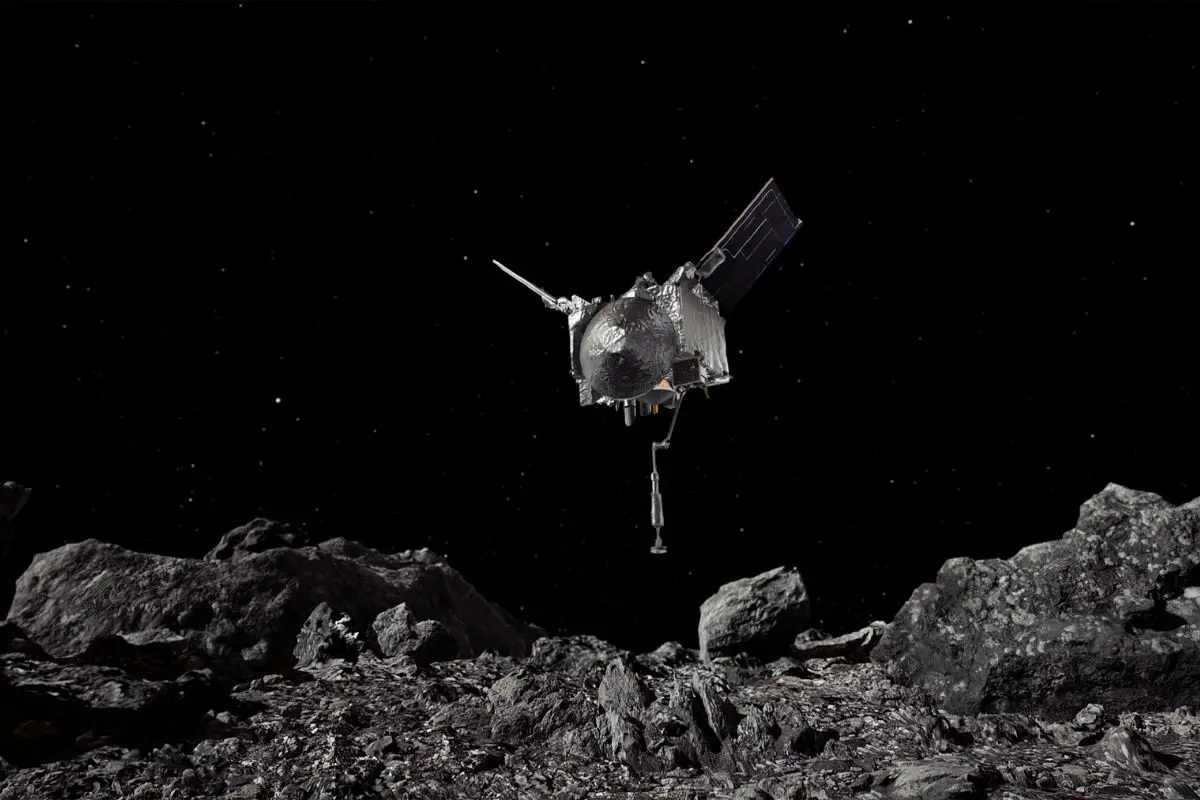
Samples retrieved by NASA's OSIRIS-REx mission from the asteroid Bennu are revealing significant information about the early history of our solar system and the origin of life’s fundamental ingredients. The OSIRIS-REx (Origins, Spectral Interpretation, Resource Identification, and Security-Regolith Explorer) spacecraft successfully delivered these pristine samples to Earth.
The ongoing analysis has led to three major discoveries detailed in new papers published recently in the journals Nature Geosciences and Nature Astronomy. These remarkable finds include biological sugars, a mysterious gum-like material previously unknown in space rocks, and unexpectedly large amounts of dust created by ancient supernova explosions.
These findings help scientists address profound questions about cosmic chemistry and planetary formation.
Do the Bennu samples contain the building blocks of life?
Scientists, led by Yoshihiro Furukawa of Tohoku University in Japan, discovered sugars essential for biology on Earth within the Bennu samples. Their findings were detailed in the journal Nature Geoscience.
The team identified the five-carbon sugar ribose. Significantly, they also found the six-carbon sugar glucose, marking the first time this has been found in an extraterrestrial sample. Although these sugars alone do not prove the existence of life, their detection, along with previous findings of nucleobases, amino acids, and carboxylic acids, demonstrates that the core building blocks of biological molecules were spread throughout the solar system.
For life on Earth, ribose and deoxyribose sugars are vital components of RNA and DNA, respectively. DNA serves as the main carrier of genetic information in cells.
RNA performs many functions, and life, as understood today, cannot exist without it. In the RNA molecule, ribose is utilised in the sugar-phosphate “backbone” that connects the string of nucleobases which carry information.
Furukawa stated, “All five nucleobases used to construct both DNA and RNA, along with phosphates, have already been found in the Bennu samples brought to Earth by OSIRIS-REx,”. He added that the discovery of ribose means that “The new discovery of ribose means that all of the components to form the molecule RNA are present in Bennu”.
Finding ribose in asteroid samples was anticipated, as it had previously been found in two meteorites recovered on Earth. However, the crucial observation from the Bennu material is that researchers did not find deoxyribose. If Bennu is typical of its environment, this suggests that ribose may have been more common than deoxyribose in the early solar system’s environments.
The presence of ribose combined with the lack of deoxyribose supports the “RNA world” hypothesis. This theory suggests that the earliest forms of life depended on RNA as the primary molecule both to store genetic information and to drive the chemical reactions necessary for survival.
Furukawa explained that “Present day life is based on a complex system organized primarily by three types of functional biopolymers: DNA, RNA, and proteins,”.
He continued, “However, early life may have been simpler. RNA is the leading candidate for the first functional biopolymer because it can store genetic information and catalyze many biological reactions”.
The samples also contained the sugar glucose. Glucose is one of the most common forms of "food" or energy used by life on Earth. This marks the first evidence that such an important energy source was present early in the solar system.
What is the ancient gum-like material?
A second academic paper, published in the journal Nature Astronomy, described a mysterious, gum-like material in the Bennu samples. This material, which had never been observed before in space rocks, might have helped create the conditions on Earth necessary for the ingredients of life to appear. This research was led by Scott Sandford at NASA’s Ames Research Center and Zack Gainsforth of the University of California, Berkeley.
This surprising substance is thought to have formed early in the solar system, when Bennu’s young parent asteroid began to warm. This ancient “space gum” was once soft and flexible but has since hardened. It is composed of polymer-like materials rich in both nitrogen and oxygen.
These complex molecules could have provided some of the chemical precursors that helped initiate life on Earth. Finding these molecules in Bennu’s pristine samples is significant for scientists studying how life began and its potential existence beyond our planet.
Sandford noted the profound temporal insight this material offers, stating, “On this primitive asteroid that formed in the early days of the solar system, we’re looking at events near the beginning of the beginning”.
Bennu’s ancestral asteroid formed from materials found in the solar nebula, the rotating cloud of gas and dust that created the solar system. This original asteroid contained various ices and minerals. As the asteroid started warming, driven by natural radiation, a compound called carbamate formed through a process involving ammonia and carbon dioxide.
Although carbamate is water soluble, it survived long enough to polymerise, reacting with other molecules and itself to form larger, more intricate chains that water could not affect.
This implies that the substance formed before the parent body became warm enough to establish a watery environment. Sandford pointed out the early nature of the finding: “With this strange substance, we’re looking at, quite possibly, one of the earliest alterations of materials that occurred in this rock,”.
Sandford’s team used an infrared microscope to select unusual, carbon-rich grains that contained abundant nitrogen and oxygen. They then used the Molecular Foundry at Lawrence Berkeley National Laboratory (Berkeley Lab) in Berkeley, California, for analysis. This involved what Sandford referred to as “blacksmithing at the molecular level,”.
The process required reinforcing a particle with ultra-thin layers of platinum, welding on a tungsten needle, and shaving the fragment using a focused beam of charged particles.
Once the particle was a 1000 times thinner than a human hair, its composition was analysed using electron microscopy at the Molecular Foundry and X-ray spectroscopy at Berkeley Lab’s Advanced Light Source (ALS). The sensitive X-ray beams and high spatial resolution of the ALS made unprecedented chemical analysis possible. Gainsforth shared the reaction to the discovery, stating, “We knew we had something remarkable the instant the images started to appear on the monitor,”. He added that the substance was highly unusual: “It was like nothing we had ever seen, and for months we were consumed by data and theories as we attempted to understand just what it was and how it could have come into existence”.
Experiments revealed that the strange substance had been deposited in layers on mineral and ice grains present in the asteroid. The material was pliable, similar to soft plastic or used gum. Researchers noted that the strange material was bendy and dimpled when pressure was applied. It was translucent, but radiation exposure made it brittle.
Sandford drew a comparison based on its chemical makeup: “Looking at its chemical makeup, we see the same kinds of chemical groups that occur in polyurethane on Earth,”. He concluded that this material from Bennu was “making this material from Bennu something akin to a ‘space plastic’”.
However, the ancient asteroid material is not simply polyurethane, which is an orderly polymer. Sandford explained that this space material has more “random, hodgepodge connections and a composition of elements that differs from particle to particle”. This comparison highlights the surprising nature of the organic material found in NASA’s samples. By investigating clues about past events deep inside an asteroid, scientists gain a better understanding of the young solar system, revealing the precursors and raw ingredients of life it already contained, and how far those materials may have been dispersed by asteroids like Bennu.
Where did Bennu’s parent asteroid originate?
A third paper, also published in Nature Astronomy, focused on presolar grains, which are dust from stars that existed before our solar system formed. This study was led by Ann Nguyen of NASA’s Johnson Space Center in Houston. The analysis aimed to determine where Bennu’s parent body formed and how geological processes had altered it.
It is widely believed that presolar dust was generally well-mixed when our solar system began to form. However, the Bennu samples contained six times the amount of supernova dust compared to any other studied astromaterial. This high abundance suggests that the asteroid’s parent body originated in a region of the protoplanetary disc that was heavily enriched with the dust from dying stars.
The study also showed that although Bennu’s parent asteroid underwent extensive alteration by fluids, some pockets of less-altered materials remained within the samples, offering insights into its origin.
Nguyen explained the significance of this preservation: “These fragments retain a higher abundance of organic matter and presolar silicate grains, which are known to be easily destroyed by aqueous alteration in asteroids,”.
She concluded that “Their preservation in the Bennu samples was a surprise and illustrates that some material escaped alteration in the parent body. Our study reveals the diversity of presolar materials that the parent accreted as it was forming”.