India’s Gaganyaan and US’s Artemis-II set to mark turning point in human spaceflight in 2026
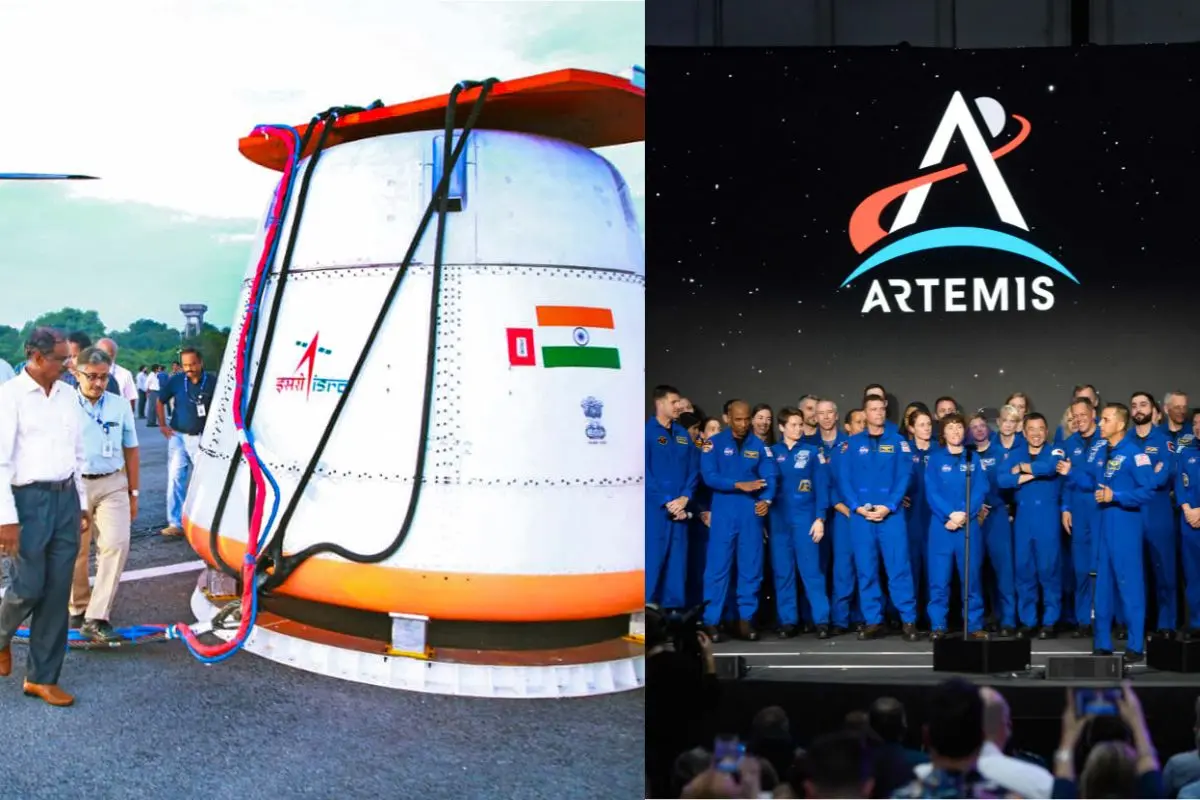
The year 2026 is emerging as a pivotal moment for human space exploration, with India and the United States preparing to launch missions that could reshape the future of spaceflight. India’s Gaganyaan programme and NASA’s Artemis-II mission, though different in scope, together underline a shift towards a more multipolar and ambitious era in space activity.
Riding on the momentum generated by Shubhanshu Shukla’s landmark mission to the International Space Station (ISS), India is preparing to take a major step towards its own human spaceflight programme. The country is preparing for its first uncrewed orbital test under the Gaganyaan programme, known as the G1 mission, which is tentatively scheduled for March 2026, according to Science and Technology Minister Jitendra Singh.
The mission will be launched aboard the human-rated LVM3 (Gaganyaan-Mk3) rocket and will carry a humanoid robot, Vyommitra, designed to replicate astronaut functions and responses in space.
The spacecraft will operate in low-Earth orbit at an altitude of approximately 300 to 400 kilometres. Its primary aim is to rigorously test critical systems, including life support, re-entry safety, communication links, mission control operations and parachute-assisted sea recovery. These trials are essential before India attempts a crewed Gaganyaan mission.
A successful G1 mission would move India closer to joining a small group of nations with the capability to independently send humans into space and return them safely. It would also lay the groundwork for future Indian space stations, private human spaceflight initiatives and reduced reliance on international partners.
Startups to launch private satellites
Private space startups are also set to play a bigger role in 2026. Skyroot Aerospace and Agnikul Cosmos are gearing up to launch satellites using their indigenously developed rockets, Vikram-1 and Agnibaan, as they seek a foothold in the rapidly expanding small-satellite launch market.
The year will further see the launch of a Polar Satellite Launch Vehicle (PSLV) manufactured entirely by Hindustan Aeronautics Limited and Larsen & Toubro. The project follows the contract awarded by ISRO to the two firms in 2023, signalling a growing role for industry in India’s space ecosystem.
US to return astronauts to the moon after Apollo mission
Meanwhile, the United States is preparing to send humans beyond the Low Earth Orbit for the first time in more than five decades. NASA’s Artemis-II mission is reportedly scheduled for no earlier than February 2026. The roughly 10-day mission will carry four astronauts aboard the Orion spacecraft, launched by the Space Launch System (SLS) rocket, on a looping trajectory around the Moon.
Artemis-II will mark the first human mission beyond low-Earth orbit since Apollo-17 in 1972. During the flight, NASA will test a wide range of deep-space systems, including navigation and communications, radiation protection, long-duration life-support systems and mission operations far from Earth. The spacecraft is expected to travel at least 4,000 nautical miles beyond the Moon, making it the farthest journey ever undertaken by humans.
The mission is regarded as a crucial step towards future lunar landings, the establishment of a sustained human presence on the Moon and, ultimately, crewed missions to Mars.
Taken together, Gaganyaan and Artemis-II highlight the rapidly changing global space landscape. As India strengthens its capabilities in low-Earth orbit and the United States leads a return to deep-space exploration with international partners, the experience and technologies developed are expected to shape human spaceflight well into the 2030s.
(With PTI Inputs)