Explained: Why India's homegrown anti-tank Nag Mk-2 can give China and Pakistan sleepless nights
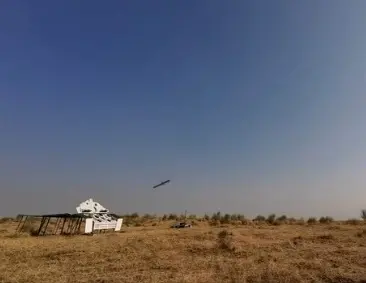
India has successfully tested its homegrown, third-generation anti-tank guided missile, the Nag Mk-2, in recent field trials at the Pokhran range in Rajasthan. The tests, conducted in the presence of senior Indian Army officers, saw the Nag Missile Carrier (NAMICA) Version 2 precisely hit all targets at both maximum and minimum ranges. This confirmed the accuracy and effectiveness of the missile system.
The Nag missile is a cutting-edge weapon with fire-and-forget technology. This means that once launched, the missile automatically tracks and engages the target without any further guidance from the operator. Equipped with an imaging infrared (IIR) seeker, it can accurately hit both stationary and moving targets, day or night.
The NAMICA Version 2, developed by India's Defence Research and Development Organisation (DRDO), is designed to destroy modern armoured vehicles. Its fire-and-forget capability allows for swift engagement, even in challenging battlefield scenarios. Defence Minister Rajnath Singh and DRDO Chairman Samir V Kamat praised the successful trials and the collaborative efforts of the DRDO, the Indian Army, and industry partners.
While the exact range remains classified, the Nag Mk-2 is estimated to have a range of 7 to 10 kilometres, a significant improvement over its predecessor, the Nag Mark 1, which had a 4-kilometer range. The missile also boasts a tandem high-explosive anti-tank (HEAT) warhead for increased destructive power and a top-attack capability to strike the most vulnerable part of armoured targets.
For its land-based operations, the Nag Mk-2 is launched from the NAMICA, an armoured vehicle based on the Indian-made BMP-2 Sarath. The Sarath ("Charioteer" in Sanskrit) is itself an Indianized version of the Soviet-designed BMP-2 infantry fighting vehicle. Manufactured under license in India, the Sarath has been adapted to meet the specific needs of the Indian Army. It provides a robust and mobile platform for the Nag missile system, allowing it to be deployed quickly and effectively across various terrains.
Although the precise size specifications of the Nag Mk-2 are kept secret for national security reasons, estimations suggest a length of 1.8 to 2 meters, a diameter of 150 to 200 mm, and a weight of around 40 to 50 kg, including the missile, launch container, and associated equipment.
Regional Rivals: A Comparison
India's successful test of the Nag Mk-2 puts it ahead in the regional anti-tank missile race. While Pakistan boasts the Barq laser-guided missile with a claimed 10 km range, it's reliant on Turkish technology and lacks the fire-and-forget capability of the Nag. China, though a world leader in missile technology, fields the HJ-10 with a comparable range to the Nag, but its reliance on wire guidance makes it more vulnerable to countermeasures. The Nag's advanced IIR seeker and top-attack mode further enhance its lethality against modern armour, giving India a significant edge in battlefield dominance. This successful test marks a significant step forward for India's defence capabilities, providing a powerful deterrent against armoured threats.
(The author of this article is an award-winning Science Writer and a Defence, Aerospace & Political Analyst based in Bengaluru. He is also the Director of ADD Engineering Components, India, Pvt. Ltd, a subsidiary of ADD Engineering GmbH, Germany. You can reach Girish Linganna at: girishlinganna@gmail.com)