The Indian fighter jet debate: US based F-35 or Russian Su-57? What will India choose?
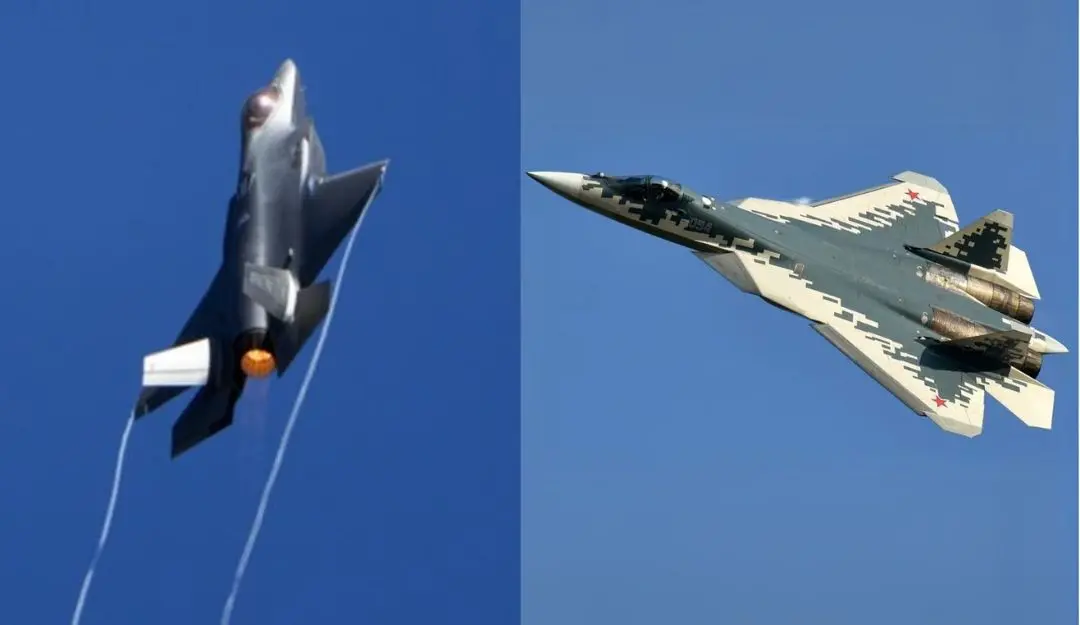
India is currently looking at two options to modernize its air force fleet – US based Lockheed Martin’s F-35 fighter aircraft or Russia’s Sukhoi Su-57 fighter jet. Although both the fighter jets are competent in their operational efficiency and offerings, the debate is, what will India choose and why?
India is currently facing a shortfall in its air force squadrons amidst rising global and regional tensions. Just as the neighboring China and Pakistan continue to expand its military, India too is seeking reinforcements to modernize its fleet.
During Prime Minister’s recent visit to the US to meet President Donald Trump, US announced plans to expand military sale to India in 2025 with a potential deal for Lockheed Martin’s F-35 stealth fighter.
Lockheed Martin claims that the F-35 is their centrepiece of 21st-century global security.
- It strengthens national security, enhances global partnerships, and powers economic growth
- It is the most lethal, survivable and connected fighter jet in the world
- The F-35 gives pilots the critical advantage against any adversary, enabling them to execute their mission and come home safe
- nine countries contributed to the growth of the F-35, including the United States, United Kingdom, Italy, Netherlands, Turkey, Canada, Denmark, Norway, and Australia
- each F-35-unit costs between $80 million to $115 million.
Approximately 1,000 F-35s are currently under operation.
Although many media reports have suggested that India is close to accepting the F-35 deal, Defence Secretary Rajesh Kumar Singh has refuted the claims saying that no formal offer has been made yet. “What Trump said is that they will look at a roadmap for making that available. We will look at that offer when it becomes a firm offer.”
Singh further added that any procurement decision would be guided by India’s defence acquisition procedures.
"Our procurements follow a structured process, based on requirements raised by the services. Let’s see how it goes. Creating an option of this type is important for us, and we will certainly look at it with an open mind," he said.
The Comparison
As of now, India does not have a fifth-generation fighter, although India is ramping up its AMCA (Advanced Medium Combat Aircraft) capacity, it will take some more time. Till then India needs a stealth fighter to counter the threats likely to emerge from neighbours. The F-35 jets are costlier than Su-57. Besides, the Su-57 are expected to cost considerably less and may get inducted with ease as most Indian warplanes are of Russian origin.
Also on the technology transfer front, the F-35 jets can by a contentious issue while it might a smooth sailing for Su-57 technology transfer as Russia has given India an offer to produce Su-57 stealth fighters locally, with full technology transfer, as part of its “Make in India” initiative.
Recently speculations over the potential F-35 fighter jet deal between India and the United States gained momentum as Commerce Minister Piyush Goyal met Michael Williamson, president of Lockheed Martin International, to explore defence and aerospace manufacturing opportunities under the ‘Make in India’ initiative. The discussion revolved around strengthening collaboration and the possibility of local production of military aircraft.
There are approximately 1,000 F-35s are in operation while Russian has been able to manufacture just 40-odd Su-57s. Moreover, there are also some concerns about Su-57’s stealth capabilities.
India’s opposition Congress party has criticized the F-35 purchase raising questions on its cost and operational effectiveness. Banking on Elon Musk’s previous reference to F-35 jets as ‘junk and that manned fighter jets are becoming obsolete in the era of drones’ – The congress is sceptical of this deal.
On the other hand, Russia is India’s long-time defence ally and has proposed that they could begin the production as early as this year if the deal is approved. Russia has traditionally supplied the majority of India’s military hardware. However, Western sanctions on Moscow have disrupted exports, forcing India to explore alternative options.
However, experts believe that the deal will Moscow could create diplomatic challenges with the US.
India has a large acquisition budget of INR 1,80,000 crore for the next financial year and INR 1,60,000 crore for the current year, which will be used for various procurements.
Some experts are also of the opinion that the F-35 deal might be closed the same way as Indian government closed the Rafale deal with French government through an intergovernmental agreement. This will require a formal proposal from the United States and a detailed evaluation by Indian authorities involving multiple factors like technology transfer, cost, operational compatibility, and geopolitical considerations.
For now, the Prime Minister’s office needs to balance cost, technology access along with geopolitical alliances for any deal to go through. Moscow’s make-in-India push along with lucrative technology transfer is definitely a plus but US-India’s diplomatic ties could tilt the balance in favour of India eyeing China’s growing military influence. For now, it’s a wait and watch!