China’s ‘robocops’ hit the streets: Wheeled robots now detect traffic violations
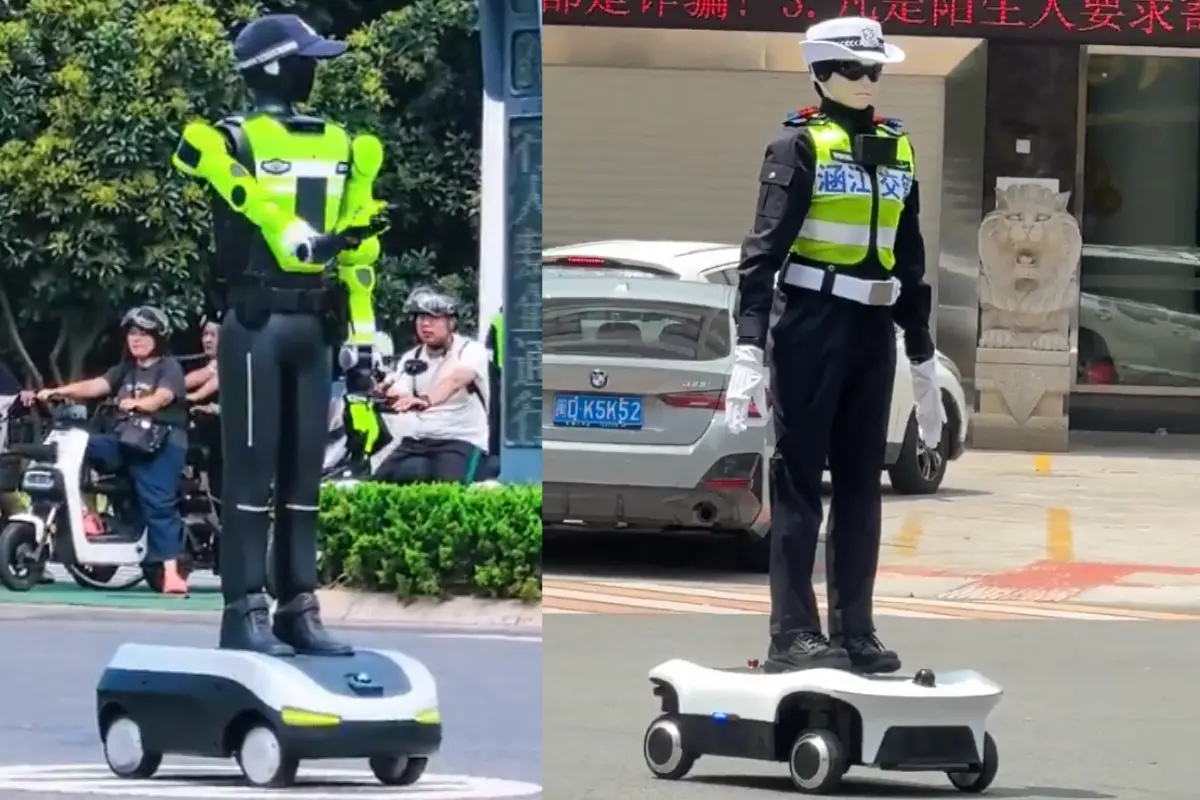
Hangzhou/Beijing: China is testing wheeled robots to handle some routine traffic-control duties, using cameras, radar and onboard computing to detect violations and issue warnings at busy intersections.
Developed by Hangzhou-based technology company SUPCON Information, the 1.88-metre, 98-kg T2 robot is being piloted in the eastern city as part of an effort to use machines for repetitive roadside tasks.
Unlike the fictional RoboCop, the machine has no weapon or power to make arrests. Instead, it is designed to identify certain traffic violations, guide road users and assist traffic police.
What the robot can detect
According to SUPCON intelligent unmanned systems innovation centre head Cao Hui, the T2 can identify several common violations, including:
- Riding an e-bike without a helmet
- Carrying passengers on e-bikes
- Vehicles stopping beyond marked lines
- Pedestrians crossing against traffic signals
The robot uses cameras, radar and onboard computing to monitor its surroundings. It can also answer questions about directions, parking and traffic rules.
An emergency function allows users to connect with local police. Its seven-jointed arms can reproduce standard traffic-police gestures in sync with traffic signals.
15 robots deployed in Hangzhou
SUPCON has deployed 15 of the robots in Hangzhou since May. The company says they have issued more than 170,000 warnings and helped reduce monthly cases of helmetless riding and vehicles crossing stop lines by more than 40%.
According to Reuters, the company says the robots are intended to remind road users about violations rather than simply punish them.
Also read | Drone carrying explosives found at German airport; minister warns of 'new quality of danger’
Designed for long hours of operation
SUPCON says the T2 can operate autonomously from 7 a.m. to 6 p.m., moving between designated positions at intersections without direct remote control. Traffic police teams can monitor and dispatch the machines through a central platform.
The company has tested the robots in tourist areas, school zones, business districts, rush-hour traffic and difficult weather conditions.
SUPCON says the robots have a violation-recognition accuracy of more than 95%. However, the company also acknowledges that their cameras and radar can be affected by strong sunlight, rain and extreme temperatures.
Nearly 50 of the robots are currently operating across about eight cities in three Chinese provinces, according to SUPCON. The company expects that number to approach 200 by the end of the year.
Read more | NASA’s $30 million mission to rescue Swift telescope fails: What went wrong in space?
Could traffic robots move overseas?
The technology could eventually find applications in countries where traffic officers face challenging roadside conditions. AiMOGA, a robotics company backed by Chery, has pointed to potential uses in regions such as the Middle East and Southeast Asia.
However, deploying such robots outside China would involve more than simply exporting the machines. AiMOGA executive Zhang Guibing said they would need to integrate with local law-enforcement systems, obtain necessary certifications and comply with data-protection regulations.
Those requirements could be particularly important because the robots rely on cameras and other sensors to monitor public spaces.
For now, China's T2 remains focused on a narrower role: taking on repetitive traffic-monitoring duties while leaving enforcement and policing decisions to human authorities.