Real Kerala story: From no grounds, thin player pool to Ranji Trophy final
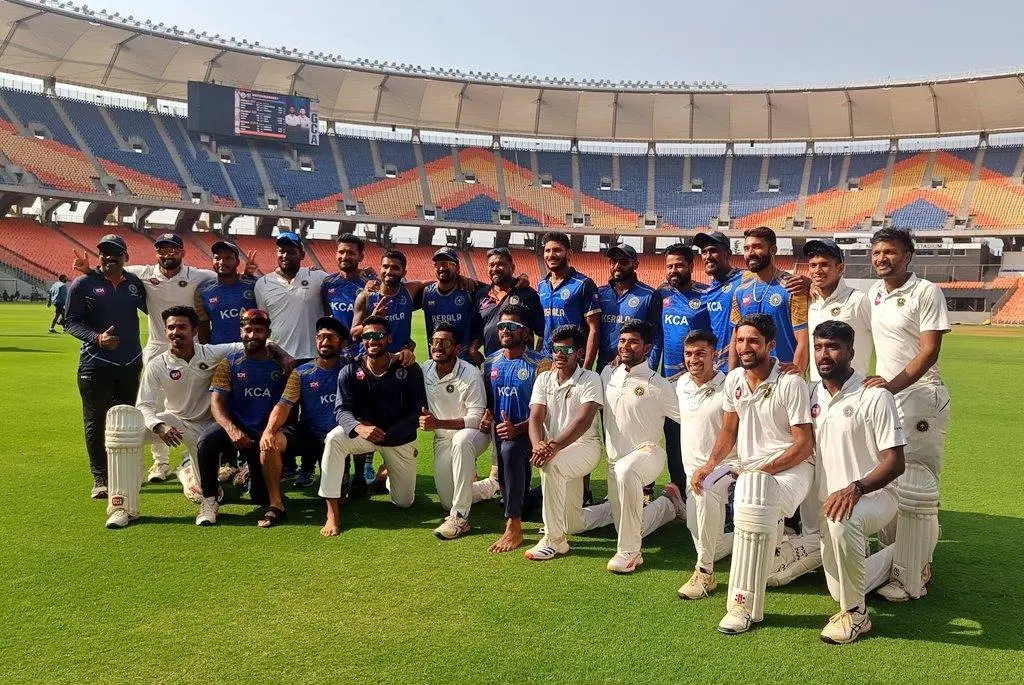
As Kerala secured its historic maiden berth in the Ranji Trophy final, a wave of celebration swept across the state. Politicians, Mollywood stars, renowned writers, and sports personalities took to social media to congratulate the team on this monumental achievement. Even casual users on X and Instagram flooded timelines with memes and reels, marking a defining moment in Kerala’s sporting history—one that arrived after 352 Ranji matches.
The excitement was evident on JioCinema, where the semifinal match against Gujarat saw a sharp rise in viewership, jumping from 2.5 lakh to 6 lakh as the game progressed. The surge in interest was unsurprising, as fan support often follows success. However, what many do not see are the years of dedication and struggle that pave the way for such historic milestones.
Laying the Foundation for Cricket in Kerala
Kerala’s cricketing journey has been a long and challenging one. Before the mid-2000s, the state’s presence in top-level cricket was limited to players like Tinu Yohannan and S Sreesanth, while newspapers often highlighted Kerala’s connections to cricketers such as Sunil Valson, Ajay Jadeja, and Abey Kuruvilla.
For years, one of the biggest cricketing events in the state was the Pooja Knockouts, organized by the Tripunithura Cricket Club since the 1950s. This tournament occasionally featured renowned players like K Srikkanth and VB Chandrasekhar. However, Kerala lacked a structured cricketing system to nurture homegrown talent.
In 2005, a few cricket officials, led by veteran administrator TC Mathew, held a crucial meeting to initiate a transformation in the state’s cricketing landscape.
Building Talents
Mathew recognized that Kerala's talent pool was significantly smaller compared to traditional powerhouses like Mumbai, Delhi, Karnataka, and Tamil Nadu.
"Our talent pool is limited compared to other teams like Mumbai, Delhi, Karnataka, Tamil Nadu etc. Kerala is actually picking the state squad from 14 districts, a squad of 15 and that makes around 220 players," Mathew, a former BCCI vice-president, told PTI.
"There is no standard in that. So I designed to have an academy in all the districts. That is where we need to find talent and train our coaches."
However, this initiative faced a major obstacle—Kerala lacked proper cricketing infrastructure. Mathew’s priority was to change that.
"Our first aim was to build proper infrastructure. Now, we have 17 first-class grounds in the state and in 2005, we didn’t have a single ground.
"We ensured that coaches get enrolled to training programmes of the BCCI and now I think we have more Level 1 coaches in Kerala than many other frontline states. We also have expert in-house curators," he said.
Former Kerala coach P Balachandran also acknowledged the significant improvements in cricket facilities over the past two decades.
"We get a lot of rain in Kerala. So, it is necessary to have indoor training centres, and now KCA (the state cricket association) has set up such places in all districts, so that the players can train irrespective of the weather," said Balachandran.
Scouting Talent from Schools and Colleges
Another major factor behind Kerala’s rise in cricket was the focused effort to identify and develop young talent at the grassroots level.
"We wanted a cricket team in all schools and colleges in the state and made a coordinated effort with all the managements of the educational institutions. We sent almost 700 coaches to all these places to impart expert training.
"The result is now visible. Once cricketers came only from cities like Thiruvananthapuram, Kochi and Thalassery. But just take a look at this Kerala team, we have players from Kasargod, Kozhikode, Idukki, Alappuzha, Palakkad etc. There is a good spread," said Mathew.
Veteran coach Biju George stressed the importance of maintaining momentum to keep Kerala cricket moving forward.
"Vinod Kumar (KCA president) is a very able administrator. He doesn’t get in the way of proper cricket. He makes sure that the right coaches are there. He made the selector travel with the team," said George.
"So, there is a lot of accountability. The coaches have given absolute freedom to do whatever is right for the team. In turn, it has instilled belief in the players.
"Also, we should thank the Kerala Cricket Academy for keeping a good supply of quality players," he added.
Mohammed Azharuddeen, the star of the semifinal with a century against Gujarat, echoed the sentiment that Kerala’s progress is built on a strong foundation of teamwork and trust.
"In fact, I have been playing alongside Salman Nizar from a very early age, and even at the KCA Academy. It has helped us create an understanding and brotherhood between us.
"We always had the belief in ourselves even when we lost top players like Sanju (Samson), Vishnu (Vinod) and Baba (Aparajith) to injuries," Azharuddeen added.