Veteran actor Amol Palekar hails Manorathangal as a fitting tribute to MT
What comes to mind when you hear the timeless melody of Thumbi Vaa Thumbakudathin from the 1982 Malayalam film Olangal? For many, it’s the charming presence of Amol Palekar—the actor who won the hearts of Malayalees and remains a beloved figure even today.
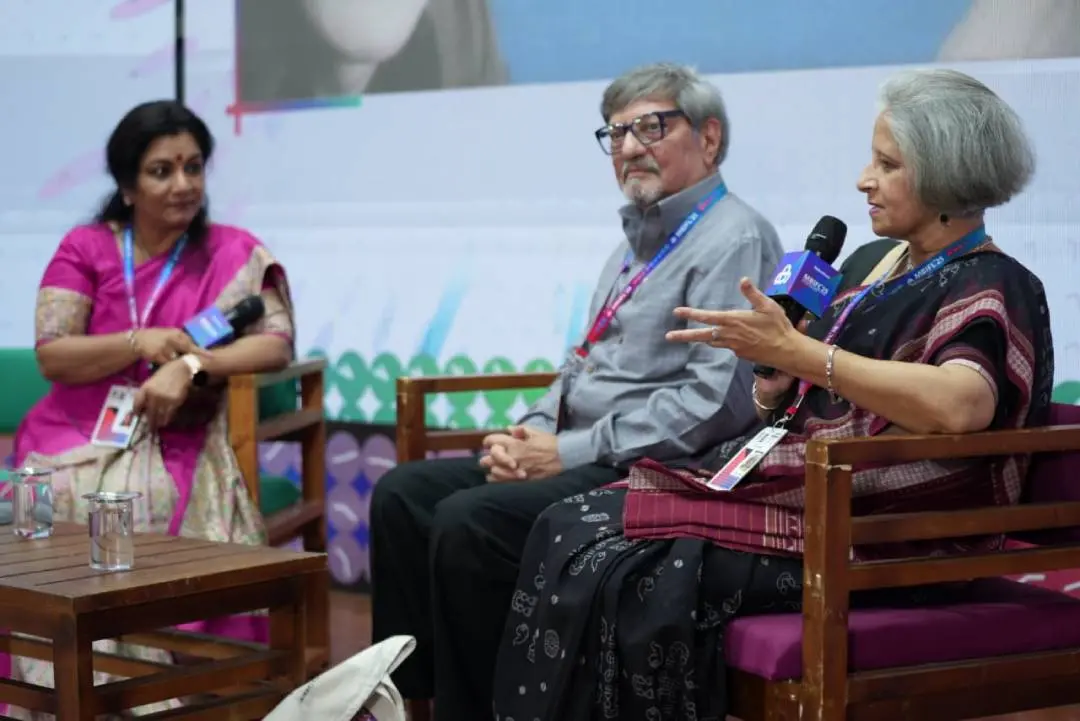
At the 6th edition of MBIFL 2025 in Thiruvananthapuram, Amol Palekar took the audience on a journey through his memories of Malayalam cinema, his entry into the world of films, and his recently launched book, Viewfinder.
"It’s the women in my life who have shaped my career," he shared, mentioning his wife, Sandhya Gokhale—a lawyer, and scriptwriter—as a key influence. He also reminisced about his debut Hindi film, Rajnigandha (1974), again a women-centric story that set the tone for his film career.
Palekar and Gokhale were joined on stage by Professor Meena T. Pillai for a thought-provoking discussion on Chitchor and Beyond covering a range of topics close to the actor’s heart.
When asked about Malayalam film Olangal, Palekar fondly recalled how he immediately said yes when director Balu Mahendra approached him for the role. "I was a huge fan of Balu, so it was an immediate yes. He was known for his early morning shoots, and we would be on set by 5 AM, preparing for the day. Most scenes were filmed in the soft light of Ooty, which was a challenging process—especially in an era without today’s advanced technology," he said.
The veteran actor also praised Manorathangal, the television series based on MT Vasudevan Nair’s nine short stories, calling it a great tribute to the legendary writer. He was particularly delighted that industry icons Kamal Haasan and Mammootty had come forward to present the anthology.
With a career spanning decades and a deep passion for good storytelling, Amol Palekar stated the basic rule he follows as an actor. "The first rule I adhere to is that, through numerous rehearsals, the audience must feel as though they are witnessing the moment for the very first time—as if it is happening right now. It is this commitment that makes me an artist, whether in theatre or film."
When asked about his favourite era of films, Amol Palekar found it difficult to choose. As both an actor and a director, he explained that every era has its own charm, and with today's rapid technological advancements, everything of cinema has transformed.
The nostalgia in the room deepened when moderator Meena T Pillai requested a playback of one of Palekar's timeless hits. Gori Tera Gaon Bada Pyara filled the air and the audience were taken to a bygone era.
Palekar strongly fought for the freedom of artists and said, "atleast during the twilight of our lives, why can't we stand up for their freedom?"
Sandhya Gokhale stated that she recognises her husband for the character he plays, describing him as a serious yet quiet person. "He is the complete opposite of what he depicts in films," she said. She acknowledged that Amol had a successful career, especially after his first three films became hits. However, when he was later cast as a villain, people were truly shocked—including his own parents.
Sandhya said that she had legally challenged the ban on a Marathi play portraying same-sex love, which was later overturned. Moreover, she had approached the Mumbai High Court against the regulations in Maharashtra and Gujarat, which require submitting the complete script to the scrutiny board.
The lively session concluded with the moderator encouraging the audience to read Amol Palekar's newly launched book, Viewfinder, in which the actor describes himself as an "accidental actor." The book talks about his journey in theatre, acting, directing, and production, as well as his career in Hindi, Marathi, and Bengali cinema. It also reflects on his work as a director and traces the evolution of cinema and theatre from the early seventies to the present.