From Trivandrum to the world stage: Venu Rajamony shares his journey at MBIFL 2025
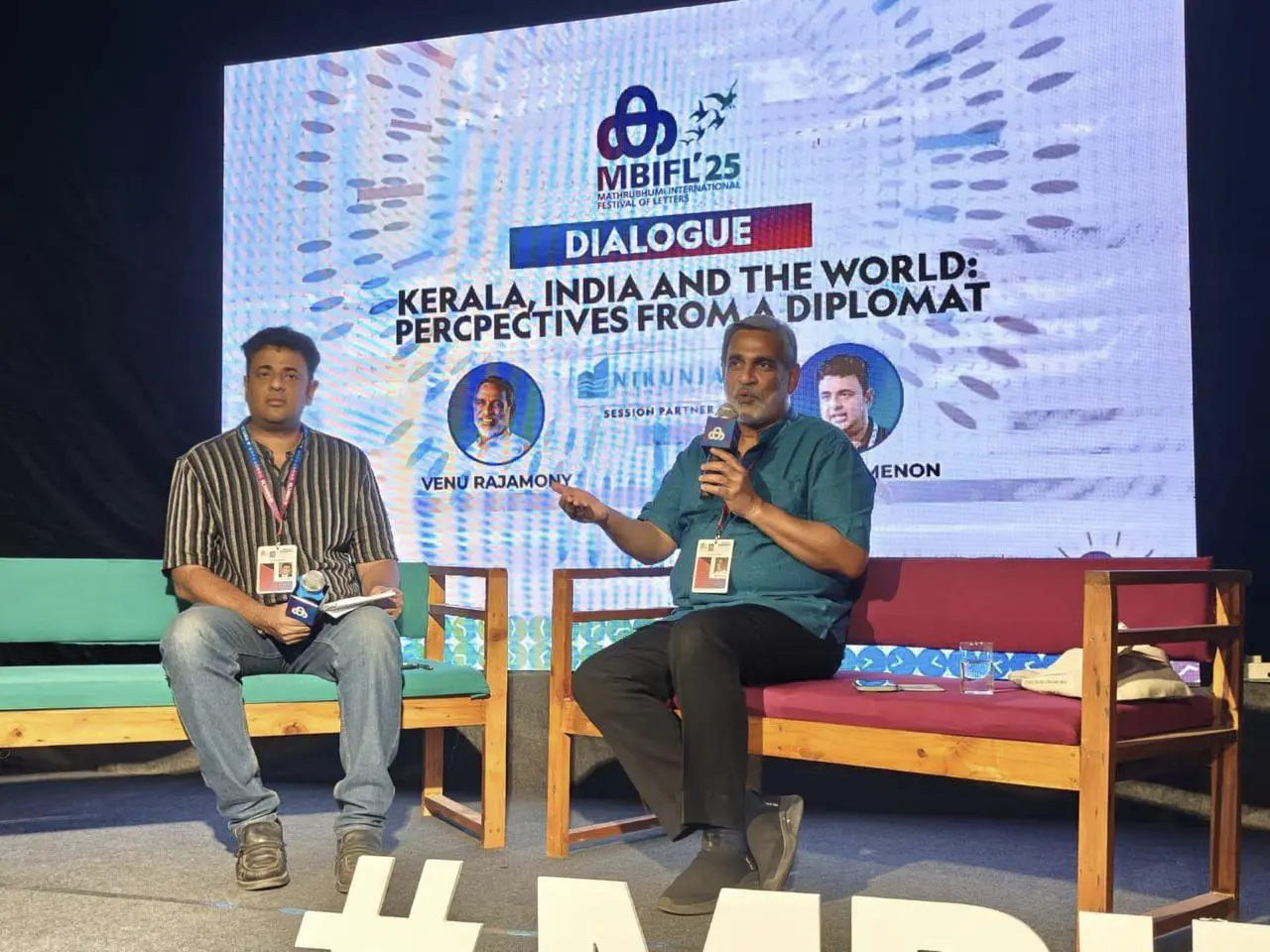
The fourth day of the Mathrubhumi International Festival of Letters (MBIFL) 2025 brought an engaging discussion featuring diplomat Venu Rajamony and marketing expert, entrepreneur, and author Narayan Menon. Titled 'Kerala, India, and the World: From the Perspective of a Diplomat', the session took the audience through Rajamony’s journey from his childhood in Trivandrum to walking alongside world leaders, his time in student activism (including a stint in Tihar Jail), his diplomatic postings, and reflections on India’s evolving place in global affairs.
A Trivandrum childhood and the dream of diplomacy
Rajamony began the session by reminiscing about growing up in Trivandrum, cycling through its slopes and watching MGR films for 40 paise. “This is where I really learned how to cycle,” he recalled. “I would go up in front of University College and imagine how it would be to study there one day. I never got to, but I have given lectures there.”
He emphasised how his journey was not extraordinary but achievable for anyone. “Whenever I address a school or college audience, I tell them: I am one of you. I went to local schools, grew up in this very city, and if I could make it, so can you.”
Student activism, JNU, and a stint in Tihar
His college years were marked by student activism, first at Maharaja’s College, Ernakulam, where he was elected students’ union chairman, and later at Jawaharlal Nehru University (JNU), where he was part of a student agitation that led to his arrest. “The climax to my life in JNU was about nine days in Tihar Jail, along with 700 other male students,” he said. “My wife was in the women’s jail with about 100 students.”
Recounting an amusing anecdote from later years, he said, “I once worked for Yashwant Sinha, the external affairs minister. He was giving a speech, making a big deal about how he spent one day in Patna Jail. I just laughed and said, ‘Nine days in Tihar, with Charles Sobhraj for company.’”
Journalism, law, and IFS
After JNU, Rajamony briefly worked as a journalist at Indian Express, covering the Kerala High Court while simultaneously studying law. “My father challenged me—‘How can you think of marriage when you don’t even have a job?’ So I started applying for everything, from tea estate managers to RBI officers,” he said.
By sheer coincidence, his father’s friend, an editor at Indian Express, was looking for someone with legal knowledge. “He later told me it was love at first sight—he recommended me to the management, and that’s how I got the job.” However, his heart was set on the foreign service. “I wrote the exam twice. The first time, I qualified for the postal service—wasn’t interested. The second time, I made it to the IFS.”
Love, telegrams, and a wedding against all odds
One of the most entertaining parts of the session was his wedding story. In the pre-mobile era, he and his fiancée, who was in Darjeeling, communicated through telegrams and trunk calls. “If I had to call her, I had to first connect from Kochi to Chennai, then Chennai to Calcutta, then Calcutta to Darjeeling. If she wasn’t near a phone, the whole thing collapsed.”
The journey to the wedding itself was a logistical nightmare. “She had to travel from Guwahati to Calcutta, then to Chennai, then to Kochi. But there were no tickets! Thankfully, the CPM’s national conference was happening in Calcutta, and a contact helped me get her a ticket on the train bringing comrades back from the event.”
Upon arrival in Kochi, there was no grand celebration. “I just called some friends and said, ‘Tomorrow, I’m getting married. If you want to come, come. No sadhya, no feast, no gifts.’ A simple ceremony at a temple, and that was it.”
China, and why India must engage, not alienate
Rajamony’s first diplomatic assignment was in Hong Kong, where he learned Mandarin. “Chinese is a tonal language—if your voice doesn’t go up and down correctly, the meaning changes completely. Musicians pick it up faster. I, unfortunately, am not a musician.”
His experience in China shaped his views on India’s often hostile perception of its northern neighbour. “We lost the 1962 war, and we took it to heart. But the common Chinese don’t even know about it. To them, India is the land of Buddha. The name for India in ancient China was ‘Western Heaven.’”
He argued for a more pragmatic approach. “China is the biggest economic success story of our time. It would be foolish for India not to learn from them. We must engage where we can and negotiate our disputes wisely.”
Dubai, human trafficking, and life as a diplomat
His tenure as consul general in Dubai was one of his most challenging yet rewarding. “The Gulf is home to millions of Indians, and many of them have nowhere to turn when in distress. One night, I got a call—‘A taxi driver has left a woman at our gate. She’s seeking help.’”
The woman had escaped a human trafficking ring. “She jumped from a window and was running on the streets with traffickers chasing her. A kind taxi driver rescued her and brought her straight to us.”
This led to the consulate setting up shelters for abused women and finding ways to help victims return home safely. “In India, you have NGOs, police, politicians. In the Gulf, they have only us.”
The case of the missing gun: diplomatic blunders and quick fixes
Diplomatic life isn’t without its share of absurdities. During a presidential visit to China, a security officer left behind his gun and bullets in a Shanghai hotel room. “We got a call from air traffic control—‘The president’s flight has taken off, but a gun and six bullets have been left behind in China.’”
The team had to act fast. “The Chinese protocol team was friendly—they suggested, ‘Put it in the ambassador’s briefcase. He won’t be frisked.’ So, we smuggled a gun and six bullets from Shanghai to Beijing. Then, getting it back to India was another challenge, but we managed!”
Kerala’s floods and lessons from the Dutch
As India’s ambassador to the Netherlands, Rajamony introduced Kerala to the Dutch “Room for the River” concept, a flood management strategy. “Instead of building walls against water, you create space for it to flow when needed. The Kerala government has now started the ‘Room for Pamba’ project, but long-term implementation will take time.”
A world in chaos and the road ahead
On today’s global scenario, he described it as “a time of fawda (chaos).” With tensions in Ukraine, Gaza, and growing hostility between superpowers, he warned, “Trump’s return will make things even more unpredictable.”
AI and diplomacy: boon or bane?
Asked about AI in diplomacy, Rajamony acknowledged its impact. “Speechwriting, research—AI is a great tool. But decision-making? That will always need a human mind.”
As the session concluded, Rajamony left the audience with an encouraging message. “My story isn’t extraordinary. I started in a small city, just like many of you. The world is vast, and diplomacy isn’t limited to officials—it’s about how we interact, engage, and learn. If I can do it, so can you.”
The discussion, filled with wit, wisdom, and remarkable anecdotes, was a masterclass in storytelling, diplomacy, and Kerala’s global significance.