MBIFL 2025: Shashi Tharoor on ‘The Great Indian Dream’
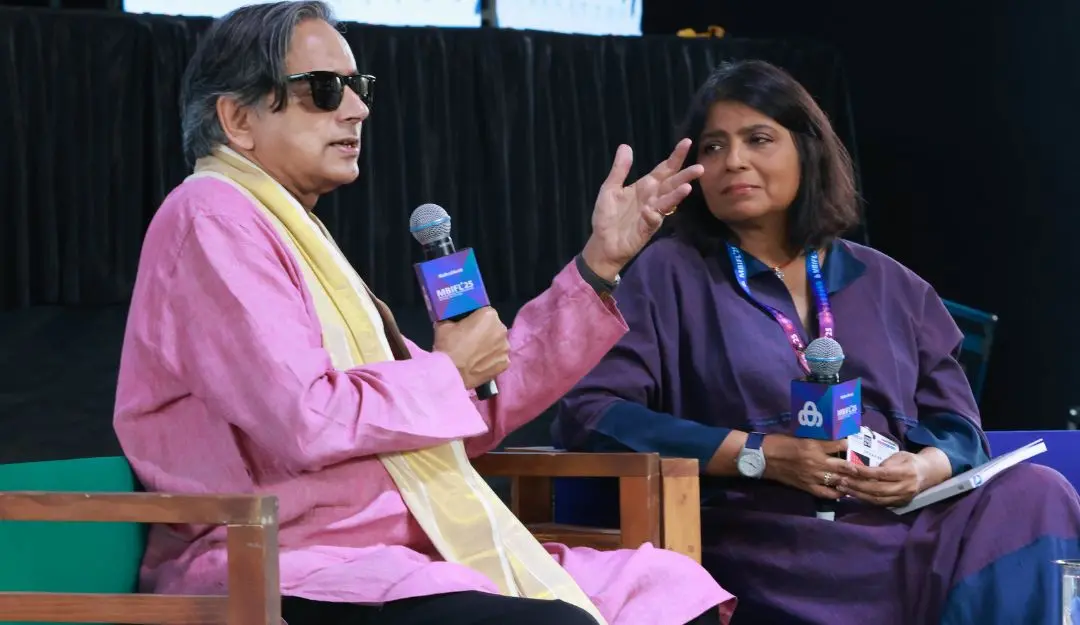
During the ongoing Mathrubhumi International Festival of Letters (MBIFL) at Kanakakkunnu Palace in Thiruvananthapuram, Kerala, Congress MP Shashi Tharoor and journalist Anuradha Sengupta engaged in a thought-provoking discussion on 'The Great Indian Dream', exploring caste, economic aspirations and India’s evolving national identity.
Before independence, Dr BR Ambedkar envisioned an India where fraternity would dissolve caste divisions, but decades later, caste remains deeply entrenched in the Indian socio-political ecosystem. While progress has been made, caste still dictates political choices and social mobility.
"Caste has become almost more entrenched than it was when the constitution was passed in 1950," Tharoor remarked, questioning whether Ambedkar’s ambition for the annihilation of caste was dying.
Political parties, he observed, continue to select candidates based on caste affiliations because "voters vote based on caste". Even Kerala, despite its progressive image, is vulnerable to such identity-based decision-making. "Even the communist party that’s against caste by ideology will choose their candidates based on caste," he pointed out.
The discussion underscored that systemic change must begin with individual choice. "As voters, we have to change and become a little more broad-minded. We must begin employing individual choice and individual change," Tharoor urged.
A Shift from Idealism to Materialism
India’s founding leaders envisioned a dream rooted in social justice, equality, and democratic values. Over the decades, however, the nature of that dream has transformed. "If you look at the past ten years, it is much more of a materialistic dream, as in the goal is primarily economical," Tharoor noted. However, since economic aspirations alone do not secure electoral majorities, parties have increasingly relied on ideological narratives. "Because this is not enough to win a majority, they have employed a Hindutva ideology to appeal to the masses."
Identity politics has become a key electoral strategy. Tharoor pointed out, "Portraying the prime minister as OBC to appeal to the OBC voters" is part of this strategy. Despite these political maneuverings, he highlighted that Kerala offers a different approach. "Forty-seven percent of Kerala’s population are minorities. Fortunately, our minority doesn’t have a minority complex." Kerala’s civic culture, he said, priorities collective well-being over religious identity.
The state’s response during the Covid-19 pandemic was a testament to this. "During the severe lockdown, the police would come home and deliver groceries. This is the kind of extraordinary civic culture that is unique to us," he recalled. However, an increasing number of young people are leaving Kerala in search of better opportunities. "Our young people are leaving the state as soon as they turn 18. This has to be reversed, with creating opportunities and a better society," she added.
Opportunities and Challenges of a Young Workforce
India is at a critical juncture, benefiting from a demographic advantage. With a young and growing population, the country has the potential to harness an economic boom. "Right now, we're in a demographic sweet spot. We have the opportunity to create a demographic dividend," Tharoor noted. However, realising this potential remains a challenge. "We have only 10% of the capital that China had. Bringing in capital investment from other countries is the challenge."
A major roadblock, however, is the country's skill gap. "We have talent, but the skill deficiency is stunning. Only 3% of our population is skilled enough to work, which is shocking," he said. He linked this issue to deep-seated social attitudes: "Nobody wanted to be a potter, cobbler, or carpenter, because of the deep-rooted caste system. This needs to change. Skilling is still a major challenge."
India in a Changing World
As global economies shift, India must reassess its place in the world order. Tharoor reflected on history, saying, "After Hiroshima and Nagasaki, the world leaders said, ‘Never again.’ A lot has changed for the good. In the eighty years after that, so much good has happened. But now there is a backlash."
Economic nationalism is on the rise in countries like the United States, where voters are increasingly resistant to outsourcing and job migration. "American voters are unhappy with the lack of employment opportunities there," Tharoor observed. "They don’t want jobs to go out of their country." He linked this shift to the struggles of regions like the Rust Belt, where deindustrialisation has left communities searching for economic revival.
For India, these global changes present both challenges and opportunities. The nation must balance its domestic economic ambitions with the realities of an interconnected world where protectionism is gaining ground.
Defining the Indian Dream Today
According to Tharoor, at its core, The Great Indian Dream remains simple—access to basic needs like food, shelter, healthcare, education, and decent work. But he emphasised that once these basic needs are met, aspirations must not stagnate. "After we have these, we must stretch our hands out and reach for more."
However, a stark reality remains. "There are probably 20% of citizens who have all this," he noted, highlighting the economic disparity that continues to shape the nation's development. The true measure of The Great Indian Dream, as outlined in the session, is not in comparison with other nations but in ensuring that every Indian has access to dignity, opportunity, and a life of security and purpose.
The challenge, and the dream, lies in making this a reality for all.