Bliss and Beyond: Unpacking the millennial experience at MBIFL 2025
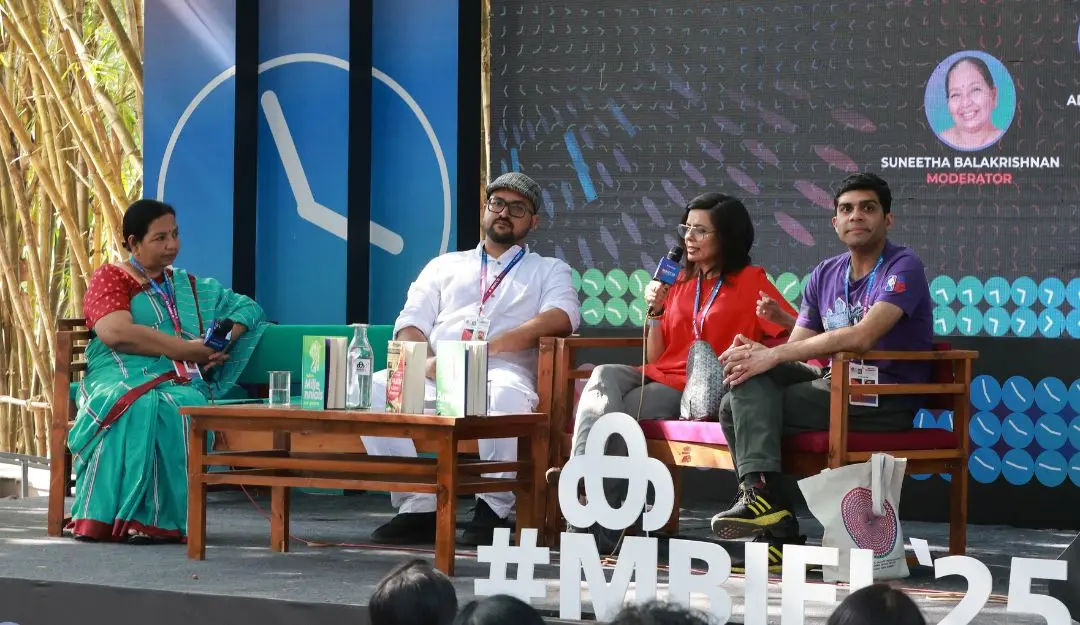
From fleeting trends to existential questions, the millennial experience is a complex tapestry woven with threads of ambition, anxiety, and a constant quest for meaning. At the sixth edition of Mathrubhumi International Festival of Letters (MBIFL), the 'Urban Tales: Bliss and Beyond' discussion unpacked this very tapestry, exploring the highs, lows, and everything in between of urban millennial life in India.
Moderated by Suneetha Balakrishnan, the panel featured authors Jyotsna Mohan, Karan Madhok, and Aditya Gautam, each offering unique perspectives on the challenges and triumphs of a generation navigating a rapidly changing world.
Aditya Gautam, author of a book exploring millennial culture, opened the discussion by describing his work as an examination of “consumption-based culture, the neoliberal world order, and consumerism” which, he argued, are “themes that run through every aspect of my generation.” He emphasized how everything, from body image to religion, has become a commodity in the modern world. “Every single culture has been boiled down to something that is sellable, buyable and consumable.”
Karan Madhok, author of a book on cannabis in India, connected the theme of consumption to his subject matter. “My book is about cannabis in India. People are kind of confused about it, they are unsure of its legality, they are unsure of the safety of its consumption.” Madhok’s work explores the cultural, legal, and pop culture impact of cannabis, weaving personal experiences with broader societal analysis. He described his research process as traveling across eight or nine Indian states, gathering stories from farmers, smugglers, and users, giving his non-fiction work a “storytelling approach.”
Jyotsna Mohan, author of "Pratap, A Defined Newspaper," focused on the consumption of knowledge, particularly in the context of her family's legacy as journalists. She discussed the challenges of maintaining journalistic integrity in an era of readily available, often unverified information. “People are not reading…it’s not amusing…it’s books like these that are trying to change that narrative.” Mohan’s book, co-authored with her father, explores the history of their family newspaper, including the impact of terrorism in Punjab. She emphasized the importance of telling untold stories, even when they are difficult. “There is a side of the story, this is the knowledge that has to come out.”
Gautam further elaborated on his research, describing his travels between Bengaluru and his hometown of Haridwar, observing the diverse experiences of millennials across India. He spoke about the "spirit that we are the same people who are forwarding misinformation… but at the same time, we are also the same cynical people who will never believe…what's on the screen." He highlighted the contrast between a millennial in Madhura who may not know what generation he belongs to but is still aware of global pop culture trends. He explained how his research challenged his own preconceived notions, making him "more open to hearing people on different spectrums of ideology, religion, philosophy, anything."
Madhok discussed the transition from writing fiction to non-fiction. "I love fiction…you choose a lie to tell a larger truth." He explained that while his book on cannabis is non-fiction, his storytelling approach remained. He described his research as a journey into the human stories behind the substance, from farmers in Himachal Pradesh to those struggling with addiction in the Northeast.
Jyotsna discussed the challenges of addressing sensitive topics in her writing, particularly in her previous book, "Stone Shame Depressed," which explored the challenges faced by Indian teens. "The reaction to that book was predictably a lot of denial because we don’t like to acknowledge that things are not okay at home." She argued that despite claims of being “western,” the issues she addresses are universal in the digital age. Her new book, she explained, also addresses the theme of acceptance, examining how the meanings of concepts like patriotism, democracy and nationalism have changed.
The conversation then turned to the topic of addiction, with Gautam identifying the internet and social media as defining institutions for millennials. "I think for millennials it was the internet and then later on the social media which is now basically synonymous with the internet." He explored the impact of social media on identity, arguing that individuals now see themselves as brands, leading to a curated and often inauthentic way of interacting with the world. "Everything becomes something that needs to be put into this meat slot."
Madhok addressed the complexities of addiction, particularly in relation to cannabis. "There’s a lot of debate about whether we can even call it an addiction. But philosophically I did do a lot of research about what it means to be dependent." He compared cannabis dependence to other forms of dependence, from shopping to harder drugs, emphasizing the importance of self-control.
Jyotsna shared her insights from researching gaming addiction for her previous book, highlighting it as an often-overlooked problem. The discussion concluded with a reflection on the challenges and opportunities facing millennials as they navigate a world of constant change, rapid technological advancements, and evolving social norms.