Young voices from South shine at MBIFL 2025
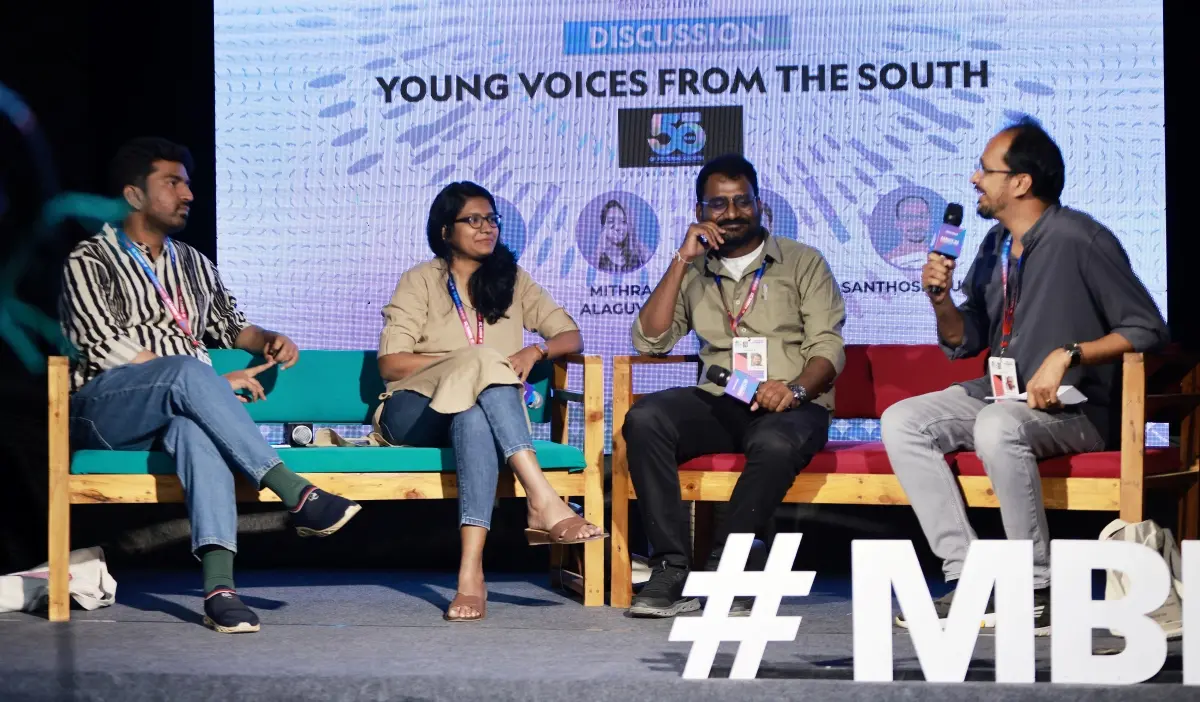
The "Young Voices from the South" session at MBIFL 2025 brought together emerging talents from Karnataka, Tamil Nadu, and Andhra Pradesh. The panel featured Kannada writer Dadapeer Jyman, Telugu writer Kavanamaali, and Tamil Nadu’s journalist-turned-writer Mithra Alaguvel. The discussion focussed on their literary journeys, challenges, and the translation landscape of their respective regions.
The accidental poet: Mithra Alaguvel
Mithra Alaguvel, a journalist and poet from Tamil Nadu, shared her unique entry into the literary world. Coming from a family of avid readers, she found herself as the first-generation writer in her family. “My higher secondary exams had a creative writing section where we could write a poem or an essay. My teachers began appreciating my poetry, and that’s when I realised I was good in it. I became an accidental poet,” she said with a smile.
Despite her passion, Mithra faced resistance from her family. While she hasn’t published much poetry, she has built a strong social media presence, which played a crucial role in boosting her first poetry collection, published in 2020.
Dadapeer Jyman: A mathematician with a literary heart
Kannada writer Dadapeer Jyman, winner of the Sahitya Yuva Puraskar, has authored three books. A mathematics teacher by profession, he never imagined he would become a writer until his classmates encouraged him to develop a reading habit.
“I write because it gives me courage, identity, and honesty,” he shared.
His award-winning short story collection Neela Kurinji gained recognition, though he admits that his poetry struggles to find publishers. Interestingly, he is also a huge fan of Malayalam cinema and food.
Kavanamaali: From Songwriting to Storytelling
Telugu writer Kavanamaali, who prefers to keep his real name anonymous, has authored five books, including a novel and two short story collections. His literary journey began in 2014, and he credits his friends for shaping his writing career.
“I started by writing lyrics for short films. One of my friends gifted me a book, and from that day, I never started a day without reading,” he reminisced.
Kavanamaali says that he started admiring Malayalam literature after he began reading the works of Vaikom Muhammad Basheer.
The role of translations
Moderator E Santhosh Kumar pointed out that in Kerala, magazine publications often serve as stepping stones for budding writers. When asked about the translation scene in their respective regions, the young writers shared mixed opinions. Kavanamaali noted that Telugu literature does feature translations from other languages, but Tamil Nadu primarily focuses on translating works of well-known authors. Mithra mentioned that the Tamil Nadu government has taken significant initiatives in recent years to translate Tamil books into languages such as Gujarati and Marathi. The government has also been facilitating meetings between international and regional publishers to boost translation opportunities.
However, she raised concerns about the quality of translations when multiple languages are involved. “Translations from Gujarati to Tamil are good, but when they go through English first, the essence is often lost,” she explained.
Dadapeer Jyman felt that while translations from Kannada to other languages do exist, the process can sometimes feel diluted, when English serves as the intermediary language. The panelists agreed that translations remain a challenge and requires improvement.
Former minister’s unexpected question
When the session opened for Q&A, veteran politician and diplomat Mani Shankar Aiyar, seated in the front row, enquired whether his books could be translated into Tamil, given that he hails from Tamil Nadu. He remarked with a touch of humor that none of his books had been translated so far.