Interdisciplinarity, access and autonomy: Experts reimagine education at MBIFL 2025
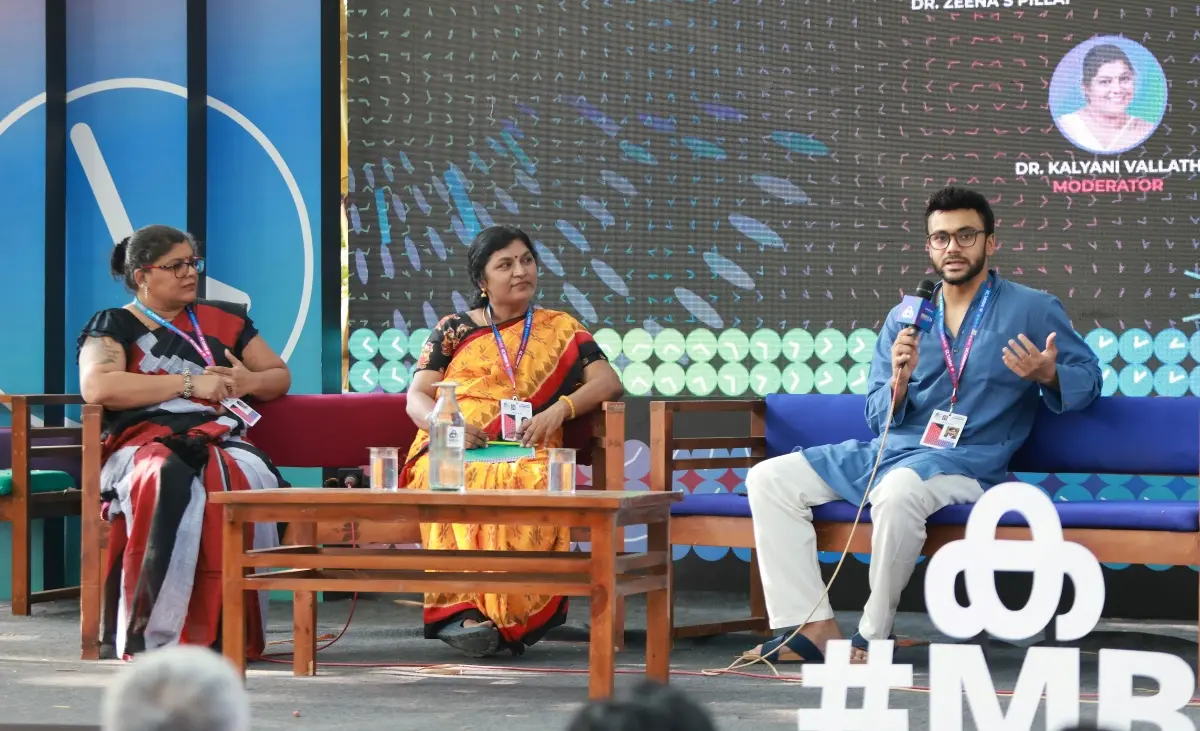
The sixth edition of Mathrubhumi International Festival of Letters (MBIFL) hosted a discussion on 'Redefining Higher Education' that explored the evolving landscape of learning in India. Moderated by Dr Kalyani Vallath, the panel featured Dr Zeena S Pillai from Amrita University and Dr Anirudh Sridhar from Alliance University, who shared insights into their institutions innovative approaches to education and tackled critical questions about access, interdisciplinarity, and the purpose of higher education in the 21st century.
Sridhar opened by discussing the challenges of establishing a liberal arts school in India, particularly the tension between problem-solving and "knowledge for its own sake."
He explained Alliance University's approach: "We decided to sort of leave that paradox at the heart of the school's sort of philosophy because I think that's a sort of very productive tension that should always be there in any school."
He emphasised the importance of intellectual exploration, allowing students to "experiment intellectually" before specialising. "Students at the age of 17 or 18 are hardly sort of, you know, exhausted in mind to be able to settle down to their major at that age." He also highlighted the university's focus on interdisciplinarity, enabling students to explore diverse fields from mathematics to the arts.
Zeena shared Amrita University's focus on "education for life and education for living," highlighting its diverse programs and alignment with the National Education Policy (NEP). She also discussed the university's commitment to skill-based education.
The discussion then shifted to the complexities of interdisciplinarity. Sridhar offered a nuanced perspective, noting that disciplines are often in a “political struggle against each other.” He argued that understanding this dynamic is crucial for students. “There isn't really a hierarchy of disciplines. There might be a hierarchy now, where science is at the top and the arts are at the bottom, let's say. But that hierarchy is just an extreme sort of happenstance.” He emphasised the need to make this clear to students so they can make informed choices about their education.
Zeena addressed the concern that interdisciplinary courses might dilute core learning. She explained Amrita University’s approach: “If we design a curriculum in such a way that they don't lose out the core aspects…it's not at the expense of you know losing out the essential requirement.” She also highlighted the university's focus on interdisciplinary research, citing her own work with bioactive natural products and the collaboration between the schools of medicine and Ayurveda. She shared examples of research that explores the interaction of allopathic and Ayurvedic medicines.
Pillai also spoke about Amrita’s “live-in-labs” program, where students work with villagers to address infrastructural challenges, combining theory with practical application. "It's something that you know they learn the theory in the classroom and then they try to apply it in the society so that you know they are aware about what all the problems are."
The conversation then turned to the challenges facing the humanities, particularly literature. Sridhar acknowledged the declining interest in these fields. "If that sense is just not there amongst the populace I don't personally see the point in trying to push it through and the onus is probably also on the writers to keep literature fresh."
The panelists then addressed the critical issue of democratisation of education. Pillai acknowledged the widening social divide but emphasised the need for greater awareness of available opportunities. "There are plenty of opportunities out there but then the awareness is very low." She stressed the importance of educating parents and empowering teachers to guide students toward diverse career paths. She suggested that NEP is trying to address these issues but awareness is crucial.
Sridhar offered a broader perspective on democratisation, highlighting the importance of education in enabling participation in a democracy. He shared an example from his work in Meghalaya, where communities are managing their own renewable energy systems. He explained how education, in this context, needs to be practical and accessible, enabling individuals to participate in “democratic reform.” He argued that a truly democratic education should focus on autonomy, giving individuals the knowledge and skills to control the material conditions of their lives. "I think that if one thinks of democratisation in terms of autonomy then one has to think about a technical education for everybody but just from the point of view of autonomy."
The discussion concluded with a reflection on the complex challenges and opportunities facing higher education in India, emphasising the need for innovative approaches that promote both academic excellence and social equity.