Why might the recent Hong Kong fire accelerate the phase-out of bamboo scaffolding?
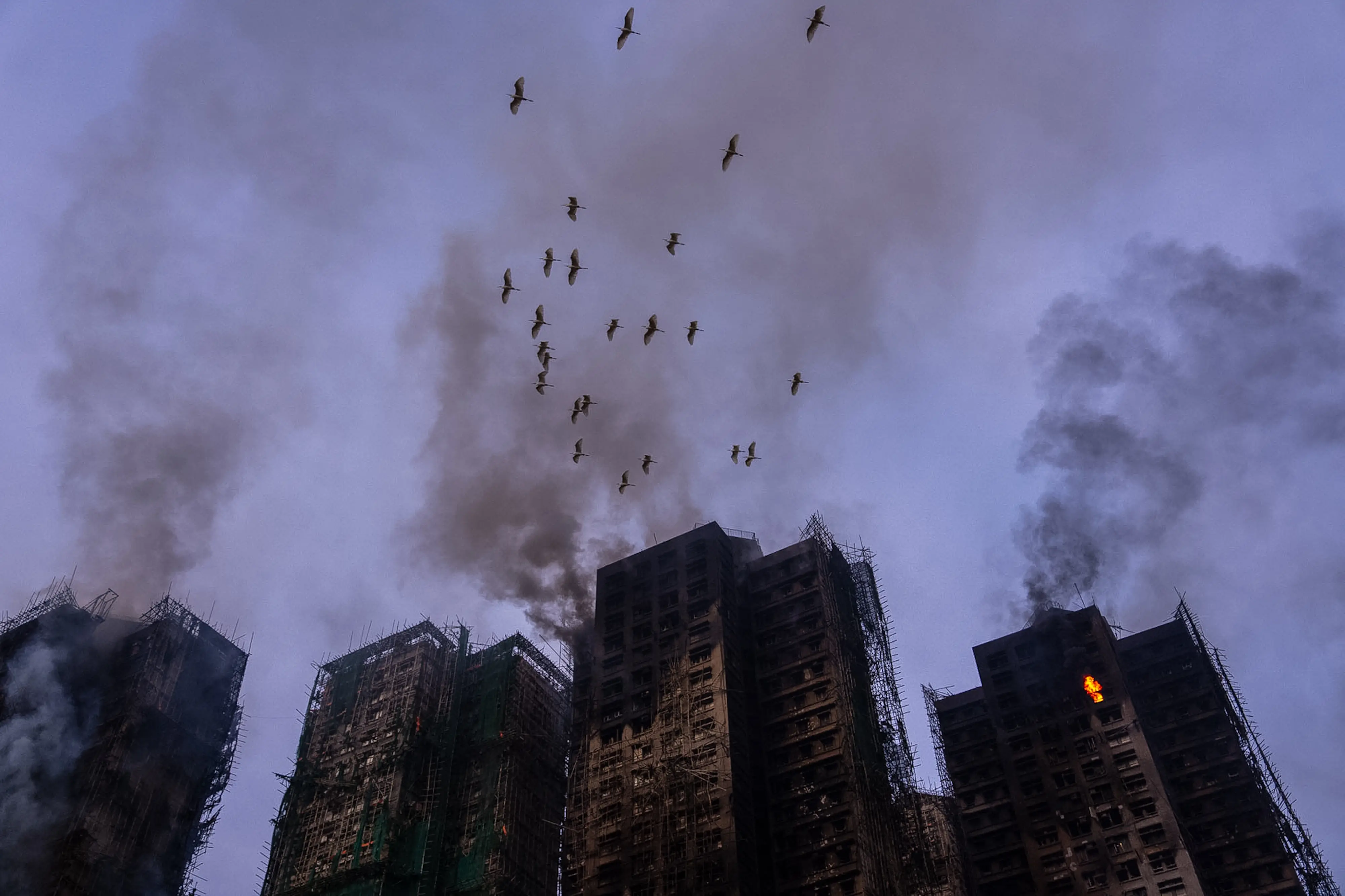
Bangkok: As investigators continue to search for the exact cause of the deadly blaze that ripped through a Hong Kong apartment complex, attention has turned to the bamboo scaffolding that covered the buildings at the time of the fire.
The inferno, which has killed at least 75 people, has prompted fresh scrutiny of the centuries-old construction technique that dates back more than 1,000 years.
Bamboo poles bound together with wire and other strong materials are commonly seen at construction sites in Southeast Asia, and Hong Kong remains one of the few major cities where such scaffolding is frequently used.
Officials said the fire on Wednesday began on the external scaffolding of a 32-storey tower in Tai Po, before spreading inside the building and then to six neighbouring towers. They said this was likely made worse by windy conditions.
Authorities are now investigating why the scaffolding and other renovation materials on the outside of the buildings were able to ignite.
Why is bamboo scaffolding used?
The bamboo poles, which come from three-year-old bamboo plants, are valued for being lightweight, inexpensive and easy to move. They are also considered practical for installation and removal in the tight spaces typical of Hong Kong’s densely built-up environment.
In accidents such as collapses, they are seen as less dangerous than heavy metal poles. The technique is also used for temporary structures, including outdoor theatres.
Most poles are imported from Zhaoxing in Guangdong province or from nearby Guangxi or Guilin in southern China.
Is Hong Kong moving away from bamboo?
Even Hong Kong is slowly shifting from bamboo to metal alternatives. A memo issued in March by the city’s secretary for development stated that Hong Kong aimed to “drive a wider adoption of metal scaffolding in public building works progressively.”
The Construction Industry Council said there are around 2,500 registered bamboo scaffolders in the city, and bamboo scaffolding-related accidents have resulted in 23 deaths since 2018.
Ehsan Noroozinejad, a professor at Western Sydney University’s Urban Transformations Research Centre, said that steel or aluminium scaffolding is non-combustible, stronger and more durable, although it is heavier, slower to assemble and more expensive. He said that for high-risk, occupied towers, metal was the safer choice. He added that bamboo should only be used if strict fire and inspection controls are in place.
Were other construction materials to blame?
In the Tai Po fire, officials have said that additional flammable construction materials, such as plastic netting and Styrofoam panels used as window coverings, may also have contributed to the rapid spread of the flames.
Police said they arrested three men, described as the directors and an engineering consultant of a construction company, on suspicion of manslaughter. Authorities said they believed some materials on the exterior walls of the high-rise buildings did not meet fire-resistance standards, enabling the unusually fast spread of the fire.
It is evident that much, though not all, of the bamboo surrounding the buildings during the renovation was destroyed in the blaze.
Devansh Gulati, founder of fire safety firm Greenberg Engineering, told that the incident carried significant lessons. He said that by chance the wrong conditions had combined in Hong Kong, allowing the bamboo scaffolding to act as fuel for the fire.
AP inputs