15 warships in the Gulf: USS Abraham Lincoln and 11 destroyers positioned for Iran blockade
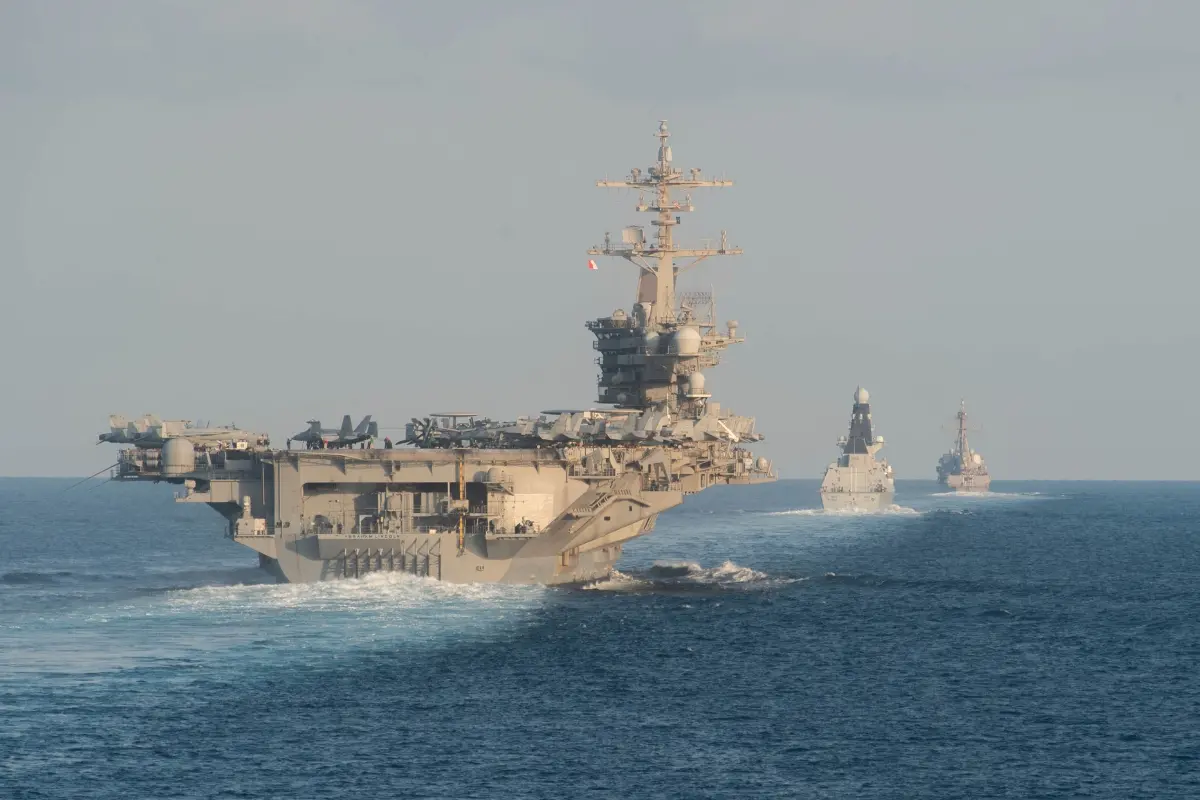
Washington: The United States Navy has positioned a formidable fleet of at least 15 vessels in the Middle East, including the aircraft carrier USS Abraham Lincoln and 11 destroyers, as President Donald Trump initiates a maritime blockade of Iranian ports following the collapse of diplomatic efforts in Pakistan.
According to a U.S. official cited by CNN, the precise distribution of these assets for blockade duties remains in flux, as naval resources are currently scattered across the U.S. Central Command’s expansive area of responsibility.
Naval Composition and Logistics
The deployed force features the USS Abraham Lincoln alongside 11 destroyers: the USS Bainbridge, USS Thomas Hudner, USS Frank E. Petersen Jr., USS Delbert D. Black, USS John Finn, USS Michael Murphy, USS Mitscher, USS Pinckney, USS Rafael Peralta, USS Spruance, and USS Milius. Furthermore, the Tripoli Amphibious Ready Group—consisting of the USS Tripoli, USS New Orleans, and USS Rushmore—is operating in the theatre.
While supported by various escort ships, certain components of the naval formation would be required to navigate the Suez Canal or circumnavigate Africa from the Mediterranean to reach optimal positions for enforcing the blockade.
The Nuclear Impasse
President Trump’s decision to impose the blockade followed marathon weekend negotiations in Islamabad that ended without a resolution. The president identified Tehran’s nuclear program as the definitive barrier to peace, reiterating his stance that "Iran will not have a nuclear weapon."
Commenting on the failed dialogue, Trump suggested that while several points were settled, the nuclear issue remained the final hurdle. "We agreed to a lot of things, but they didn't agree to that, and I think they will agree to it. I'm almost sure of it. In fact, I am sure of it," he remarked.
The president issued a categorical ultimatum regarding the future of the talks: "If they don't agree, there's no deal. There will never be a deal."
Uranium Recovery and Ultimatums
A primary American objective remains the retrieval of enriched uranium stockpiles within Iranian borders. "We're going to get the dust back. We'll get it back. Either we'll get it back from them, or we'll take it," Trump stated.
The situation is tempered by a two-week ceasefire announced by the president last week. However, Vice President JD Vance confirmed following the Pakistan summit that Iran refused to pledge to a permanent nuclear freeze. Trump warned that if the ceasefire expires without a signed accord, "it won't be pleasant for them."
When asked if his previous warning that "a whole civilisation will die" remained relevant, the president was elliptical. "I don't want to comment on that, but it won't be pleasant for them. Let me put it that way," he replied. Prior to the current truce, Trump had threatened the destruction of Iran's power infrastructure, noting it "makes no difference to me" if a deal is reached.
International Cooperation
While the blockade is currently a unilateral American military action, the president claimed that "other countries" have volunteered to assist, though he declined to name them.
"We don't need other countries, frankly. But they've offered their services," Trump said, indicating that specifics regarding international participation would likely be "let it be known, probably tomorrow."
With inputs from ANI