Trump scraps 20% Strait of Hormuz toll; here's what he plans instead
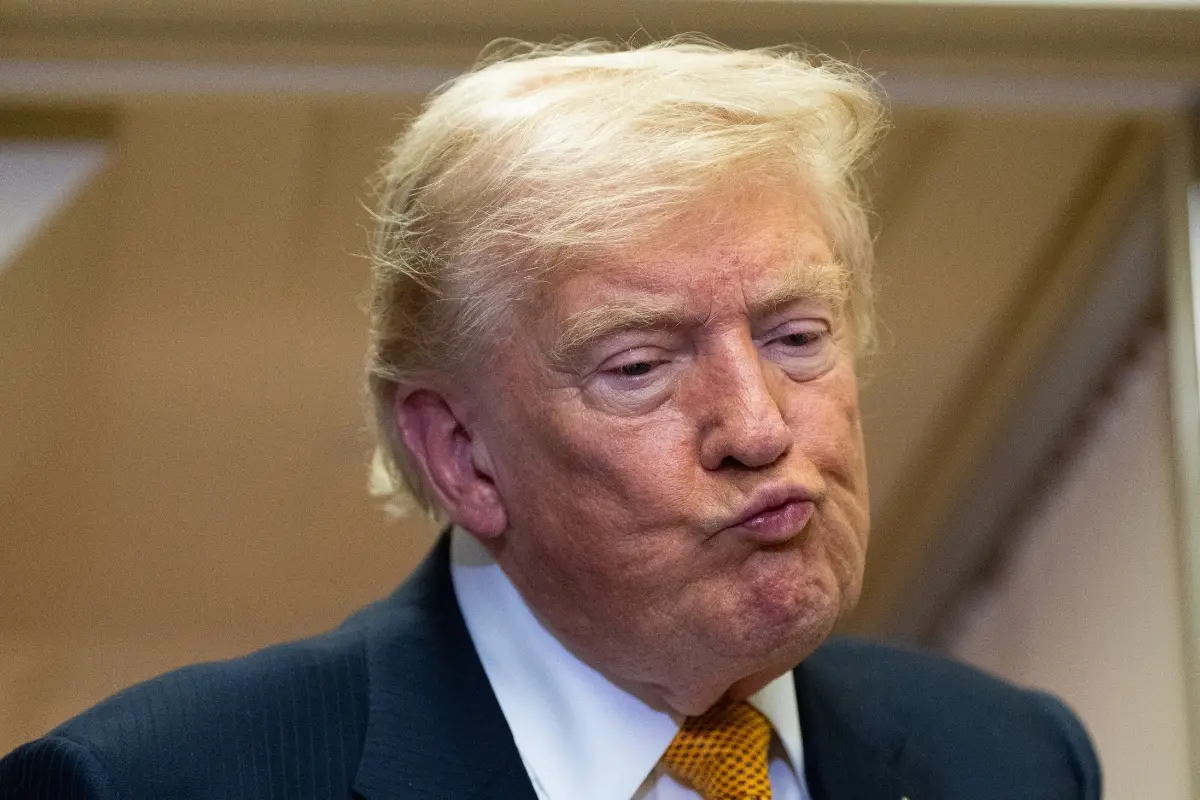
US President Donald Trump on Tuesday withdrew plans to impose a 20% fee on cargo passing through the Strait of Hormuz, saying Gulf nations would instead pursue investment and trade agreements with the United States.
The announcement came as military tensions in the region intensified. The United States carried out fresh strikes on Iran, which responded by attacking American allies and commercial vessels, further undermining an interim agreement intended to reduce hostilities and restore safe passage through the strategically vital waterway.
"Based on highly productive conversations with Middle East leadership, I have decided to replace the 20% United States Reimbursement Fee with Trade and Investment Deals that the various Gulf States will be making into the United States," Trump said in a post on social media.
He added that the investments "will be MASSIVE", although it remains unclear whether they represent new commitments beyond those announced following his visit to the Middle East last year.
Fighting threatens interim agreement
The latest exchange of strikes has dealt a major blow to the temporary agreement that was intended to pause the conflict, reopen the Strait of Hormuz to commercial shipping and provide negotiators with time to reach a permanent settlement.
Instead, fighting has spread across the region once again, raising concerns over the global economy and prompting fresh warnings for international airlines. Diplomats continue to push for negotiations, but the renewed violence has increased the risk of a wider regional conflict.
The Strait of Hormuz remains central to the crisis. During peacetime, around one-fifth of the world's traded crude oil and natural gas passes through the narrow waterway.
Iran had effectively disrupted shipping during the conflict by attacking and threatening vessels, driving up the prices of oil, fertilisers and other commodities at a time when governments were already grappling with inflation.
Although the interim agreement was meant to restore free navigation, Iran has continued attacking vessels travelling along a US military-supervised route outside its territorial control.
The United States has threatened to reopen the strait by force. However, experts say such an operation would require a significantly larger naval deployment and possibly tens of thousands of American ground troops. They also note that Trump could reverse course, as he has done previously.
US and Iran exchange fresh attacks
US Central Command said American forces struck multiple locations in Iran, targeting "coastal defense systems, missile and drone sites and maritime capabilities."
Iran acknowledged the strikes but did not immediately release details on casualties or damage.
"These strikes will continue imposing a heavy cost on Iranian forces and degrade their ability to attack innocent civilians and commercial shipping in the Strait of Hormuz," the US military said.
Iran responded by launching attacks on Bahrain, Jordan and three tankers that had travelled through the strait.
Two tankers linked to the United Arab Emirates — Mombasa and Al Bahiyah — caught fire during the attacks. According to the Emirati Defence Ministry, one mariner was killed and eight others were injured. The UAE warned it would retaliate.
Dutch shipping company Stolt Tankers said one of its vessels, Stolt Magnesium, came under attack off the coast of Oman. A fire broke out in the engine room, but all crew members were reported safe.
Iran's Revolutionary Guard claimed the Mombasa and Al Bahiyah had ignored repeated warnings. Tehran has previously targeted ships using a route through the strait that passes near Oman outside Iranian territorial waters.
Hours after Washington announced the end of its latest strikes, Iran's state-run IRNA news agency reported that the city of Bushehr on the Persian Gulf had been hit in at least four locations. The attacks renewed speculation that Gulf Arab states may have carried out retaliatory strikes.
Airspace warnings and diplomatic efforts continue
Bahrain, which hosts the US Navy's Fifth Fleet, activated missile warning sirens three times early on Tuesday. Jordan's military said it intercepted four Iranian missiles. Jordan, which hosts US forces, has faced repeated attacks from Tehran in recent days.
The European Union Aviation Safety Agency advised airlines not to operate in the airspace over Bahrain, Kuwait, Qatar, the United Arab Emirates and the Gulf of Oman.
In a safety bulletin, the agency warned that "unpredictable military developments, combined with the possible use of missiles, drones, combat aircraft and air-defense systems, create a high risk to civil flights."
Blockade dispute adds to tensions
The renewed fighting has further weakened the interim peace agreement, now approaching the halfway point of its 60-day implementation period. Negotiators were expected to use the period to finalise a broader agreement addressing Iran's nuclear programme and other outstanding issues.
Trump's renewed threat to impose a blockade has added further uncertainty.
The United States had lifted a blockade introduced in mid-April under the interim agreement. However, the US military announced it would reinstate the blockade from midnight on Wednesday in Dubai.
"We are reinstating the THE IRANIAN BLOCKADE," Trump said on social media on Monday.
He had also proposed charging ships a fee equal to 20% of the value of their cargo to cover "any and all costs necessary to do the job of providing safety and security."
The proposal marked a departure from longstanding US policy supporting unrestricted passage through the Strait of Hormuz. It also contradicted recent assurances by US Secretary of State Marco Rubio during his visit to the region that shipping through the waterway would remain toll-free.
Under the interim agreement, Iran had agreed not to impose charges for transit through the strait during the 60-day period. However, the agreement left unresolved what would happen afterwards. Tehran maintains that it has the authority to regulate shipping and potentially levy fees, a position disputed by Washington.
Any attempt by either side to impose transit charges would challenge established international norms on freedom of navigation and could further disrupt global trade.
Brent crude, the international oil benchmark, climbed above $87 a barrel on Tuesday, reaching its highest level in a month. Although still below the nearly $120 seen at the peak of the conflict, the increase has renewed concerns over higher global energy costs.
Regional mediation continues
Regional mediators are continuing efforts to bring Washington and Tehran back to the negotiating table, according to two regional officials familiar with the discussions.
Speaking anonymously due to the sensitivity of the talks, the officials said Pakistan-led mediation was continuing around the clock in an effort to restore the ceasefire.
Separately, Lebanese and Israeli delegations were expected to meet in Rome on Tuesday for US-mediated negotiations.
Hezbollah entered the conflict after the war began on February 28, launching attacks on Israel in support of Iran. Israel responded with a ground offensive in Lebanon.
Last month, Lebanon and Israel announced a framework agreement under which Israeli forces would withdraw from southern Lebanon in exchange for Hezbollah's disarmament. However, implementation has stalled.
Even before the latest escalation around the Strait of Hormuz, fighting between Israel and Hezbollah had repeatedly threatened the interim agreement. While a ceasefire remains in place in Lebanon, its future could depend on whether the United States and Iran avoid a return to full-scale war.