‘Missiles and drones smashed, ships sunk’: Trump’s Middle East update
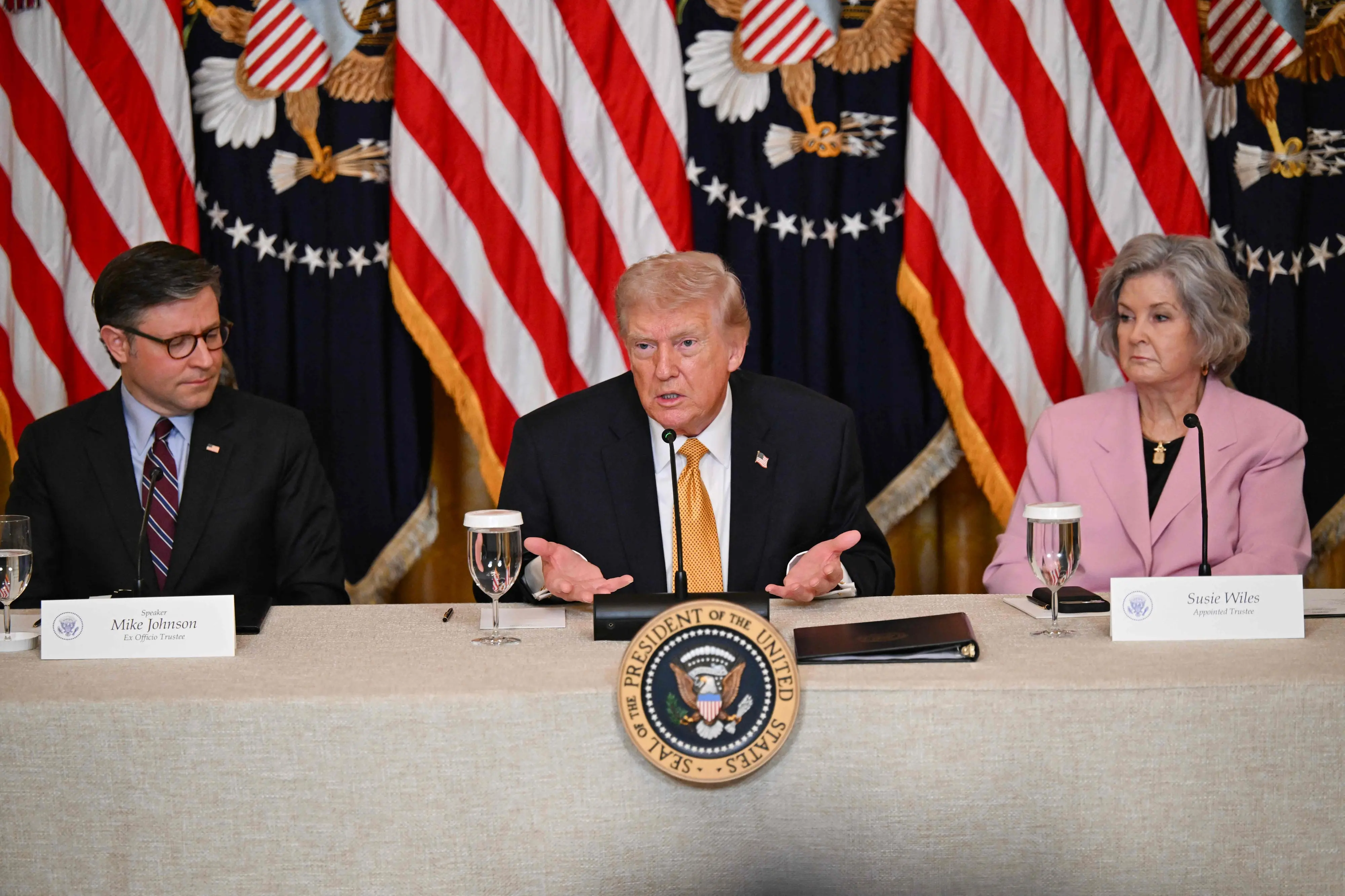
Washington: US President Donald Trump on Monday said American forces had delivered a devastating blow to Iran’s military capabilities and urged major global economies to help protect the Strait of Hormuz, a crucial energy corridor through which a large portion of the world’s oil passes.
Speaking at the White House during a meeting with board members of the Trump-Kennedy Centre, Trump said the US military campaign against Iran had intensified in recent days.
“Our powerful military campaign to end the threats posed by the Iranian regime has continued in full force over the past few days,” he said, claiming the operation had severely weakened Iran’s armed forces.
“They have been literally obliterated. The Air Force is gone, the Navy is gone. Many, many ships have been sunk,” Trump added.
The President said the United States had carried out a sweeping series of strikes since the conflict began.
“Since the beginning of the conflict, we’ve struck more than 7,000 targets across Iran, mostly commercial and military,” he said, adding that the operations had sharply reduced Iran’s missile and drone attacks.
“We’ve achieved a 90 per cent reduction in their ballistic missile launches and a 95 per cent reduction in drone attacks,” he stated, noting that US forces had also targeted Iranian weapons production facilities.
“Additionally, we’ve attacked the manufacturing plants where they make missiles and drones,” Trump said, highlighting significant damage to Iran’s naval capabilities.
Also Read| Lebanon displacement figures: Over 1 million people registered since Israel-Hezbollah war
“More than 100 Iranian naval vessels have been sunk or destroyed over the last week and a half,” he said, noting that US forces had also targeted ships capable of laying naval mines that could threaten global shipping.
“We’re hammering their capacity to threaten commercial shipping in the Strait of Hormuz, with more than 30 mine-laying ships destroyed,” Trump added.
Despite the ongoing military campaign, Trump urged countries that rely heavily on the Strait of Hormuz to contribute to securing the vital shipping lane.
“We strongly encourage other nations whose economies depend on the strait far more than ours,” he said, pointing out that the United States imports very little oil through the waterway compared with other major economies.
“You know, we get less than one per cent of our oil from the Strait. Japan gets 95 per cent, China gets 90 per cent, many European countries rely heavily, and South Korea gets 35 per cent. So we want them to come and help us with the Strait,” he said.
Also Read| ‘Which side are you on?’: Iran’s Ali Larijani slams Muslim nations over US-Israel ties
Read more at: https://english.mathrubhumi.com/news/world/iran-ali-larijani-islamic-solidarity-appeal-us-israel-conflict-bfx8wkyd
Trump also suggested that some long-time US security partners had shown reluctance to assist despite American military commitments.
“We have some countries where we have 45,000 soldiers protecting them. And when we ask if they have any minesweepers, the reply is, ‘We’d rather not get involved, sir,’” he said.
Earlier, White House Press Secretary Karoline Leavitt told reporters that many countries were benefiting from the US military campaign targeting Iran’s capabilities.
“These other countries are benefiting greatly from the United States military taking out the threat of Iran,” she said, adding that Iran posed threats not only to the US but also to partners across the Middle East and Western allies.
“The rogue Iranian regime has long posed a threat not just to the United States, but also to our Gulf and Arab partners in the region. Its ballistic missile capabilities were a direct and imminent threat to our European allies as well as US bases in the region,” Leavitt said.
The Strait of Hormuz, situated between Iran and Oman, is one of the world’s most critical energy chokepoints, transporting roughly a fifth of global oil shipments. Tensions in the area have frequently escalated during conflicts involving Iran, raising concerns about global energy prices and international trade.
IANS