Opposition fighters at Damascus' gates: Who are they and what’s next for Syria?
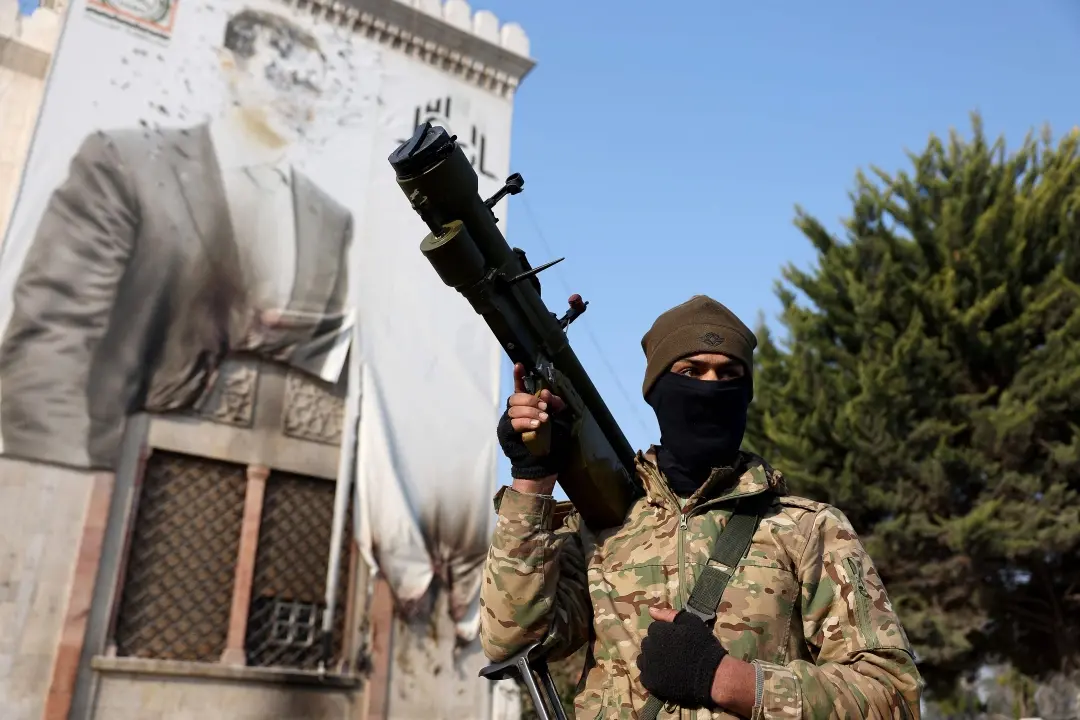
Damascus: In a rapidly developing crisis, opposition fighters have entered Syria's capital, Damascus, catching the world by surprise. The Syrian army has abandoned key cities with little resistance, and President Bashar Assad has now left the country. This marks a stunning reversal of fortunes for Assad's government, which has controlled much of Syria for over a decade.
Who are these opposition fighters? If they take control of Damascus after seizing some of Syria's largest cities, what then?
Who are the opposition fighters?
The opposition fighters advancing toward Damascus are led by the most powerful insurgent group in Syria, Hayat Tahrir al-Sham (HTS). This group, which has its origins in al-Qaida, is considered a terrorist organisation by both the United States and the United Nations. However, HTS has claimed in recent years that it has severed ties with al-Qaida and has shifted its focus to establishing civilian governance alongside its military activities.
Alongside HTS, an umbrella group of Turkish-backed Syrian militias, known as the Syrian National Army, is also participating in the offensive. Both groups have been based in the northwest of Syria and began their shock offensive on November 27. They captured Syria's largest city, Aleppo, as well as the central city of Hama, the country’s fourth largest.
According to reports, HTS leader Abu Mohammed al-Golani told that the goal of the offensive is to overthrow Assad’s government.
The complex situation: Allies or rivals?
While the HTS and the Syrian National Army have worked together in the past, they have also been rivals. Their differing aims could become a significant issue if they succeed in overthrowing Assad.
The Turkish-backed Syrian militias have a particular interest in establishing a buffer zone near the Turkish border to keep Kurdish militants away. Turkey has long supported fighters seeking to overthrow Assad, but recently has called for reconciliation. Turkish officials have strongly denied any involvement in the current offensive.
It remains uncertain whether the HTS and the Syrian National Army will continue to cooperate after achieving their goal, or if their relationship will deteriorate once Assad is overthrown.
Other areas join the fight
While the main offensive has been in the north, other armed opposition groups have also mobilized in different parts of Syria. The southern areas of Sweida and Daraa have both been taken by opposition fighters.
Sweida, which is home to Syria's Druze religious minority, had seen ongoing anti-government protests even after Assad regained control over the region. Daraa, a Sunni Muslim area, is known as the birthplace of the uprising against Assad in 2011. While Daraa was recaptured by Syrian government forces in 2018, some rebel groups remained active in the area. In recent years, Daraa had been relatively quiet under a ceasefire agreement brokered by Russia.
In the east, the Syrian Democratic Forces, a Kurdish-led group backed by the United States, continue to control much of the region. They have clashed in the past with many other armed groups in the country.
Currently, the Syrian government controls only three of the country’s 14 provincial capitals: Damascus, Latakia, and Tartus.
What comes next?
Opposition forces are now in the "final stage" of their offensive, according to a commander with the insurgents. They are reportedly encircling Damascus, preparing to capture it. Syrian troops have also withdrawn from the central city of Homs, Syria’s third largest city. If Homs falls, the link between Damascus and the coastal region—where Assad enjoys significant support—would be severed.
A Damascus resident, Anas Joudeh, expressed the gravity of the situation, saying, “Homs to the coastal cities will be a very huge red line politically and socially. Politically, if this line is crossed, then we are talking about the end of the entire Syria, the one that we knew in the past.”
Assad's allies are distracted
Assad now appears to be largely isolated, with his main allies, Russia and Iran, distracted by other conflicts. Hezbollah, a Lebanon-based militant group that has supported Assad in the past, has been weakened by its war with Israel, which is currently under a fragile ceasefire.
International efforts to address the crisis
The UN special envoy for Syria, Geir Pedersen, has called for urgent talks in Geneva to ensure an “orderly political transition” in Syria.
He has met with foreign ministers and senior diplomats from eight key countries—including Saudi Arabia, Russia, Egypt, Turkey, and Iran—on the sidelines of the Doha Summit.
(Agency inputs)