Eight killed after Beryl sweeps across US; power outage leaves people in disarray
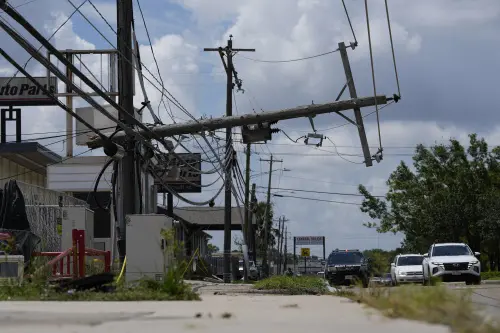
Houston: At least eight fatalities were reported in the southern United States following the havoc wrought by Storm Beryl, which brought down trees and triggered severe flooding before dissipating into a post-tropical cyclone on Tuesday.
Beryl made landfall in Texas early Monday as a Category 1 hurricane, claiming seven lives in the state and another in neighbouring Louisiana, according to authorities. The storm's total death toll now stands at least 18, having previously devastated parts of the Caribbean as a record-breaking Category 5 hurricane.
In Texas alone, around 2 million households faced power outages as damaged grids struggled to cope, compounded by scorching temperatures forecasted to soar up to 106 degrees Fahrenheit (41 degrees Celsius) with humidity. President Joe Biden expressed concern over the dire situation, emphasising the impact of widespread power cuts and extreme heat on Texans.
Across Texas and Louisiana, approximately 14,000 homes remained without electricity, prompting the establishment of air-conditioned shelters to aid affected residents while restoration efforts continued.
By Tuesday, Beryl had weakened considerably, moving northeastward through the midwestern United States with winds of 30 miles per hour (45 kilometres per hour), as warned by the US National Hurricane Center. Although downgraded, the storm still posed risks of flooding and tornadoes.
Houston, home to 2.3 million residents, bore the brunt of Beryl's wrath with hurricane-force winds and extensive flooding. Harris County Sheriff Ed Gonzalez confirmed the deaths of a 53-year-old man and a 74-year-old woman due to falling trees on their homes. Meanwhile, Houston Mayor John Whitmire reported additional fatalities, including one from a lightning-induced fire and another involving a police department employee caught in floodwaters.
In neighbouring Louisiana, the Bossier Parish sheriff's office reported a fatality caused by a tree collapse onto a residence.
Rose Michalec, a resident of south Houston, described the storm's impact on her neighbourhood, highlighting downed fences and unexpected levels of damage. Downtown Houston experienced significant inundation, including areas frequented by locals like 76-year-old Floyd Robinson, who noted unprecedented water levels.
The storm's path began with Grenada and Saint Vincent and the Grenadines, where it struck as a Category 4 hurricane, before advancing through the Cayman Islands, Jamaica, and ultimately Mexico, where it caused further destruction. Beryl's early intensity, reaching Category 5 at one point, marked a historic event in June, followed by its landing in Texas, the earliest such hurricane in a decade.
Meteorologists attribute the storm's rapid intensification to climate change, suggesting warmer oceans provide more energy for storms like Beryl to strengthen quickly. This phenomenon underscores the growing impact of climate change on hurricane dynamics during the Atlantic hurricane season, extending from early June to late November.
On the whole, Beryl's trajectory from the Caribbean to the southern US left a trail of devastation, underscoring the urgent need for preparedness and climate action in the face of increasingly powerful storms. Agencies