Security Council reform remains elusive: UN General Assembly postpones discussions again
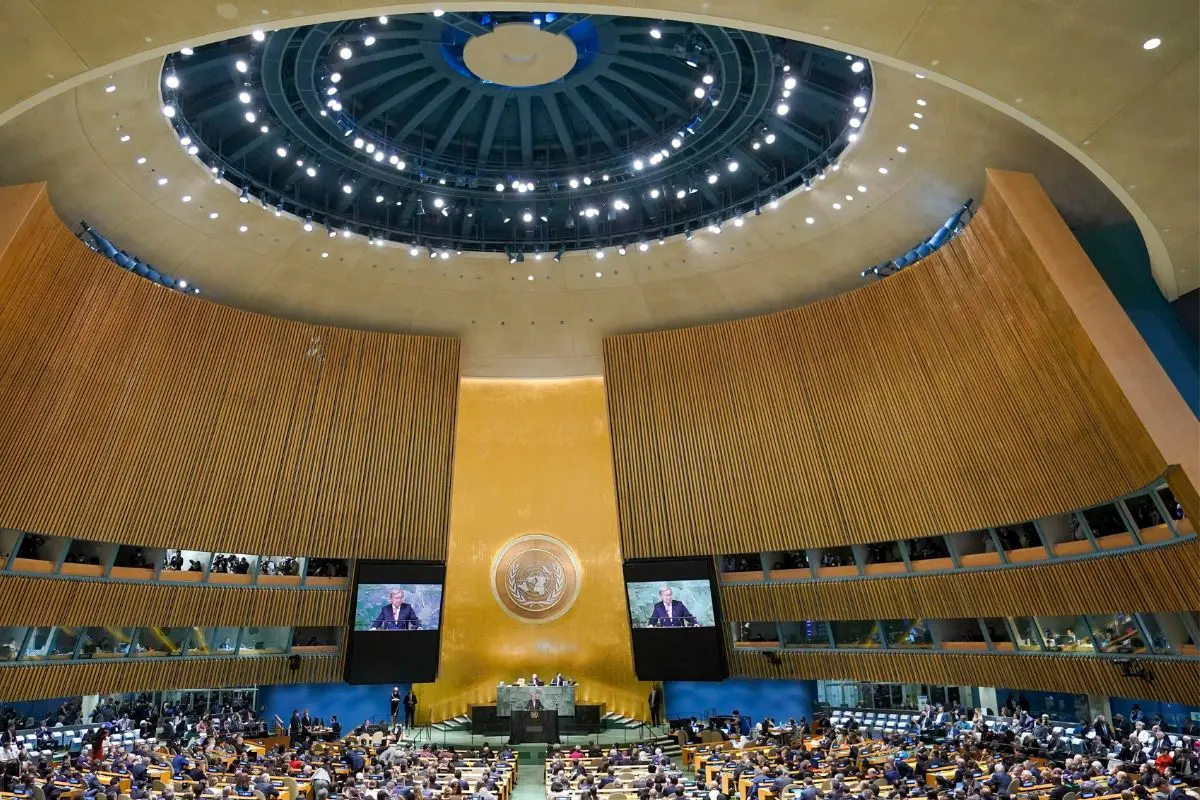
New York: For the 17th consecutive time, the UN General Assembly has postponed discussions on Security Council reforms, failing again to agree on a text to guide debate.
On Tuesday, the Assembly unanimously adopted a resolution to carry forward discussions on reforming the Council, including proposals to add new permanent members, to the next session beginning next month.
Speaking on behalf of India, Brazil, Germany, and Japan, which together form the G4 group, Japan said the Assembly’s repeated failure undermines trust in the UN and its ability to maintain international order.
“The continued failure in Security Council reform is an issue that goes well beyond the Council itself,” said Iriya Takayuki, a minister in Japan’s UN Mission. “Given the reality that the UN, which is at the centre of multilateralism, has been shaken and the international order is in flux, reform of the Council is needed not only to strengthen the UN as a whole, but also to maintain the entire international order.”
“The G4 would therefore like to emphasise that this is an urgent issue that deeply concerns all member states, not just a few,” he added.
The four nations advocate increasing the number of permanent seats on the Council and support each other for those positions. “In light of the continued and serious challenges to international peace and security, and the critical role of the Security Council in addressing them, reform of the Council is urgently needed and must be advanced without delay,” Takayuki said.
One sign of progress in the Inter-Governmental Negotiations (IGN), the formal reform process, was the revised “Elements Paper” produced by its co-chairs, outlining their interpretation of the positions of different countries and groups. However, Takayuki said the document does not recognise that the majority of UN members support adding both permanent and non-permanent members.
Since the IGN began in 2009, negotiations have been stalled by a small group of countries, known as Uniting for Consensus (UFC), led by Italy and including Pakistan. They oppose adopting a negotiating text without consensus on reforms, effectively blocking progress. Most countries, including the G4, have repeatedly called for text-based negotiations.
General Assembly President Philomen Yang’s spokesperson, Sharon Birch, said the process had seen progress during the session. “The negotiations on reforms have been energised, and member states have been more engaged than ever in the discussions,” she said, adding that the Pace of the Future report, adopted at last year’s high-level meeting, laid a strong foundation for Security Council reform.
The Council’s structure remains rooted in post-World War II geopolitics. Its last reform, 57 years ago, added four non-permanent members but did not expand permanent membership. At that time, UN membership was 113; today it stands at 193, while the Security Council remains frozen at 15 members, with five permanent seats held by Britain, China, France, Russia, and the United States.
IANS