Parcel in the sky: How three aviation lovers designed the Airbus A350F’s special look
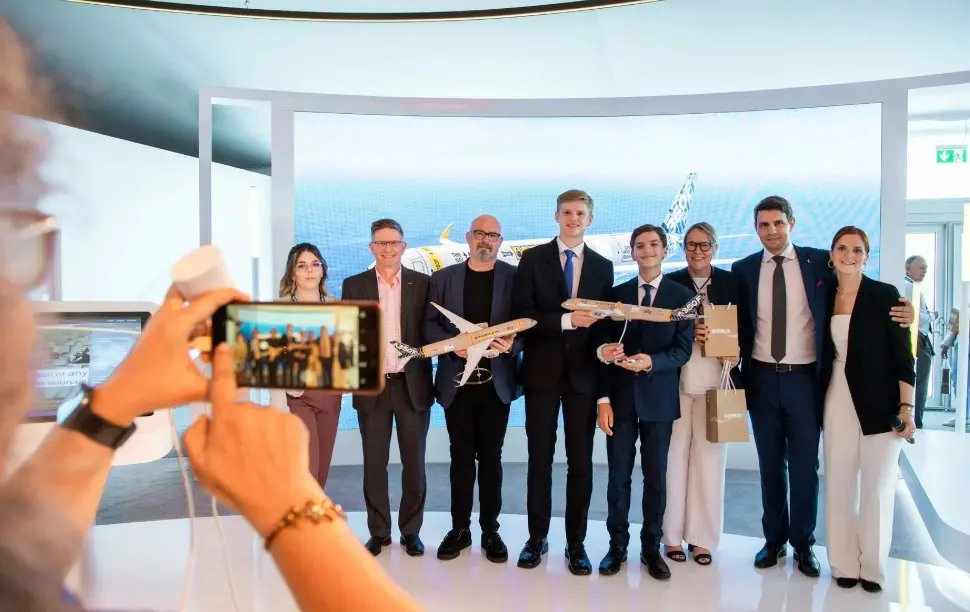
An Irish graphic designer and two Canadian brothers, separated by an ocean and a generation, found the same inspiration in an everyday cardboard box. Their shared idea now flies on one of the world’s newest cargo aircraft.
Sometimes, the most beautiful ideas begin with the simplest things. A cardboard box, for instance, might seem an unlikely source of inspiration for an aircraft design. But for three aviation enthusiasts living thousands of kilometres apart, it became the idea that brought them together.
John Feehan, a graphic designer from Dublin, Ireland, and brothers Quinnten and Ellisten Iversen from Calgary, Canada. They had never set out to work together. They belonged to different generations, lived on different continents and came to an aircraft design competition with their own ideas. Yet, when Airbus invited the public to design the special livery of its new A350F freighter, all three arrived at a remarkably similar conclusion, why not make the aircraft look like the very thing it was built to carry a parcel?
Today, their imagination has become part of an actual flying aircraft. The distinctive design adorns the first Airbus A350F, turning a routine sight in the sky into a story about creativity, family, shared dreams and the unexpected ways in which people can connect.
An invitation that brought the world together
In September 2022, Airbus opened an unusual competition to the public. Instead of leaving the appearance of its new freighter entirely to its corporate design team, the company invited people from around the world to imagine what the aircraft should look like.
More than 4,000 people entered. Among the submissions were the designs of Feehan and the Iversen brothers, whose ideas had emerged independently but shared a common theme.
The jury selected their two concepts, and Airbus brought them together with the company's corporate design team to create a single livery. The finished design was unveiled alongside the winners at the Paris Air Show in June 2023.
What makes the story special is that the three winners did not simply receive recognition for separate ideas. Their work was combined into one design, demonstrating how different people can contribute to something greater than any one of them could have created alone.
Why a cardboard box?
For the Iversen brothers, the inspiration was hiding in plain sight. A freighter carries packages across countries and continents, so why not let its appearance tell that story?
Quinnten explained that a packaging box seemed the natural choice for an aircraft whose purpose was to transport cargo. The concept was simple, immediately recognisable and playful, while still looking professional.
Across the Atlantic, Feehan had reached much the same conclusion. He wanted the aircraft to look as though it did exactly what it was meant to do. A parcel-inspired design, he felt, communicated the purpose of a cargo aircraft without needing a lengthy explanation.
The similarities between the two submissions made them natural partners. Airbus Corporate Design Manager Cassian Koshorst, who led the process of combining the concepts, said the designs focused on slightly different elements but complemented each other perfectly.
The final result wraps the A350F in the visual language of a package in transit. It is a clever idea that even a person with little knowledge of aviation can appreciate: an aircraft carrying parcels across the world looks like a parcel itself.
A father’s encouragement and a brother’s shared dream
Feehan entered the competition after encouragement from his aviation-loving son. For the Dublin-based designer, it was an opportunity to think differently, challenge himself and work with a leading name in aviation.
The Iversen brothers came to the competition through their shared interest in aircraft. Quinnten, then 16, discovered the opportunity while reading aviation news and described the idea to his younger brother, Ellisten, then 12. Ellisten, a plane-spotter and model aircraft collector, joined him in developing the concept.
At that age, winning an international design competition might have seemed like an almost impossible dream. Quinnten remembered thinking about the odds of being selected from thousands of entries. Yet, as he reflected later, creativity and passion can take people further than they expect.
For the brothers, the experience moved well beyond a competition submission. Their names would be associated with an aircraft built to carry cargo around the world, and their idea would become part of its identity.
When a drawing becomes an aircraft
The journey from a design on paper to an actual aircraft takes time, patience and many people's efforts. The A350F livery was unveiled in 2023, but seeing the design on a flying aircraft brought the experience to an entirely new level.
The first A350F has now taken to the skies for its flight-test campaign, wearing the distinctive parcel-inspired livery. The winners' names are painted on the fuselage, travelling with the aircraft as it undergoes testing.
For Feehan, watching the aircraft fly was an extraordinary experience. Seeing the collective work that made the aircraft take flight, with his name on its side, was the icing on the cake.
For Quinnten, it was a dream come true. Ellisten described the feeling in simpler terms: pure joy.
It is easy to imagine the excitement of spotting the aircraft in photographs or videos and knowing that an idea once sketched out by a young aviation enthusiast had become part of a real aeroplane. For the brothers, the design also became a reminder that an interest nurtured at home can lead to opportunities far beyond the familiar surroundings of their city.
More than paint on an aircraft
An aircraft's livery is its exterior identity, the colours, markings and design that help people recognise it. Airlines often use liveries to express their brand, while special designs can celebrate milestones, partnerships or important stories.
The A350F's livery does something a little different. It tells people what the aircraft is there to do, using an object that almost everyone recognises. A cardboard parcel is ordinary, but on the fuselage of a modern freighter, it becomes a symbol of the connections that air cargo makes possible.
The aircraft itself is designed to carry goods across long distances. Airbus says the A350F is capable of carrying a payload of up to 111 tonnes, with capacity for 42 pallets and a range of up to 4,700 nautical miles. It remains in its flight-test programme as it moves towards certification.
Yet, alongside the engineering behind the aircraft, there is a human story painted on its exterior. Three people, separated by geography and age, imagined the same thing and saw their ideas brought together.
A dream that keeps flying
There is another lovely twist to this story. When Quinnten first entered the competition, he was a student pilot. He has since earned his commercial pilot's licence and is preparing to enter the aviation industry. His younger brother, Ellisten, who once imagined becoming a pilot himself, was inspired by his experience with Airbus to explore engineering. He is now pursuing studies with an eye on the aerospace field.
Their paths may be different, but the competition gave both brothers a glimpse of how many possibilities exist in aviation beyond the cockpit. An aircraft needs pilots, of course, but it also depends on engineers, designers, technicians and countless other people whose ideas and skills bring it to life.
For Feehan, the livery has become a lasting reminder of what can happen when a creative idea finds the right opportunity. For the Iversen brothers, it is a remarkable chapter in their journey into the world of aviation.
And for everyone who sees the A350F crossing the sky, the design offers a small reason to smile. Somewhere between Dublin and Calgary, a simple idea found common ground. Now, carried on the side of a cargo aircraft, it is travelling farther than its creators could ever have imagined when they first put pencil to paper.