'It's all in ruins': the devastated lives at epicentre of Spain's flood disaster
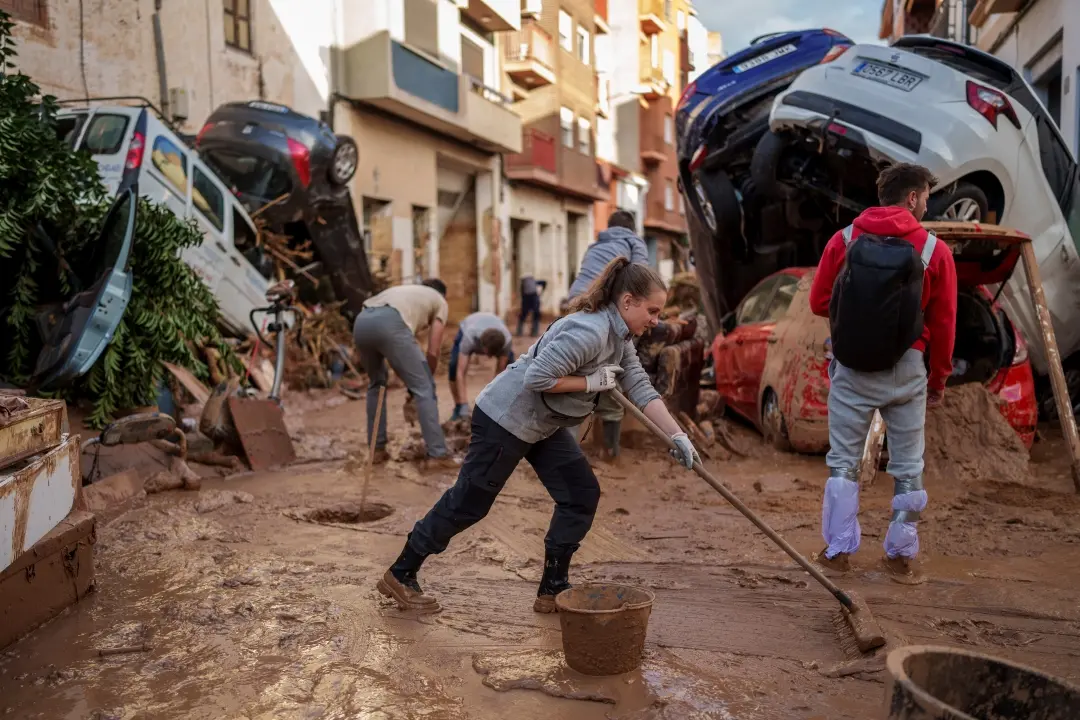
Paiporta (Spain): Four days after tsunami-like floods engulfed the southern outskirts of Valencia, communities remain buried under layers of thick, sticky mud. The municipality of Paiporta, home to 30,000 people, has been struck with unprecedented destruction, with local media describing it as the “ground zero” of Spain’s deadliest natural disaster in recent memory.
While a few images of smiling toddlers on the wall miraculously survived, nearly everything else in a daycare center – cradles, highchairs, toys – was lost as water surged through the town. Xavi Pons, a longtime resident, pointed to the knee-high mudline inside the center that his wife’s family had run for over 50 years. “We’ve lost everything,” he told the Associated Press. “I’ve lived here all my life. This has never happened before, and no one could have imagined it. All of Paiporta is like this – it’s all in ruins.”
Of the 213 confirmed deaths from the floods that struck Spain on Tuesday and Wednesday, at least 62 occurred in Paiporta, with the majority happening in Valencia’s eastern region. Many of Paiporta’s streets remain inaccessible to anything but bulldozers, blocked by piles of ruined furniture, household items, and countless wrecked vehicles. Streets are caked with mud, and residents, using poles to keep steady, must walk as if trekking through a marsh.
In the midst of the debris, a washing machine lies on its side in a church square. An enormous tree trunk has smashed through a shop wall, while antiques, paintings, and a teddy bear lie half-buried in the muck. Lidia Giménez, a school teacher, watched in horror as the usually dry canal dividing the town — “Barranco del Poyo” — went from empty to overflowing within 15 minutes. Describing the aftermath as “a battlefield without bombs,” she added, “Not a drop of rain even fell on Paiporta.”
The storm had unleashed a torrential downpour upstream, which swept through Paiporta and other areas closer to the Mediterranean coast, causing widespread devastation. Yet residents received no flood warnings from the regional government until two hours after the water had surged through.
The flood’s force widened the riverbank, tearing away buildings, collapsing a pedestrian bridge, and stripping metallic handrails from another. A truck lies overturned in the canal’s muddy bed, only its wheels visible above the sludge. Recovery will be a lengthy process, as the scale of damage will take weeks to clear.
Thousands of volunteers made the journey from Valencia city, walking over an hour carrying buckets, brooms, and shovels to help clean up Paiporta’s wreckage. Homeowner Rafa Rosellón waited for heavy machinery to remove two cars — one perched partially atop the other — that had washed up outside his front door, blocking entry. He had to unscrew a metal grate and climb through a window just to see the mess inside. “I can’t do anything until those cars are moved,” he said, adding that, so far, it was only citizens and volunteers who were shouldering the cleanup efforts. “The government forces that could help – from the regional or national levels – haven’t done anything to assist us.”
To aid in recovery, 2,000 soldiers, along with 1,800 national police officers and nearly 2,500 Civil Guard gendarmes, have been deployed to the flood zone to search for survivors, distribute essential goods, and assist with cleanup. Spanish Prime Minister Pedro Sánchez reported on Saturday that the combined efforts had rescued around 4,800 people and assisted over 30,000 others in homes, on roads, and in flooded industrial areas. Sánchez announced that an additional 5,000 soldiers and 5,000 police were being dispatched to eastern Spain to intensify recovery operations.
Soldiers in action
Only a small team of soldiers was working to push through the mud in Paiporta on Saturday when Sánchez made his promise. As they labored, residents continued to confront their immense losses. A woman sweeping muddy water from her door broke into tears when asked what she had lost. “I can’t find my husband, so none of this matters,” she said.
Nearby, a street bore a haunting sight: half a dozen cars scattered and covered in reeds that once grew nearby. From within a house, a man’s desperate voice echoed, “There’s nothing more I can do! There’s nothing more I can do!”
Agenies