Netanyahu proposes unity government, offers Eisenkot first term as PM ahead of Sunday meeting
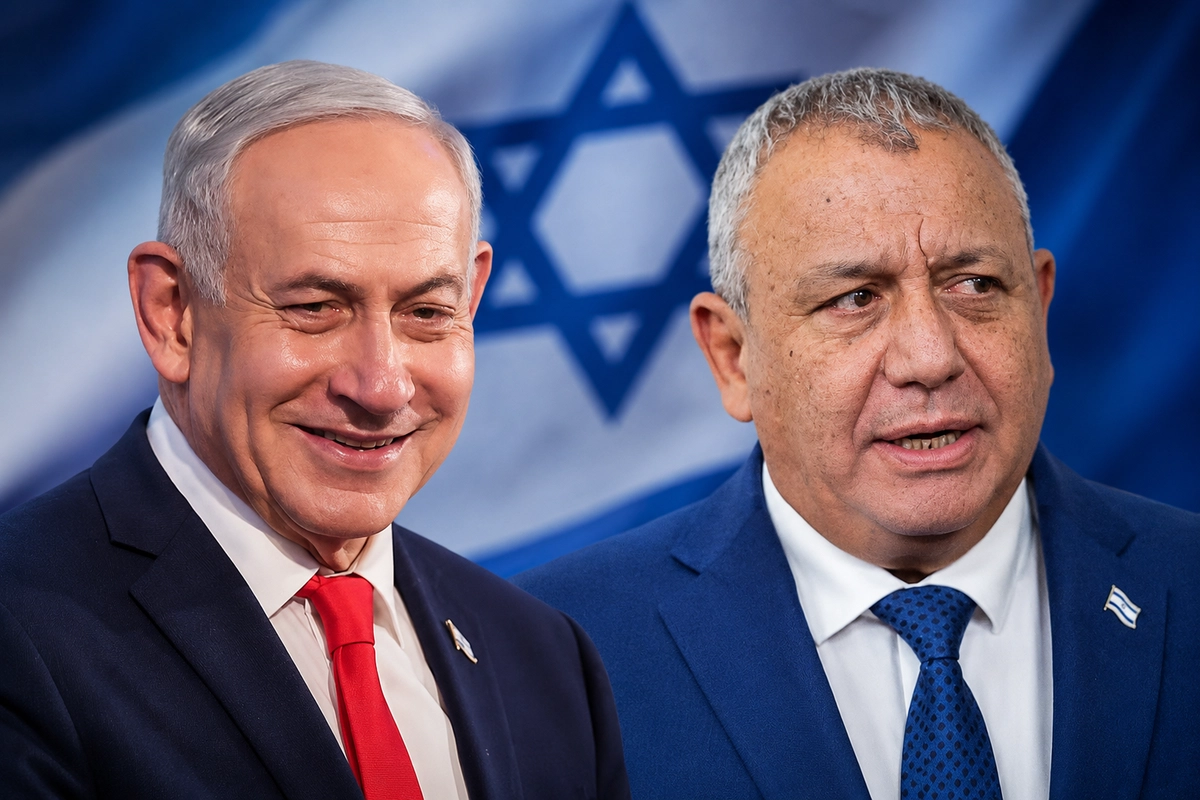
Israeli Prime Minister Benjamin Netanyahu has offered to step aside and allow rival Gadi Eisenkot to serve as prime minister first under a rotation arrangement, as efforts to form a government intensify following the country's inconclusive elections.
The two leaders are scheduled to meet on Sunday morning for coalition talks in Herzliya, after Netanyahu proposed a unity government late on Saturday. The offer comes as Eisenkot, who was tasked with forming the next government, faces difficulties assembling a coalition with a parliamentary majority.
Netanyahu, Israel's longest-serving prime minister, said he was willing to put political differences aside and serve as alternate prime minister at the beginning of the proposed government's term.
"My responsibility as a leader requires me to set everything aside... and agree that Gadi Eisenkot will serve first as prime minister, while I will serve as alternate prime minister at the beginning of the term," Netanyahu said in a social media post.
His Likud party later confirmed that the two leaders had spoken and agreed to meet at 10 am local time on Sunday.
Eisenkot responded by saying he was willing to consider the proposal if Likud was serious about forming a genuine unity government.
"If Likud is ready for genuine unity, I am prepared to see how serious it is over the next 24 hours," he said.
Eisenkot faces coalition arithmetic challenge
The elections held in late October left neither of Israel's main political blocs with a clear parliamentary majority. President Isaac Herzog subsequently tasked Eisenkot with forming a government after consultations with political parties.
The Yashar party leader has been attempting to bring together anti-Netanyahu parties but faces competing demands over potential alliances with Arab-Israeli parties and ultra-Orthodox factions.
Eisenkot has said he intends to announce a new government by the December 6 deadline, without seeking the additional 14-day extension available to him.
However, negotiations have faced setbacks, with Eisenkot accusing Likud of failing to offer concrete compromises.
On Friday, he alleged that Netanyahu's party had stalled negotiations for more than two weeks without presenting a substantive proposal, raising suspicions that it wanted to push the country towards another election.
Eisenkot also said Likud had not responded to a detailed proposal submitted by his camp.
Netanyahu's offer faces opposition
Netanyahu's proposal for a rotating premiership was criticised by political opponents, who questioned his willingness to honour such an arrangement.
Yair Lapid, former prime minister and co-chair of the centrist Beyachad party, described the proposal as "yet another transparent con", accusing Netanyahu of misleading political partners and breaking agreements.
Youssef Jabareen, leader of the Arab-majority Joint List, also called for Netanyahu's government to be removed, arguing that the election results reflected a public desire for political change.
The Joint List is expected to support an Eisenkot-led government without necessarily joining the coalition.
Arab parties could prove crucial
Eisenkot's coalition-building efforts have also opened the door to possible cooperation with Arab-Israeli parties.
His Yashar party has already reached coalition agreements with the left-leaning Democrats and the right-wing Israel Beiteinu. Together, the three parties hold 36 seats in the 120-member Knesset, leaving them well short of the 61 seats required for a majority.
The support of Arab-majority parties could significantly strengthen Eisenkot's chances of forming a government.
Mansour Abbas, leader of the Raam party, indicated on Saturday that his party could support an Eisenkot-led coalition, either from the outset or at a later stage.
Abbas also acknowledged Hamas as a terrorist organisation, a position that could help address one of Eisenkot's conditions for cooperation with Arab parties.
He pointed to Raam and the Joint List's support for a bill seeking to establish an inquiry into the security failures surrounding the October 7, 2023, attacks, which described Hamas as a terrorist organisation.
Abbas said his earlier reluctance to explicitly use the designation was driven by concerns over its implications for Israel's Arab community and relations with Palestinians in the West Bank and Gaza.
With coalition negotiations approaching a deadline, Sunday's meeting between Netanyahu and Eisenkot could determine whether Israel moves towards a unity government or faces another round of political uncertainty.
With AFP inputs