Fattah-2: Iran’s hypersonic missile could hit Israel, US amid ongoing conflict
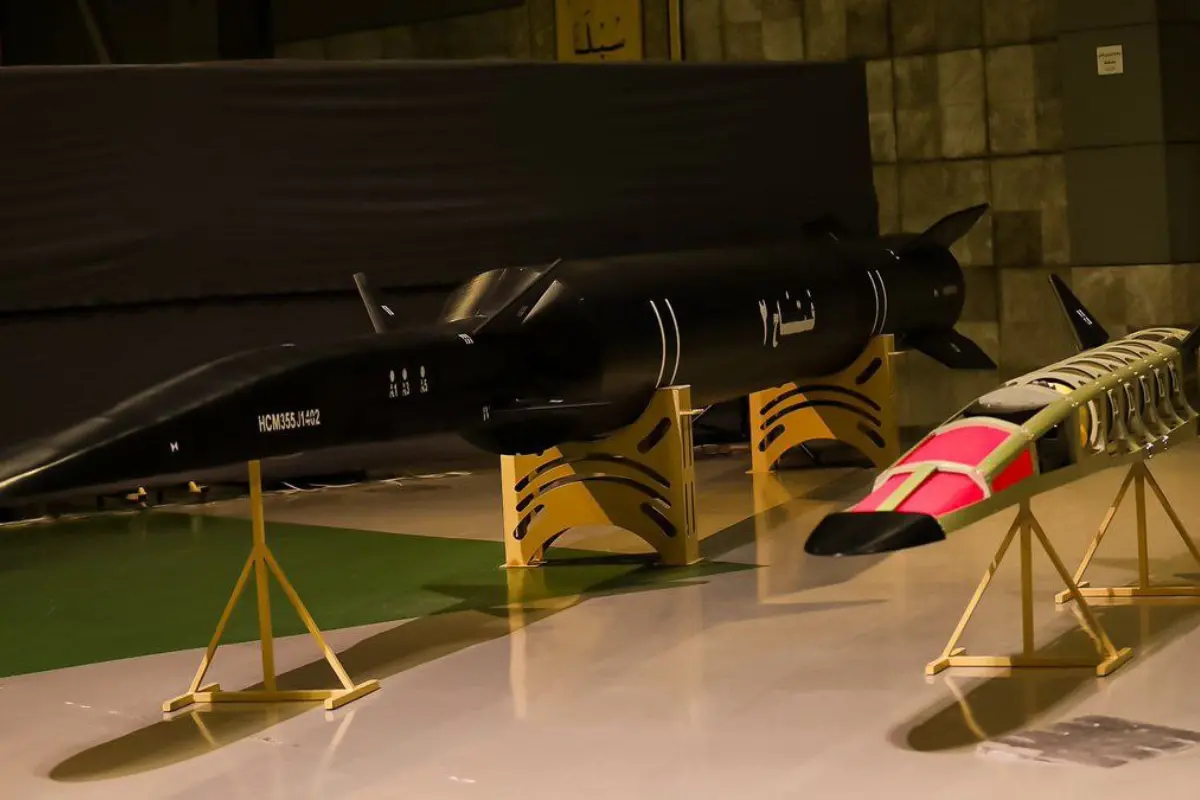
Tehran/Washington: As Israel and the United States carry out coordinated strikes on strategic Iranian sites on Saturday, attention has turned to Iran’s hypersonic missile program, particularly the Fattah‑2, which Iranian officials describe as a game-changing weapon capable of striking deep into enemy territory.
Unveiled by the Islamic Revolutionary Guard Corps (IRGC) in November 2023, Fattah‑2 is a successor to the Fattah‑1 missile and features a hypersonic glide vehicle (HGV) engineered for extreme speed, manoeuvrability, and evasive flight paths. Iran claims the missile can travel at speeds up to Mach 15, with a strike range of up to 1,500 kilometres, and carries a 200 kg explosive payload capable of targeting both land and naval assets.
Also read | Iran launches missiles toward Israel; Sirens blare across multiple areas
Analysts note that such capabilities, if operational, would pose a serious challenge to US aircraft carriers and Israeli missile defence systems, which rely on interceptors like the Mach 3.5 SM-6.
A hypersonic missile like Fattah‑2 can manoeuvre unpredictably during flight, making it difficult for radar systems to track. This is particularly significant in the current context, as US and Israeli forces conduct airstrikes on Tehran and other sensitive sites, following weeks of escalating tension in the region.
Also read | Iran’s Supreme Leader Khamenei moved to secure location after Tehran blasts: Reports
Iranian officials have warned that attacks on the country will be met with a “crushing” response, highlighting the Fattah‑2 and other advanced weapons as part of their deterrence strategy. “We warned you! Now you have started down a path whose end is no longer in your control,” said Ebrahim Azizi, head of Iran’s National Security Commission, in a statement to Reuters.
Iran currently has a self-imposed limit on its ballistic missile program, limiting its range to 2,000 kilometers (1,240 miles).
That puts all the Middle East and some of eastern Europe within reach. There is no public evidence of Iran seeking to have intercontinental ballistic missiles, though Washington has criticized its space program as potentially allowing it to one day.
Iran has also said it no longer enriches uranium, but it has blocked international inspectors from visiting the sites the United States bombed during the 12-day war in June.
Satellite photos analyzed by The Associated Press have shown new activity at two of those sites, suggesting Iran is trying to assess and potentially recover material there.
In a related development, the Israeli military said it had identified an additional barrage of missiles launched towards Israel, after it announced it was striking targets in Iran.
"An additional barrage of missiles was launched towards the State of Israel," the military said.
"The public is requested to continue to follow the instructions of the Home Front Command. The public is requested to stay in protected spaces until official notice."