Trump’s law-and-order push begins in Washington with National Guard rollout
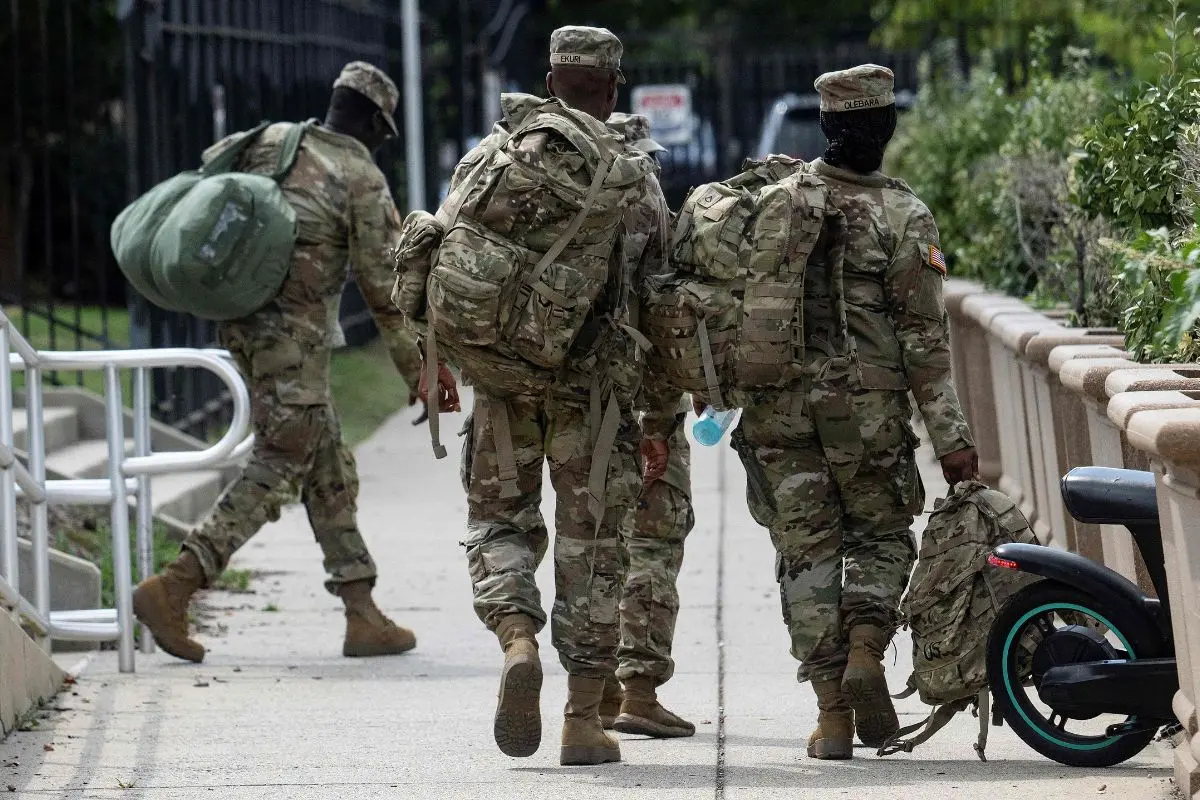
Washington: A new chapter in law enforcement unfolded in the US capital on Tuesday as National Guard troops began arriving under President Donald Trump’s new plan. The deployment follows Trump’s declaration of a state of emergency in Washington, citing lawlessness – a claim city officials say is unsubstantiated given recent declines in crime.
Approximately 800 National Guard members were authorised by Trump to support efforts to curb crime, with some arriving in the city this week. The move also includes a temporary federal takeover of the Metropolitan Police Department (MPD), permitted under longstanding legislation that grants the federal government wider authority over the District than it has over individual US states.
Mayor Muriel Bowser, while pledging cooperation, made clear that the city's police chief remained in command of local officers. “How we got here or what we think about the circumstances -- right now we have more police, and we want to make sure we use them,” Bowser told reporters.
Her tone marked a shift from earlier this week, when she called the federal intervention counterproductive and said Trump’s assertion of a crime emergency was not reflected in the data. Violent crime has reportedly dropped to a 30-year low, with carjackings down by half in 2024, and further decreases recorded this year.
Despite these figures, Trump’s White House maintains that drastic action is required. Press Secretary Karoline Leavitt said more than 850 federal officers and agents had fanned out across Washington on Monday night, resulting in 23 arrests for a range of offences including homicide, drunk driving, and fare evasion. Further details have not yet been released.
Meanwhile, the US Park Police have cleared 70 homeless encampments over the past five months. According to Leavitt, those evicted were offered shelter or addiction treatment, though those who refused risked fines or jail time.
Local sentiment remains mixed. “I feel safe walking through the city each and every day. The police are doing a mighty fine job,” said Jeraod Tyre, a 15-year Washington resident. Others are more uneasy. “It’s more fearful now... especially because I’m African-American,” said Sheina Taylor. “Even if you follow the law, you don’t know what might happen.”
Bowser, a Democrat, had frequent public clashes with Trump during his first term, opposing his 2020 deployment of federal law enforcement to suppress anti-police brutality protests and resisting his efforts to stage a military parade in the capital. While Bowser managed to delay or resist some of those plans, the dynamics have shifted with Trump now in his second term and bolstered by a Republican-controlled Congress.
Trump’s use of Section 740 of the D.C. Code to take over city policing marks the first time a U.S. president has enacted such a measure. The law allows control for up to 30 days, but the administration has hinted this could be extended pending “reevaluation”, a move that would require Congressional approval – an unlikely prospect in the face of Democratic opposition.
Critics say the intervention is more about political optics than practical outcomes. “It’s a power play and we’re an easy target,” said Clinique Chapman, CEO of the D.C. Justice Lab and a known Bowser critic. Even some former Trump allies have acknowledged the city’s progress. Ed Martin, Trump’s original pick for U.S. attorney in D.C., praised a 25% drop in violent crime earlier this year.
Still, Trump’s newly confirmed federal prosecutor for the District, former judge and Fox News host Jeanine Pirro, insists that the threat remains serious. “These were vibrant human beings cut down because of illegal guns,” Pirro said in a statement.
As the situation unfolds, Bowser acknowledges the limits of local power under the 1973 Home Rule Act, which grants Congress final authority over the capital. “As long as D.C. is not a state, these kinds of takeovers remain possible,” she warned.