‘Illegal, null and void’: China dismisses Philippine South China sea claims
Beijing: China dismissed maritime jurisdiction claims asserted by the Philippines over contested features in the South China Sea, categorising Manila's stance as "illegal, null and void" following a formal demand from the Philippine Department of Foreign Affairs.
The Philippines had explicitly demanded that China halt its operations on Panganiban Reef (Mischief Reef) and Zamora Reef (Subi Reef), maintaining that Beijing's artificial island construction violates international law and Philippine domestic legislation.
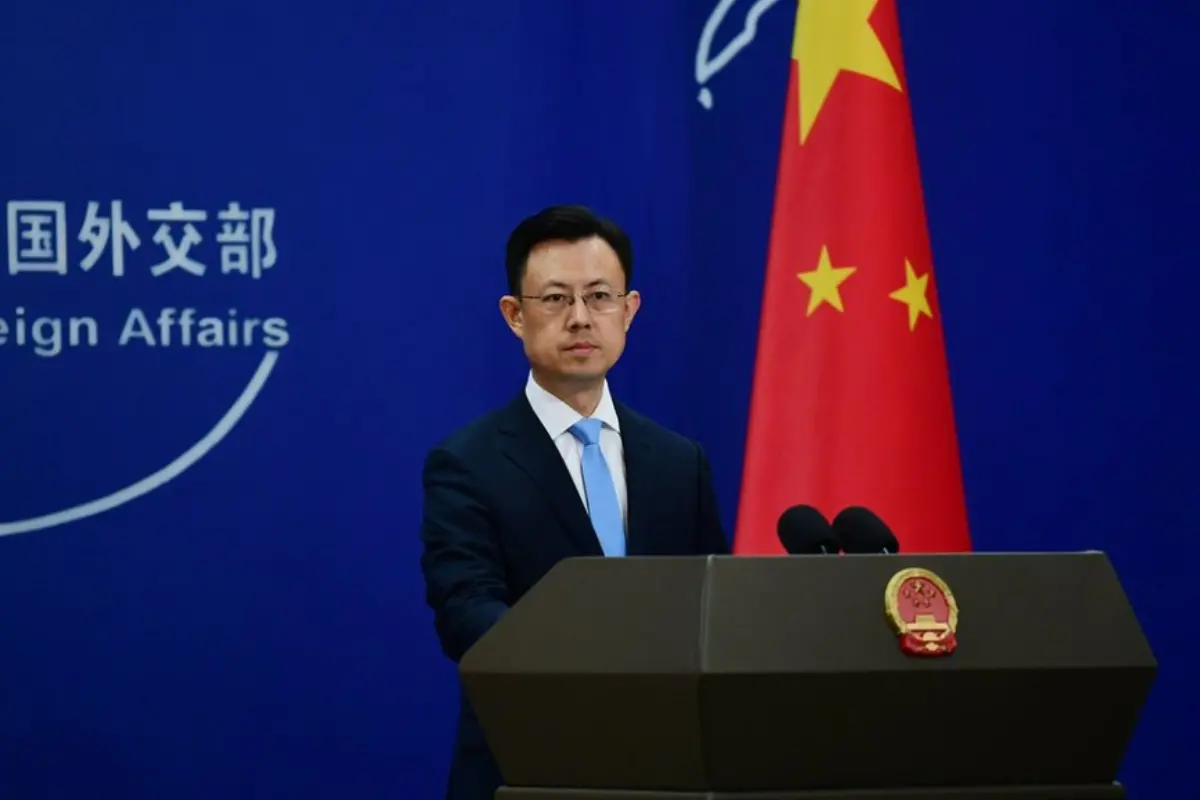
During a routine press briefing, Chinese Foreign Ministry Spokesperson Guo Jiakun addressed statements issued by Manila concerning Meiji Jiao (Mischief Reef), Zhubi Jiao (Subi Reef), and Zhongye Dao (Thitu Island).
"Nansha Qundao, including Meiji Jiao, Zhubi Jiao and Zhongye Dao, are China’s inherent territory. It is totally legitimate and lawful for China to conduct construction and other activities on its own territory, a matter within China’s sovereignty," Guo stated.
Guo rejected the legal foundation of Manila's claims, arguing that the Philippines' territorial boundaries are established by international treaties which exclude the Nansha Islands.
"The territorial scope of the Philippines has already been defined by a series of international treaties. Nansha Qundao has never been part of the Philippine territory. According to the 'land dominates the sea' principle in international law, the Philippines’ claim of so-called maritime jurisdiction over China’s territory is illegal," the spokesperson said.
ALSO READ: 'Because you lost': Philippines defence chief fires back after China note lands mid-speech
Guo also criticised what he described as inconsistencies in Manila's narrative regarding Zhubi Jiao, noting shifts in the Philippine Department of Foreign Affairs’ statements.
"The Philippine side at one point claimed that Zhubi Jiao is within its EEZ and continental shelf, but later claimed that it lies within the territorial sea of the island it illegally occupies. This only exposes how absurd and random its claim is, making it totally untenable," Guo added.
Responding to Manila's invocation of international and domestic law, Guo reaffirmed Beijing's persistent refusal to acknowledge the 2016 South China Sea Arbitral Award or the Philippines’ Maritime Zones Act.
"The 'South China Sea arbitration' is completely a political manipulation by the Philippines to grab unlawful gains. The so-called 'award' is illegal, null and void, and has no binding force," Guo said.
"The Philippines’ so-called 'Maritime Zones Act' illegally includes China’s Huangyan Dao and most of the islands and reefs in Nansha Qundao and relevant waters into the Philippines’ maritime zone. This is a grave violation of China’s territorial sovereignty and maritime rights and interests in the South China Sea, and is illegal and null and void. China firmly opposes it and will never accept it," he continued.
The spokesperson called on the Philippines to cease unilateral actions in the contested waters, cautioning that Beijing remains ready to defend its territorial claims.
"China will continue to take resolute measures to safeguard its territorial sovereignty and maritime rights and interests, and firmly oppose any infringement," Guo emphasised. "The Philippines should immediately stop infringing upon China’s rights, and stop the provocations and publicity stunts."
ALSO READ: China hands Philippines Defence Chief a note Mid-speech
Guo's comments followed a formal statement issued Friday by the Philippine Department of Foreign Affairs (DFA), which reiterated Manila's sovereign rights over the maritime features in the West Philippine Sea, "in accordance with the United Nations Convention on the Law of the Sea (UNCLOS) and as upheld by the 2016 Arbitral Award."
Clarifying the legal framework surrounding low-tide elevations (LTEs), the DFA stressed that such geographical features cannot be appropriated or claimed as sovereign land.
"As low-tide elevations, the Philippines exercises sovereign rights and jurisdiction over the features, and these can neither be the subject of a sovereignty claim nor capable of appropriation under international law," the statement read.
Addressing China’s military and infrastructure developments on the reefs, Manila noted that physical alterations do not bestow legal territorial ownership under UNCLOS or domestic law.
The Philippines demanded an immediate cessation of Beijing's presence on the features, citing the binding 2016 South China Sea Arbitral Award.
"We call on China to cease its illegal occupation and activities in Panganiban Reef and Zamora Reef immediately, and to abide by the final and binding 2016 Arbitral Award," the DFA statement added.
Reaffirming its long-term policy in the disputed waters, the department concluded, "The Department will continue to assert the Philippines’ sovereignty, sovereign rights and jurisdiction in the West Philippine Sea, and champion the Philippines’ legitimate rights and interests in the maritime domain."
Separately, the Indian Ministry of External Affairs confirmed Tuesday that Prime Minister Narendra Modi and the Philippine President engaged in broad strategic and regional discussions during their bilateral meeting on the sidelines of the BRICS summit in New Delhi, reaffirming India's stance on the South China Sea.
"If you look at the readout that we put out, you would see that we have mentioned that both leaders exchange views on issues of regional and global importance, issues on which issues which are of mutual interest to both countries. So that should answer your question," an MEA spokesperson stated.
ANI