‘Can sustain an intense war for up to six months,’ says Iran as Israel strikes Beirut hotel | VIDEO
Tehran: Iran’s Revolutionary Guards on Sunday said the country could sustain an intense war for up to six months against the United States and Israel, as Israel reported targeting senior Iranian commanders in a strike on a seaside hotel in Beirut.
The conflict entered its second week with tensions escalating across the Middle East. Saudi Arabia said it intercepted a large number of drones heading toward key sites including the diplomatic quarter in Riyadh, while Kuwait reported that an attack struck fuel storage tanks at its international airport.
The incident raised concerns over regional energy security. Kuwait’s national oil company also announced a reduction in crude output amid threats to shipping through the Strait of Hormuz, a critical route through which roughly one-fifth of the world’s oil and gas supplies pass.
Attacks target energy infrastructure
Tehran accused the United States and Israel of striking an oil depot in the Iranian capital on Saturday — the first reported attack on Iran’s oil infrastructure since the conflict began. The development has unsettled global markets, sending crude prices higher and pushing stock markets lower.
The Israeli military confirmed it had struck “a number of fuel storage facilities in Tehran” that were used “to operate military infrastructure”.
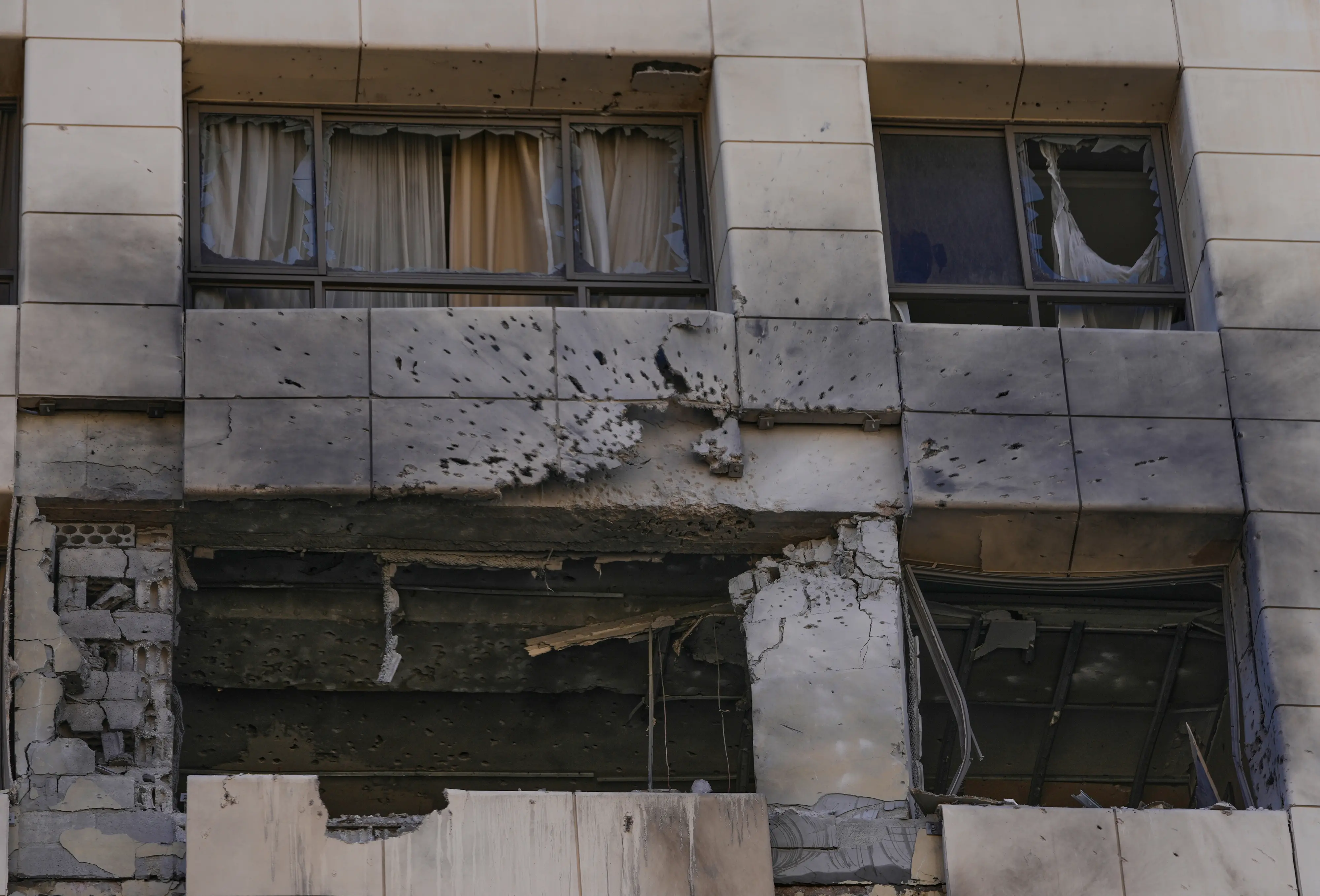
Israel also launched a new round of strikes “across Tehran” on Sunday, following what it described as a precision operation targeting “key commanders” of the Quds Force — the foreign operations wing of Iran’s Revolutionary Guards — at a hotel in central Beirut popular with tourists.
Lebanon’s Health Ministry said at least four people were killed in the hotel strike. Images from the scene showed shattered windows and fire-damaged walls.
Netanyahu vows to press offensive
Israeli Prime Minister Benjamin Netanyahu has pledged to continue the campaign against Iran “with all our force”, following joint US-Israeli strikes last week that killed supreme leader Ayatollah Ali Khamenei and triggered the wider regional conflict.
Despite mounting pressure, Iran’s Revolutionary Guards insisted their forces are prepared for a prolonged fight.
Guards spokesman Ali Mohammad Naini said Iran had so far used “first and second generation” missiles but warned it would soon deploy “advanced and less-used long-range missiles”.
Regional tensions widen
The war’s expanding reach was underscored by US President Donald Trump attending the return of six American service members killed in a drone strike on a US base in Kuwait last Sunday.
Iran’s security chief Ali Larijani accused Washington of miscalculating the conflict.
“Their perception was that it would be like Venezuela -- they would strike, take control and it would be over -- but now they are trapped,” he said in a pre-recorded interview broadcast on state TV on Saturday.
Iranian judiciary chief Gholamhossein Mohseni Ejei warned neighbouring countries cooperating with the United States or Israel that they could face retaliation.
He said Middle Eastern states that are “openly and covertly at the disposal of the enemy” should expect that “the heavy attacks on these targets will continue”.
Iranian President Masoud Pezeshkian also warned that Tehran “will be forced to respond” if neighbouring territory is used to launch attacks against Iran.
Missiles and drones across the Gulf
Iran had earlier threatened to target US interests in the region. On Sunday, Saudi Arabia, Qatar, the United Arab Emirates and Kuwait all reported fresh attacks.
Saudi authorities said more than a dozen drones were intercepted, while Qatar reported that Iran launched two cruise missiles and ten ballistic missiles toward the country on Saturday.
The UAE Defence Ministry said its forces were intercepting incoming missiles and drones from Iran.
Footage circulating online showed a projectile crashing near Dubai airport, while journalists reported explosions in Baghdad and Erbil on Saturday evening.
Civilians face mounting toll
Inside Iran, residents reported growing anxiety as damage to infrastructure and residential neighbourhoods increases amid heavy security deployments.
“I don't think anyone who hasn't experienced war would understand it,” a 26-year-old teacher told AFP on condition of anonymity.
Iran’s health ministry said Friday that at least 926 civilians had been killed and around 6,000 wounded, though AFP could not independently verify the figures.
Lebanon drawn deeper into conflict
Israel also carried out strikes on a Hezbollah stronghold in Beirut’s southern suburbs. Lebanon became more deeply involved in the conflict earlier this week when Hezbollah launched rockets and drones at Israel following Khamenei’s death.
Lebanon’s Health Ministry said at least 294 people have been killed in Israeli air strikes over the past week.
Prime Minister Nawaf Salam warned the country could face a looming “humanitarian disaster”.
Israel’s latest strikes followed some of its largest raids in Iran since the war began, targeting a military academy, an underground command centre and missile storage sites.
Netanyahu said Israel had achieved near total control of the skies over Tehran.
No clear path to peace
Trump repeated claims that Iran had been close to developing a nuclear weapon and suggested US troops might eventually be needed to secure Iran’s enriched uranium stockpiles.
He also blamed Iran for a deadly strike on an elementary school in Minab last Saturday that authorities said killed at least 150 people. Tehran has accused Washington of carrying out the attack.
Neither the United States nor Israel has claimed responsibility, and the circumstances surrounding the incident could not be independently verified.
Analysts say there is still no clear route to ending the conflict, which US and Israeli officials believe could continue for weeks or longer.
China’s top diplomat Wang Yi said on Sunday that the Middle East war should “never have happened”.
“This is a war that should never have happened,” he told a press conference in Beijing, adding that “a strong fist does not mean strong reason. The world cannot return to the law of the jungle.”